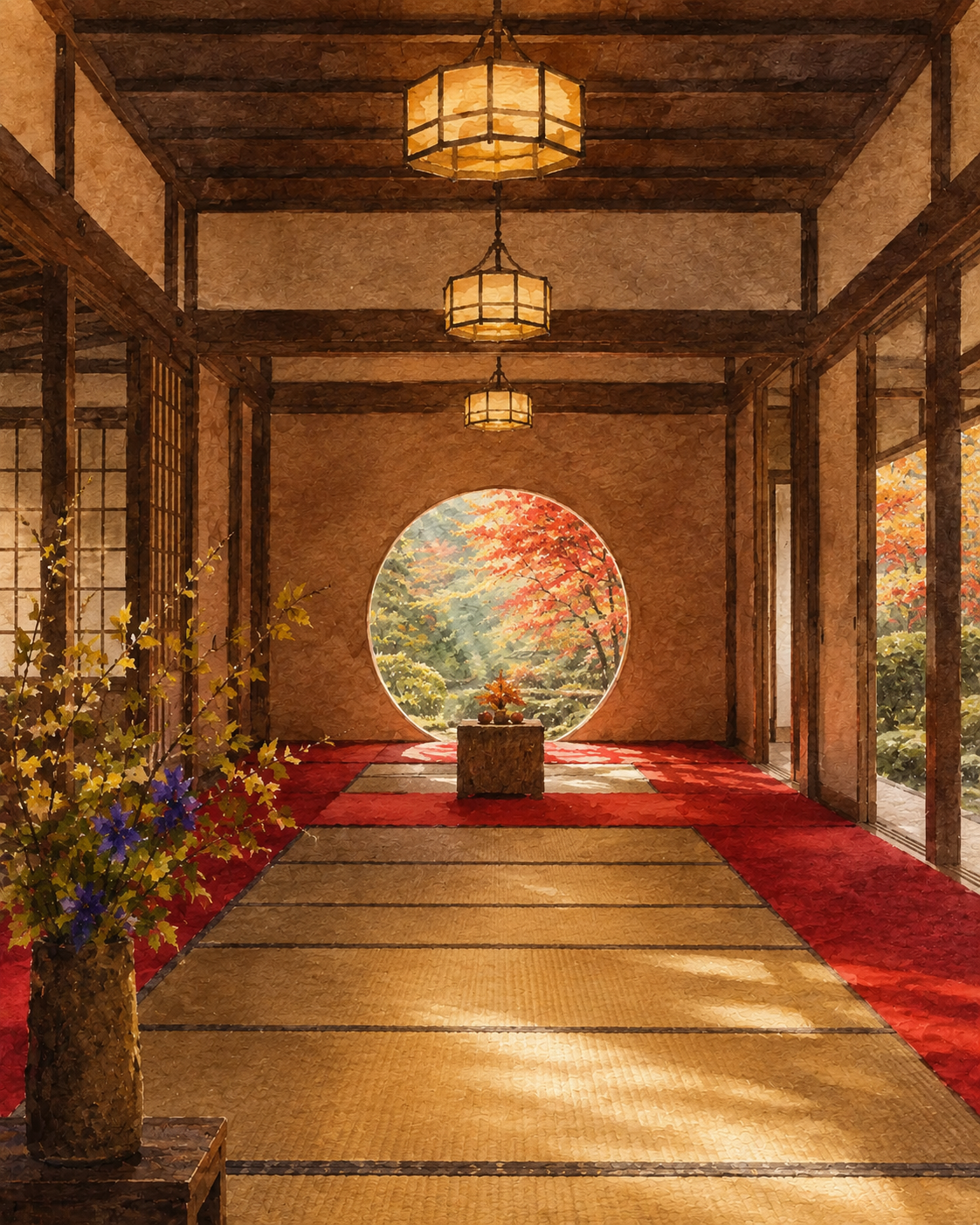
The Season Waits at the End of Silence
Critique
Introduction This painting depicts a symmetrical wooden corridor directed toward a circular opening and an autumn garden. Glowing lanterns and red carpeted margins establish warmth, while the distant foliage introduces clear seasonal color. The principal subject is the controlled passage from a structured interior to a luminous natural view. Description Three lanterns descend in size along the central ceiling axis. Tatami panels form a pale path between red bands, with timber posts, screens, and open side bays repeating on either side. A tall arrangement of yellow and violet flowers stands at left. Beyond a small central pedestal, the round opening contains a red-leaved tree, green shrubs, and softened light. Analysis Strict perspective organizes nearly every architectural element, producing depth through rhythmic reduction. The circle interrupts the surrounding rectangles and becomes the visual destination. Red, ochre, and brown establish a warm field, against which the cooler greens retain clarity. Light patches across the mats repeat the broken pattern of foliage. Dense, faceted brushwork softens exact geometry without weakening the underlying structure. Interpretation and Evaluation The corridor suggests movement, but its symmetry and emptiness convert movement into expectation. The intense red tree appears as a seasonal event held within a stable frame. Drawing and spatial organization are convincing, the color design is coherent, and the painterly surface gives the scene material unity. The side openings add complexity by suggesting that the central view is selected from a larger environment. Conclusion What first appears to be an inviting autumn interior gradually reveals a study of selection and anticipation. Through disciplined composition, controlled color, and consistent technique, the painting makes the act of approaching a view as important as the view itself.
Same Subcategory
Similar Artworks
 When Autumn Enters the Room
 Emptiness Framing a Small Eternity
 Autumn Held in a Circle
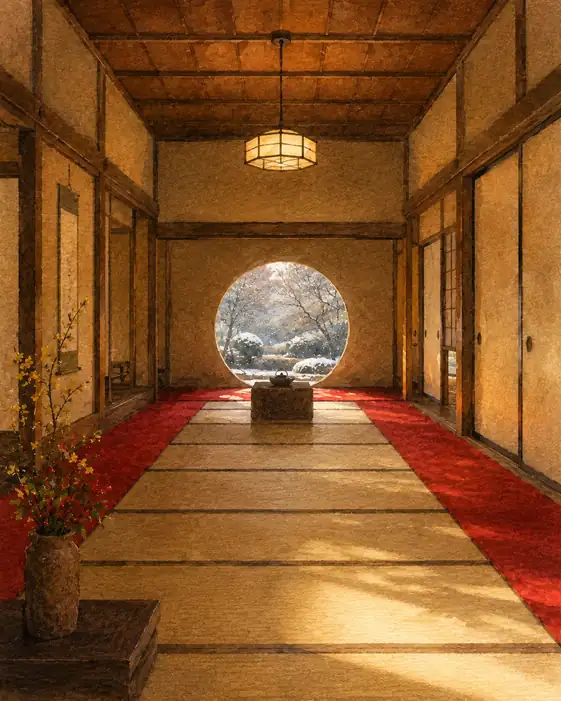 Winter, Warmly Framed
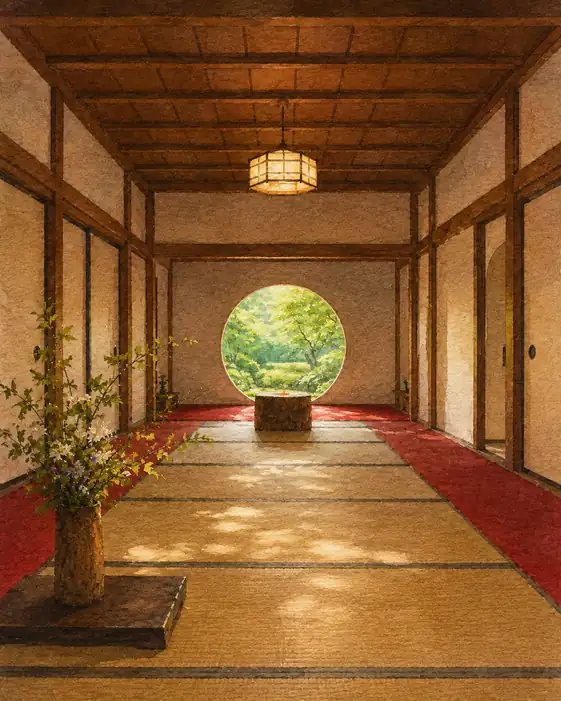 Green Breath Beyond the Circle
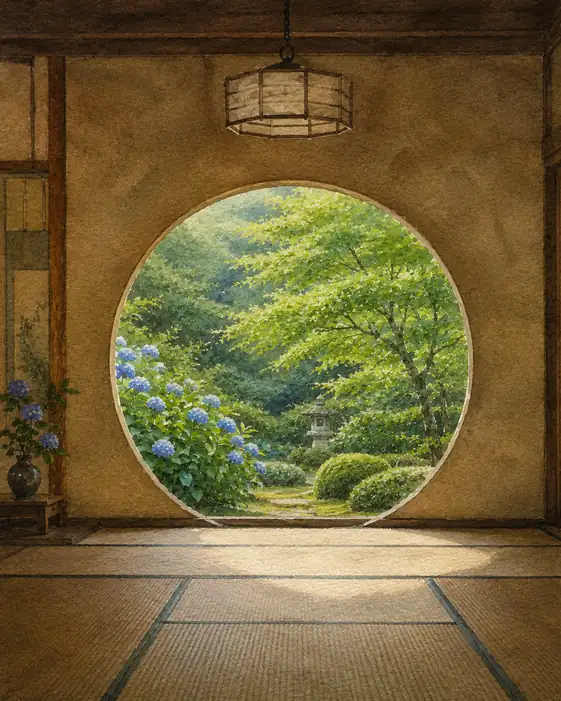 Where Stillness Learns the Light
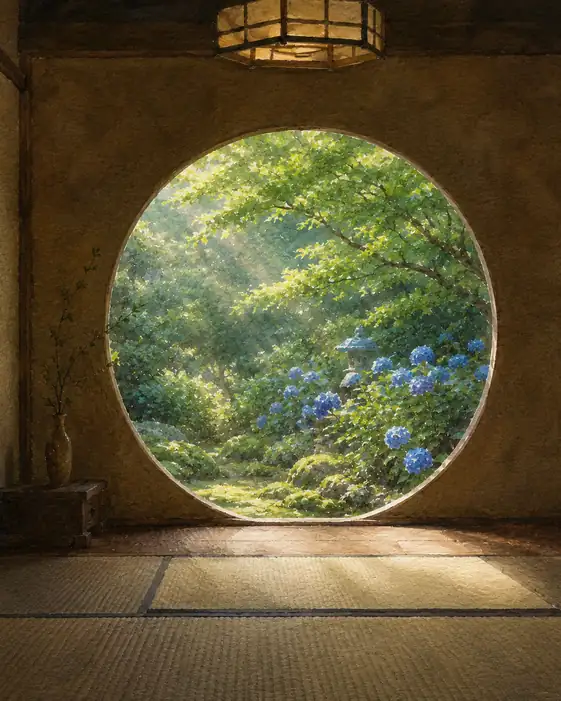 The Circle Holds the Morning
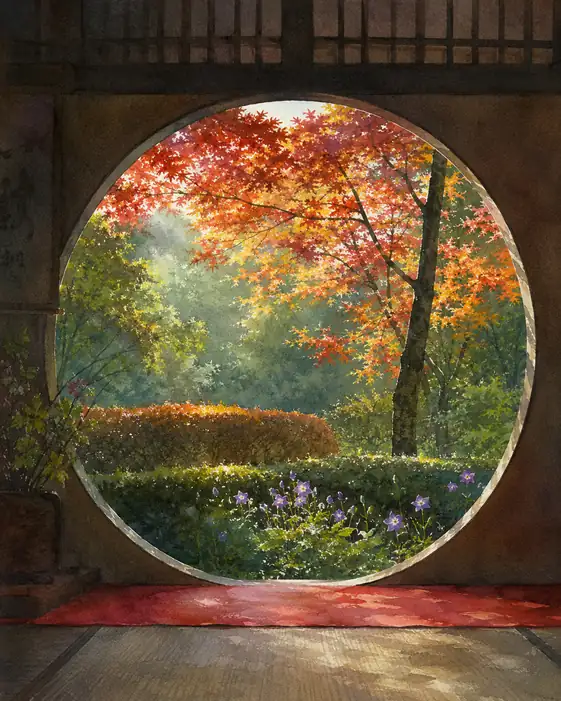 A Round Window for the Returning Sun
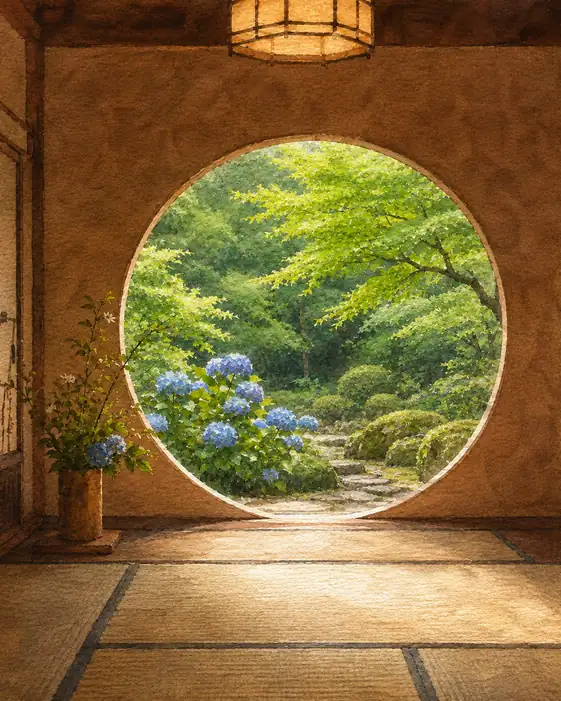 The Garden Breathes Through a Circle
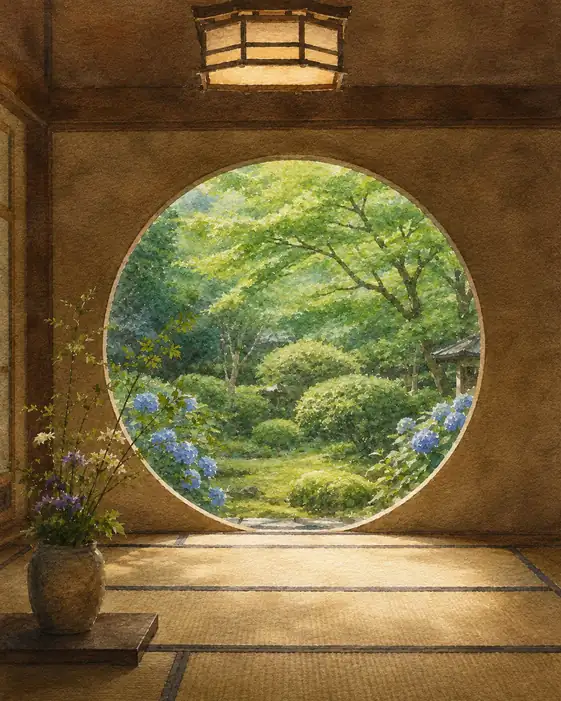 Summer Enters Without Footsteps