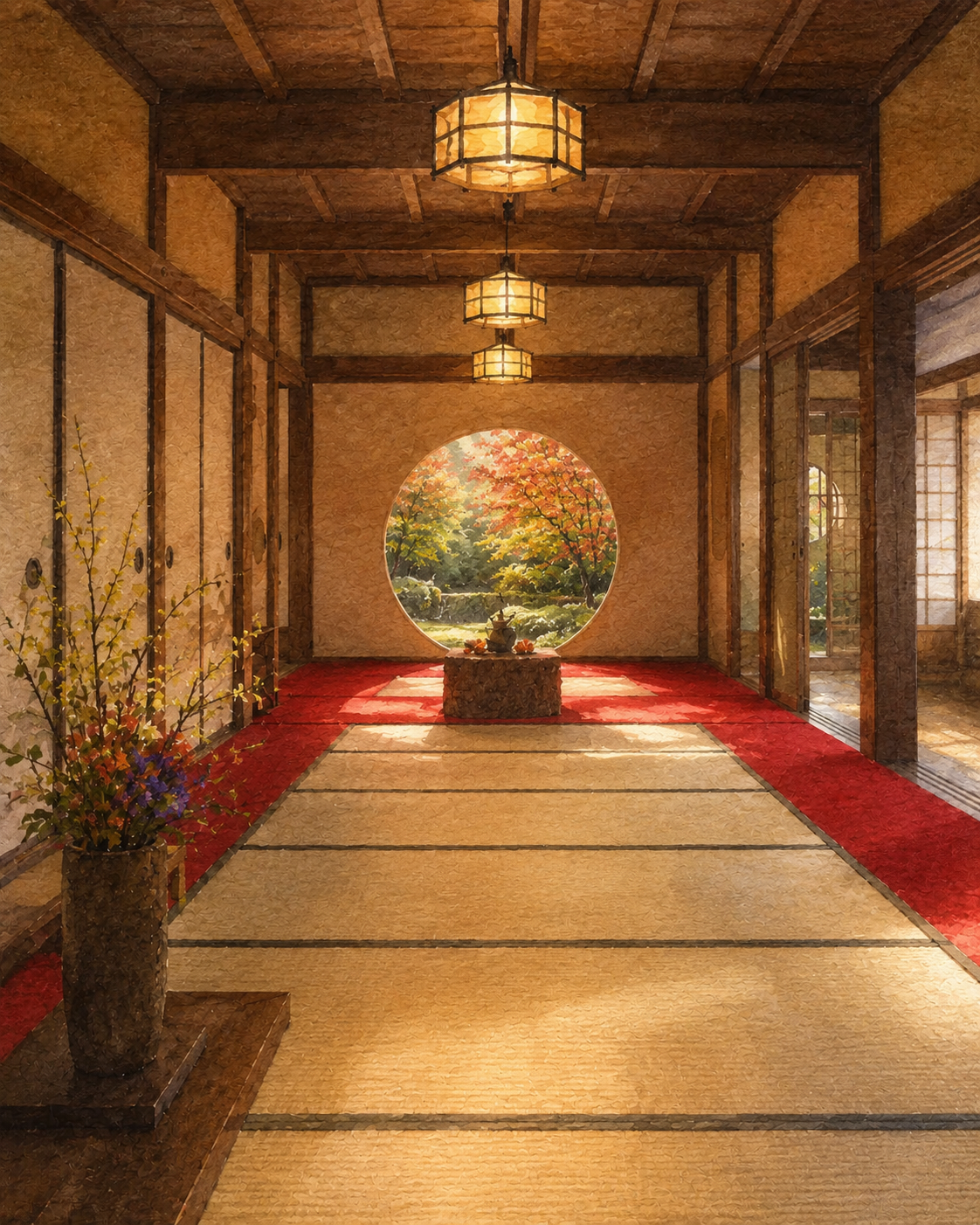
Autumn Held in a Circle
Critique
Introduction This painting presents a long tatami corridor terminating in a circular view of an autumn garden. Warm lanterns, red floor coverings, and amber wood surround the distant foliage, creating an atmosphere of ordered calm. The work joins architectural perspective with seasonal color to guide a deliberate act of looking. Description Three suspended lamps recede along the ceiling above a central path of pale mats. Sliding panels and dark beams frame both sides, while a tall flower arrangement stands in the left foreground. At the far end, a round opening reveals red, gold, and green leaves; a low pedestal and vessel occupy the axis before it. Analysis Repeated beams, lamps, and tatami borders create strong linear perspective and draw the eye toward the circle. The red covering forms two continuous bands that stabilize the central route. Warm browns dominate the interior, while brighter autumn hues concentrate at the endpoint. Small, textured strokes unify wood, plaster, leaves, and fabric, and the graduated light establishes depth without hard separation. Interpretation and Evaluation The corridor turns vision into a measured approach, although the empty room keeps the viewer at a contemplative distance. The circle condenses a broad season into a focused image, while the central vessel marks a quiet transition between constructed and natural space. The composition is precise, the color harmony is controlled, and the repeated forms demonstrate strong spatial design. Its originality lies in making distance itself an expressive subject. Conclusion An initial impression of autumnal warmth gradually becomes an understanding of how architecture directs attention. Coherent perspective, balanced color, and consistent brushwork transform the corridor into a disciplined setting for reflection.
Same Subcategory
Similar Artworks
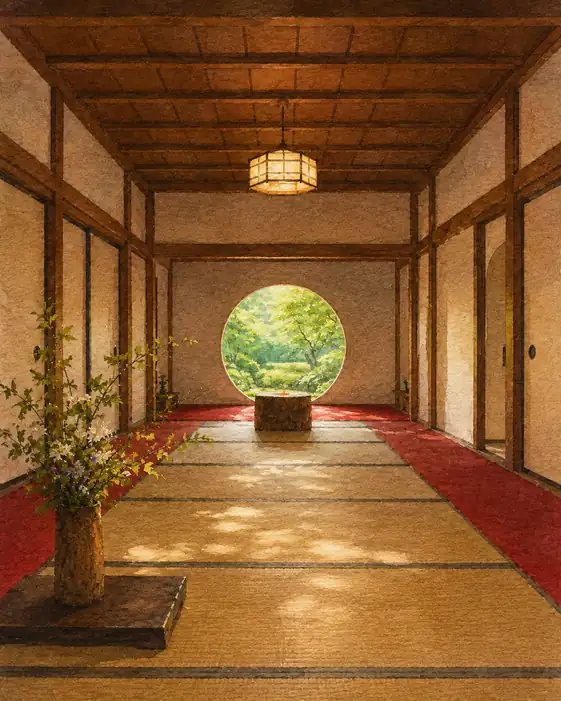 Green Breath Beyond the Circle
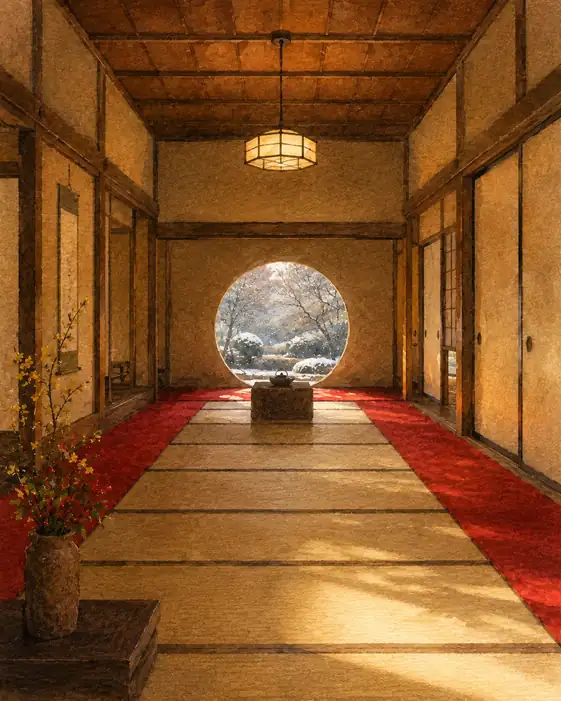 Winter, Warmly Framed
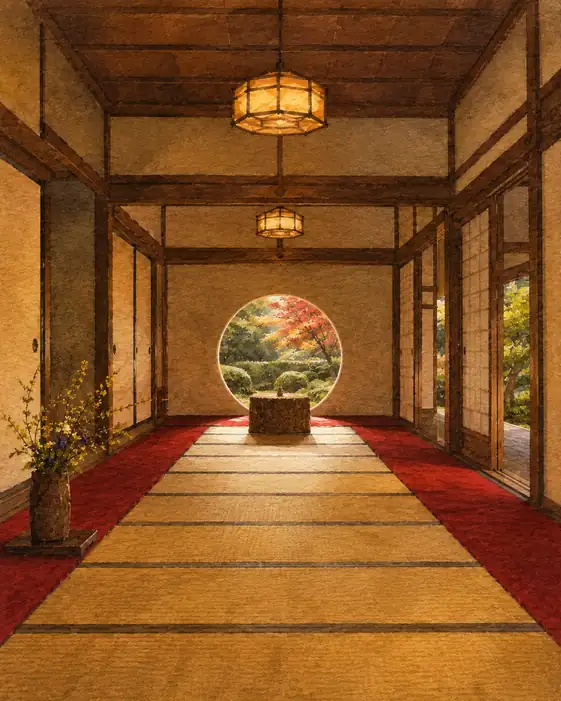 Emptiness Framing a Small Eternity
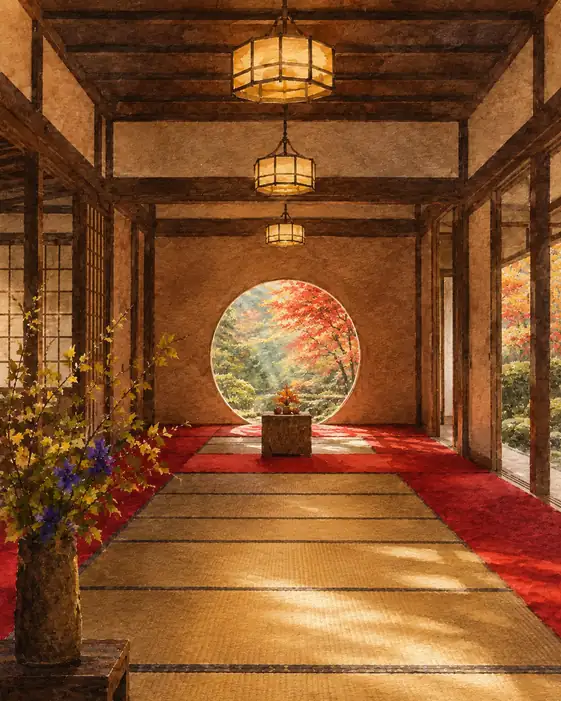 The Season Waits at the End of Silence
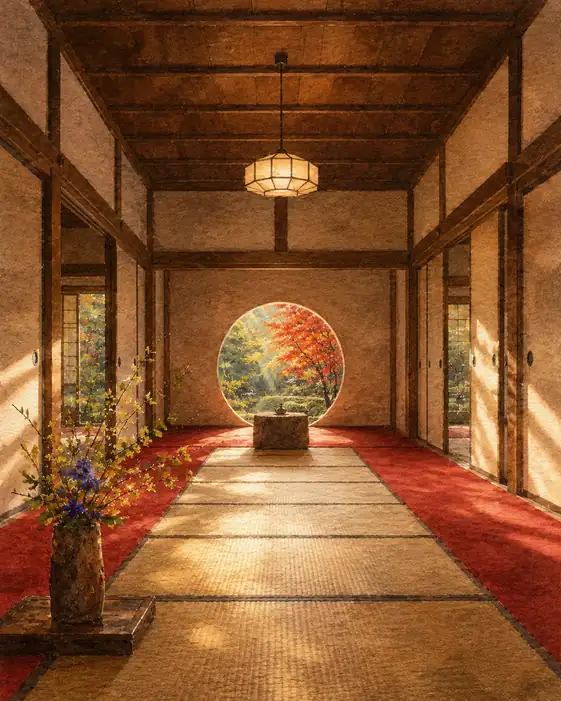 When Autumn Enters the Room
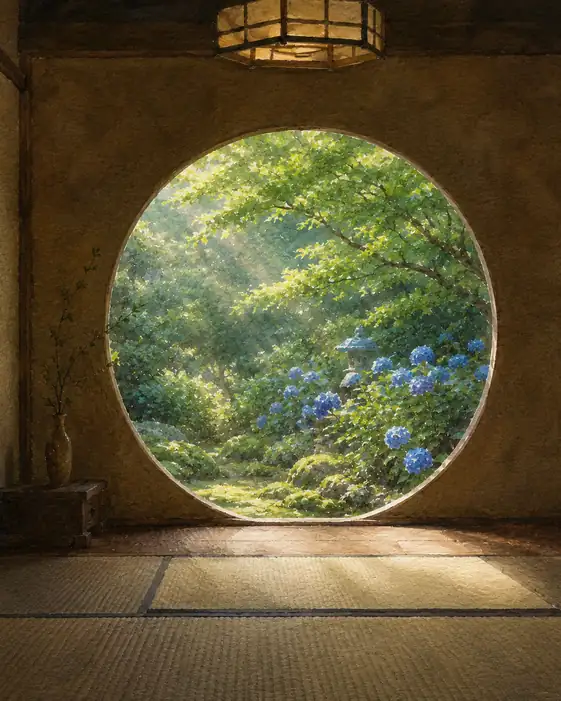 The Circle Holds the Morning
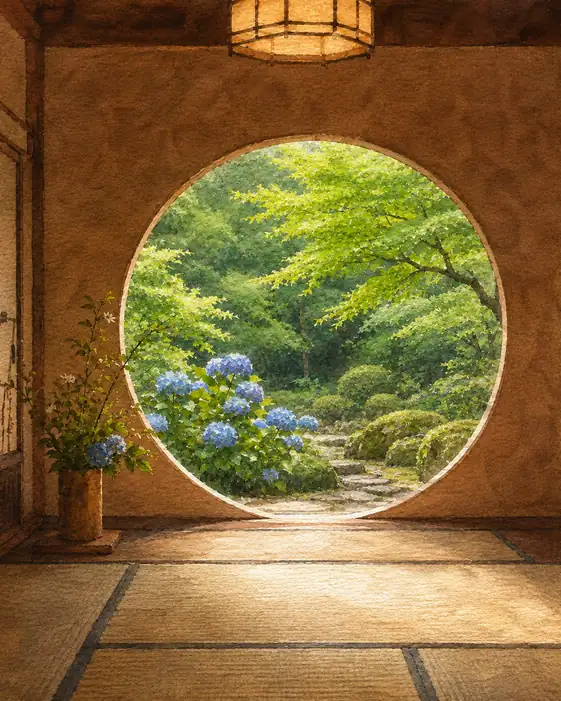 The Garden Breathes Through a Circle
 Summer Enters Without Footsteps
 Rain Between Two Silences
 A Round Window for the Returning Sun