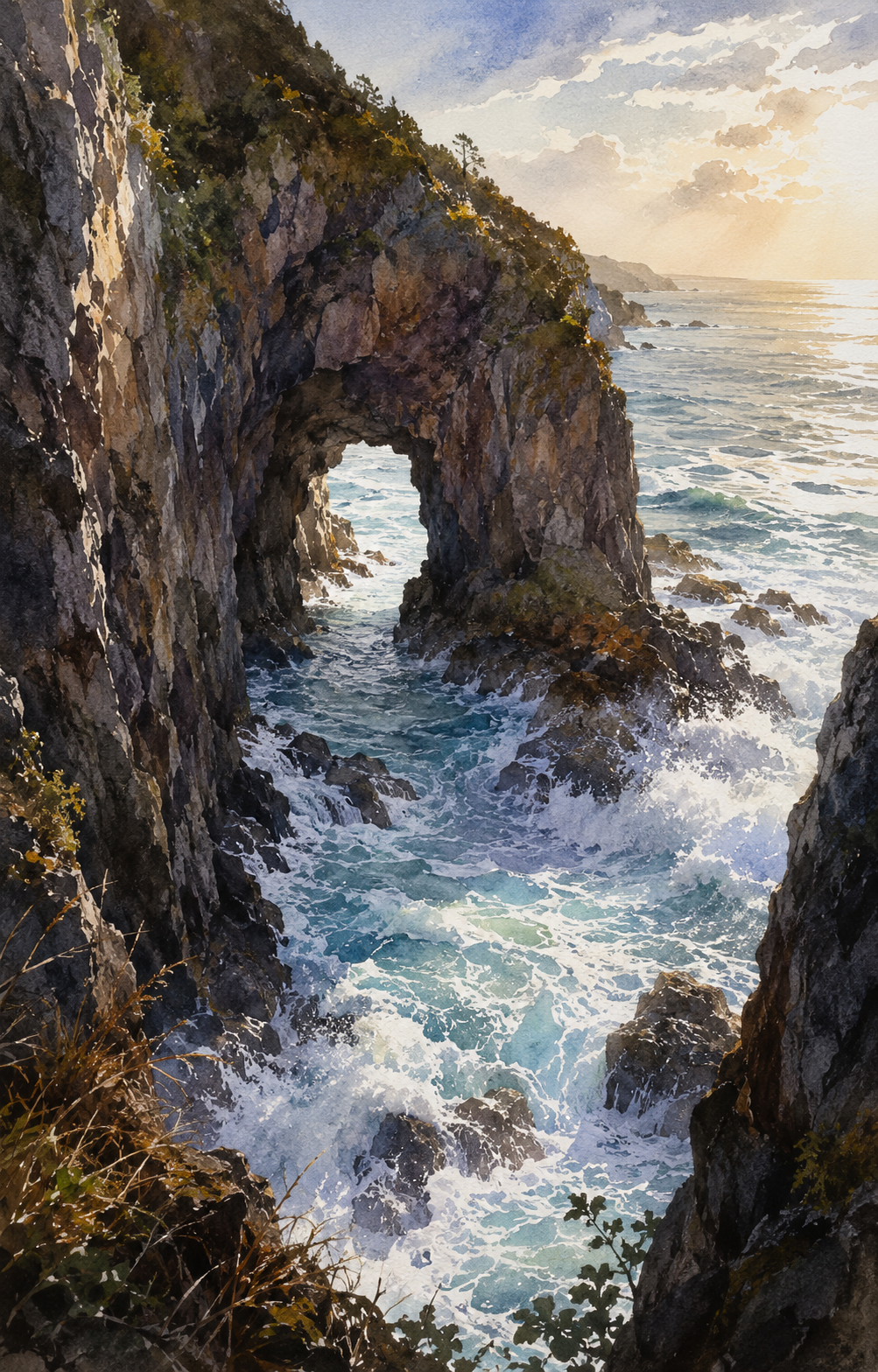
The Sea Carves a Window
Critique
Introduction This landscape painting presents a monumental sea arch cut through a dark coastal cliff. The principal focus is the bright opening filled by surging turquoise water, while open sea and a low sun beyond the rock extends the setting. Its quiet impression reveals an ordered relationship between nature, built form, and human presence. Description The foreground holds jagged cliff edges and bright foam below, giving tactile weight and scale. The middle distance guides attention toward open sea and a low sun beyond the rock. Light from cool daylight entering the opening from the sea defines forms without hardening every edge. A palette of slate gray, turquoise, foam white, and muted green unifies the scene. Analysis The composition is structured by the natural aperture centering a confined view of moving water, turning the narrow format into spatial stages. Brighter accents gather around the motif, while dark margins contain the view. Repeated contours create rhythm. Transparent washes and granular strokes distinguish distance and suggest moisture or moving air. Interpretation and Evaluation Beyond recording scenery, the image considers erosion turning destructive force into monumental form. Small built or human elements remain subordinate to the environment, encouraging attention to duration and place. Descriptive clarity, controlled color, and disciplined organization are persuasive. Its originality lies in making atmosphere structural. Conclusion Near texture, the central motif, and the distant field form one continuous visual passage. Specific foreground forms balance abbreviated remote ones, so the eye travels slowly through the scene. What first appears to be an attractive view becomes a study of erosion turning destructive force into monumental form. The technique remains controlled and coherent.
Same Subcategory
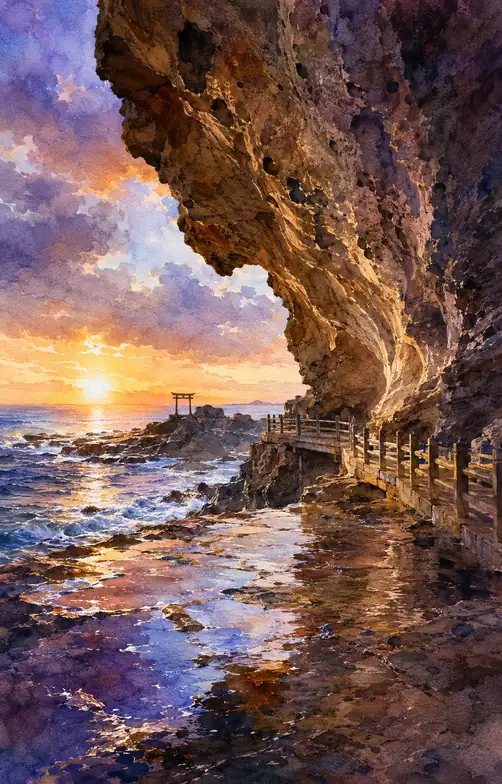 Under the Stone Wing, the Sea Remembers
Similar Artworks
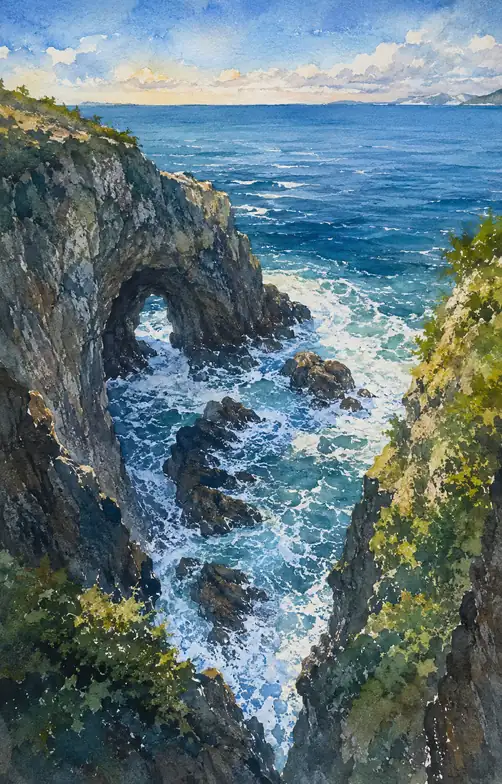 A Doorway Made by the Sea
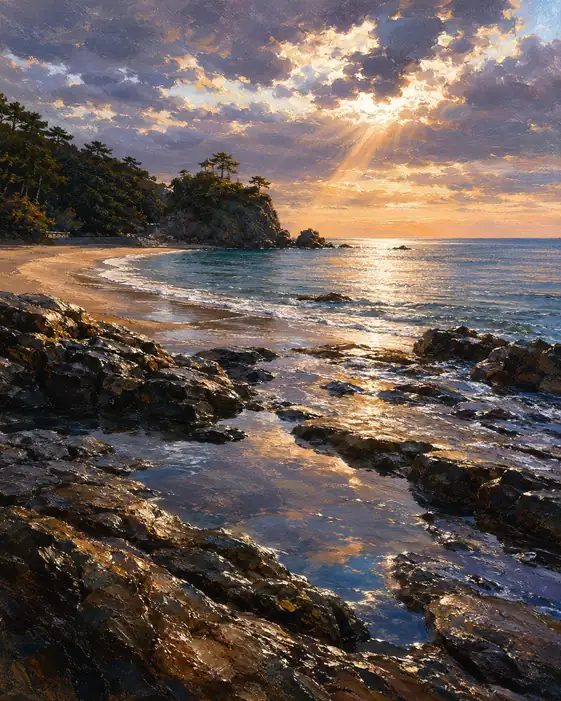 The Cove Keeps a Fallen Sun
 The Shore Keeps the Last Light
 The Last Light Finds Its Way Home
 Spring Keeps Watch over the Fire
 The Sun Finds a Sanctuary Inside Stone
 Light Threads the Islands Back Together
 Spring Opens a Gate Between Two Rocks
 Trade Winds in the Old Harbor
 Gates the Tide Carries Inward