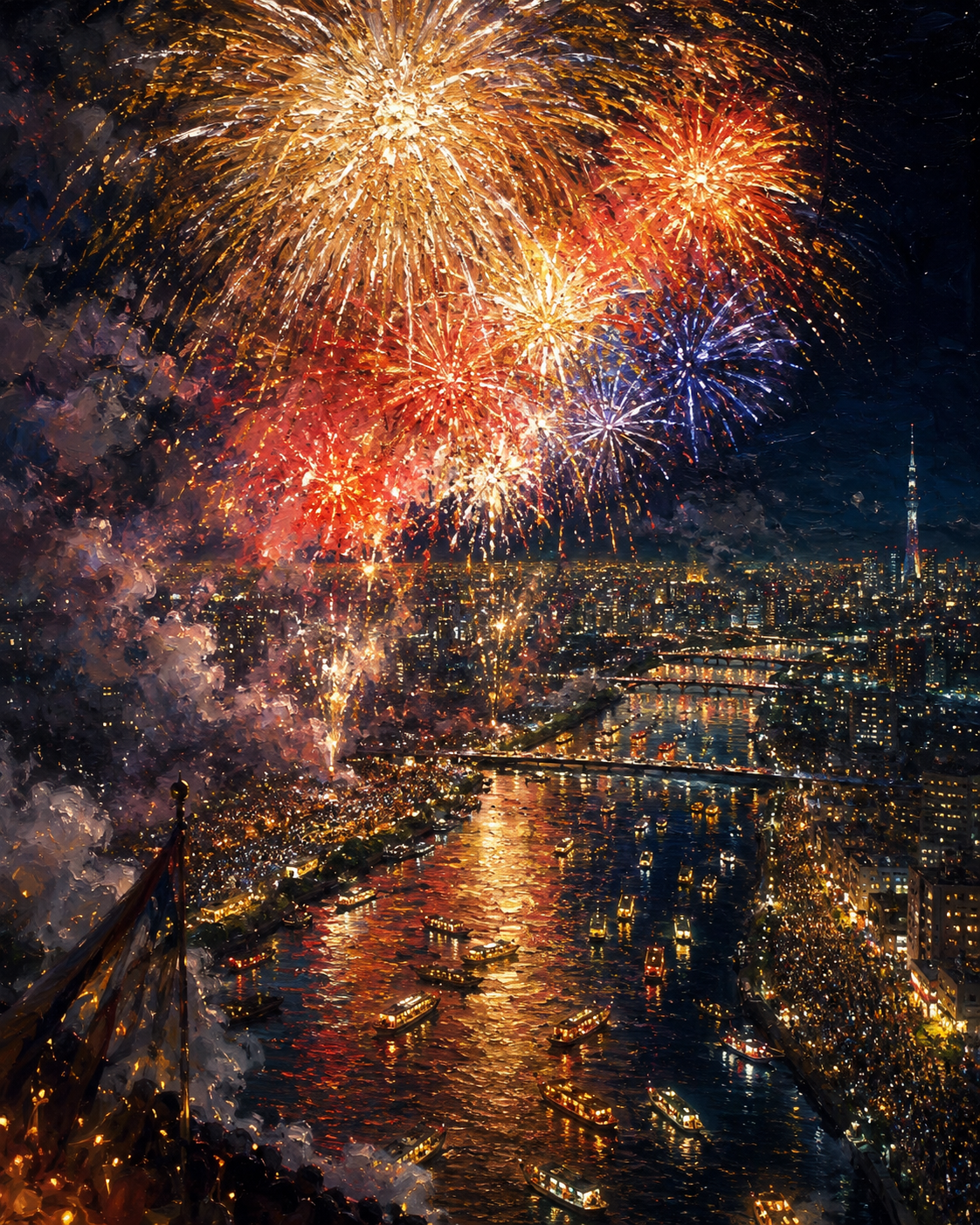
We Watched the City Become Fire
Critique
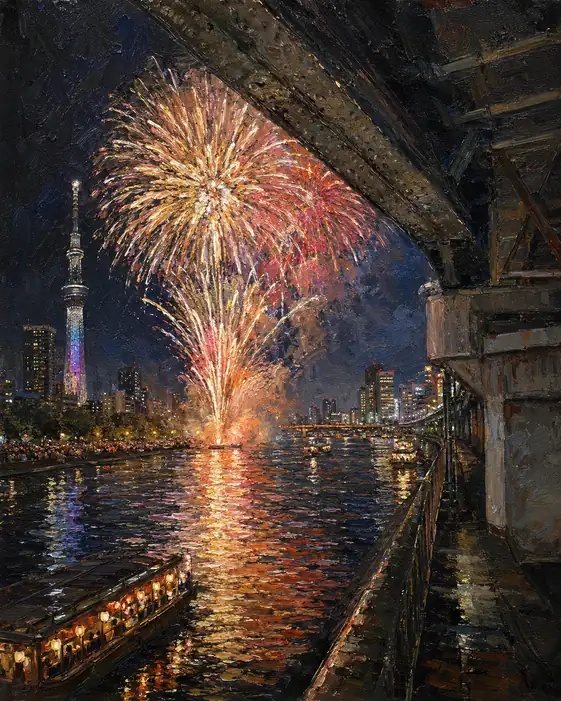
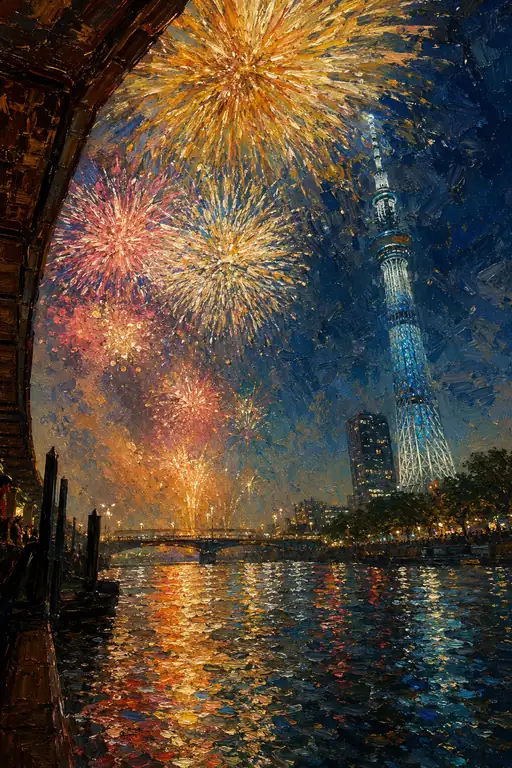
Introduction This urban landscape presents the Sumida River Fireworks Festival from an elevated riverside structure. A dark flagpole and roof edge frame the foreground, while fireworks, boats, bridges, Tokyo Skytree, and dense crowds extend across the nocturnal city. Description Large gold and red bursts spread across the upper left, accompanied by smaller blue and white flowers of light. The river occupies the center and carries many illuminated vessels toward distant bridges. Tokyo Skytree stands far to the right, while smoke and spectators form bright, irregular bands along the banks. Analysis The foreground pole and diagonal roof create a dark threshold before the open panorama. Beyond it, the river supplies deep perspective and the fireworks establish expansive circular rhythm. Dense warm strokes describe crowds and reflections, whereas blue-black areas around the tower and water preserve contrast, distance, and visual breathing space. Interpretation and Evaluation The framing device places the viewer within a specific act of watching rather than at a neutral aerial position. Temporary fire, moving boats, fixed bridges, and the distant tower represent different measures of urban time. The work balances asymmetry effectively, controls saturated color, and uses textured paint to convey smoke, reflected light, and collective density. Conclusion The dark foreground opens onto a city reorganized by the festival. What first reads as brilliant spectacle becomes a layered account of spectatorship, movement, and metropolitan memory along the Sumida River. Its strong framing and coherent illumination distinguish this view from a purely panoramic celebration.
Same Subcategory
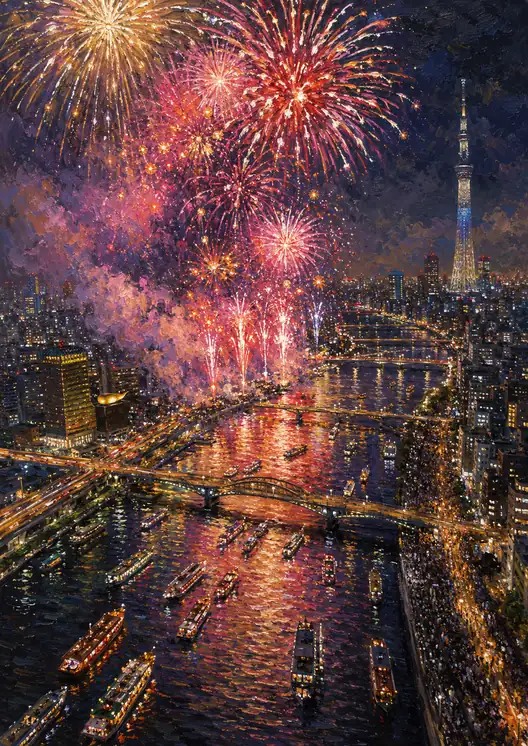 Every Boat Carries a Piece of the Sky
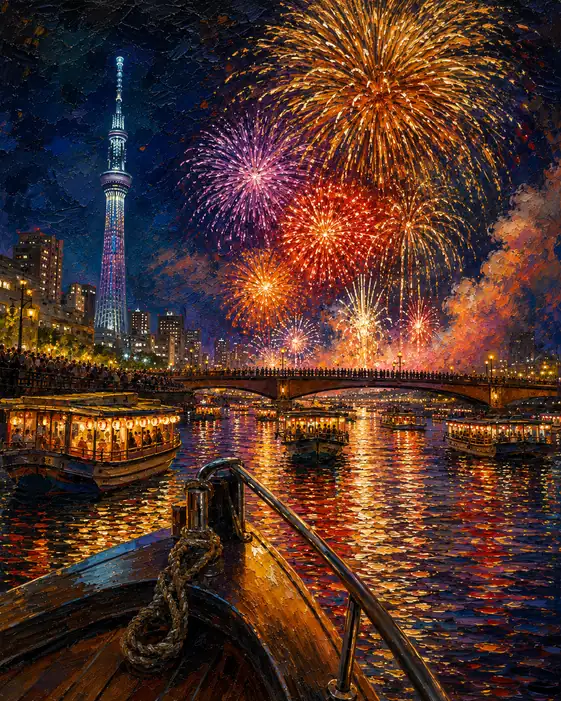 The Bow Enters a River of Stars
Similar Artworks
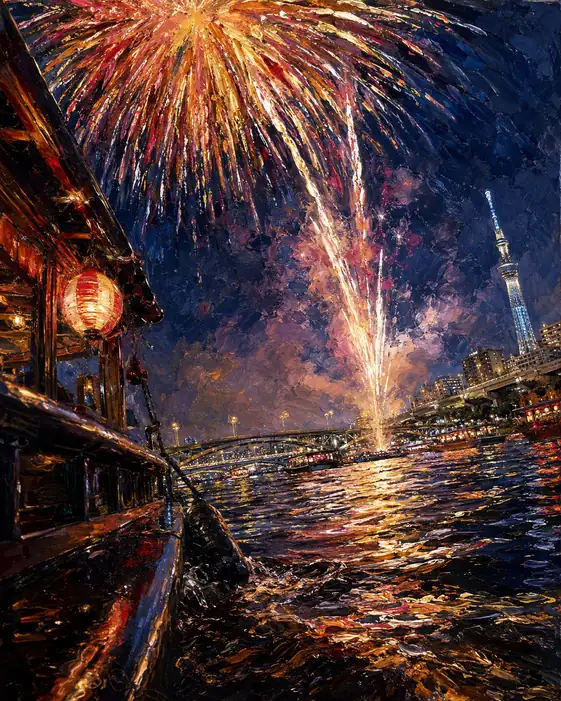 The Night Tilts, and We Rush into Gold
 At the End of Iron, a Flower of Light
 All of Sumida Became a Sky
 Before the Sparks Can Fall, We Pass
 The River Wore the Color of Dawn
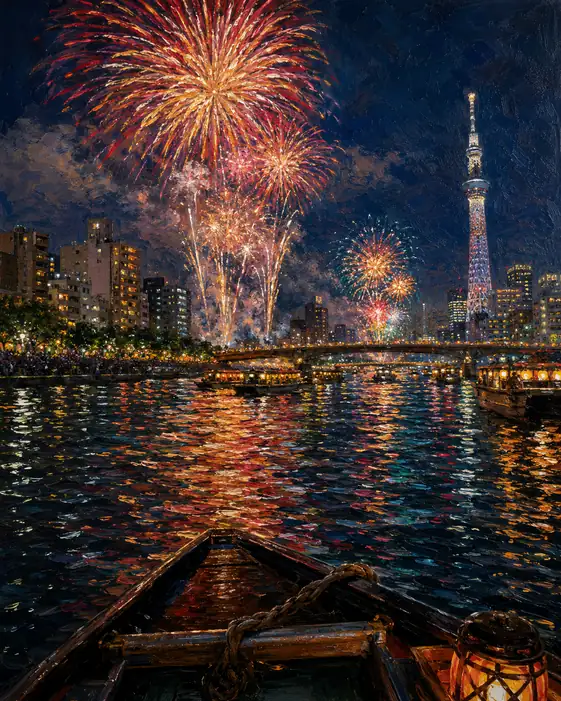 A Small Lantern Sails Toward the Heavens
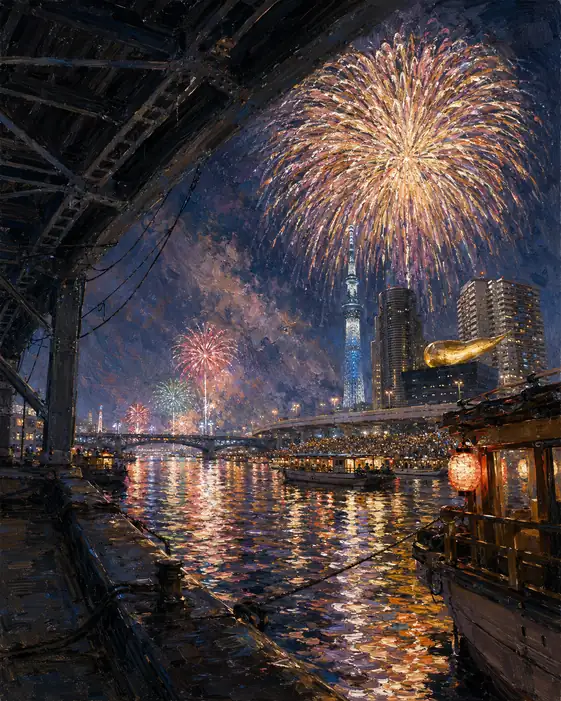 One Sun Beneath the Iron Night
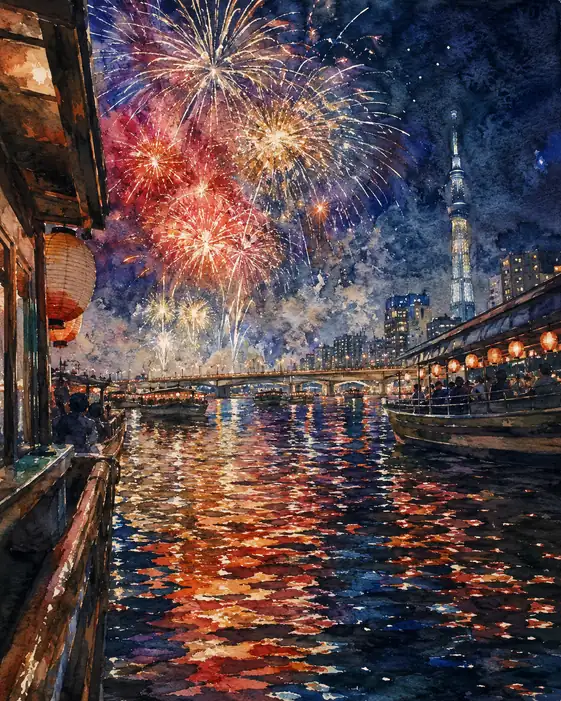 After the Thunder, Colors Remain
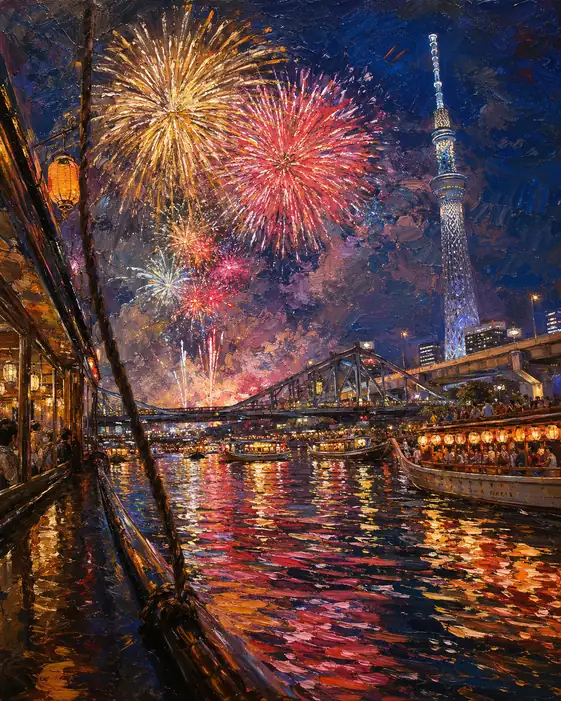 Every Crossing Leads to Fire
 The Golden Sky Beyond the Arch