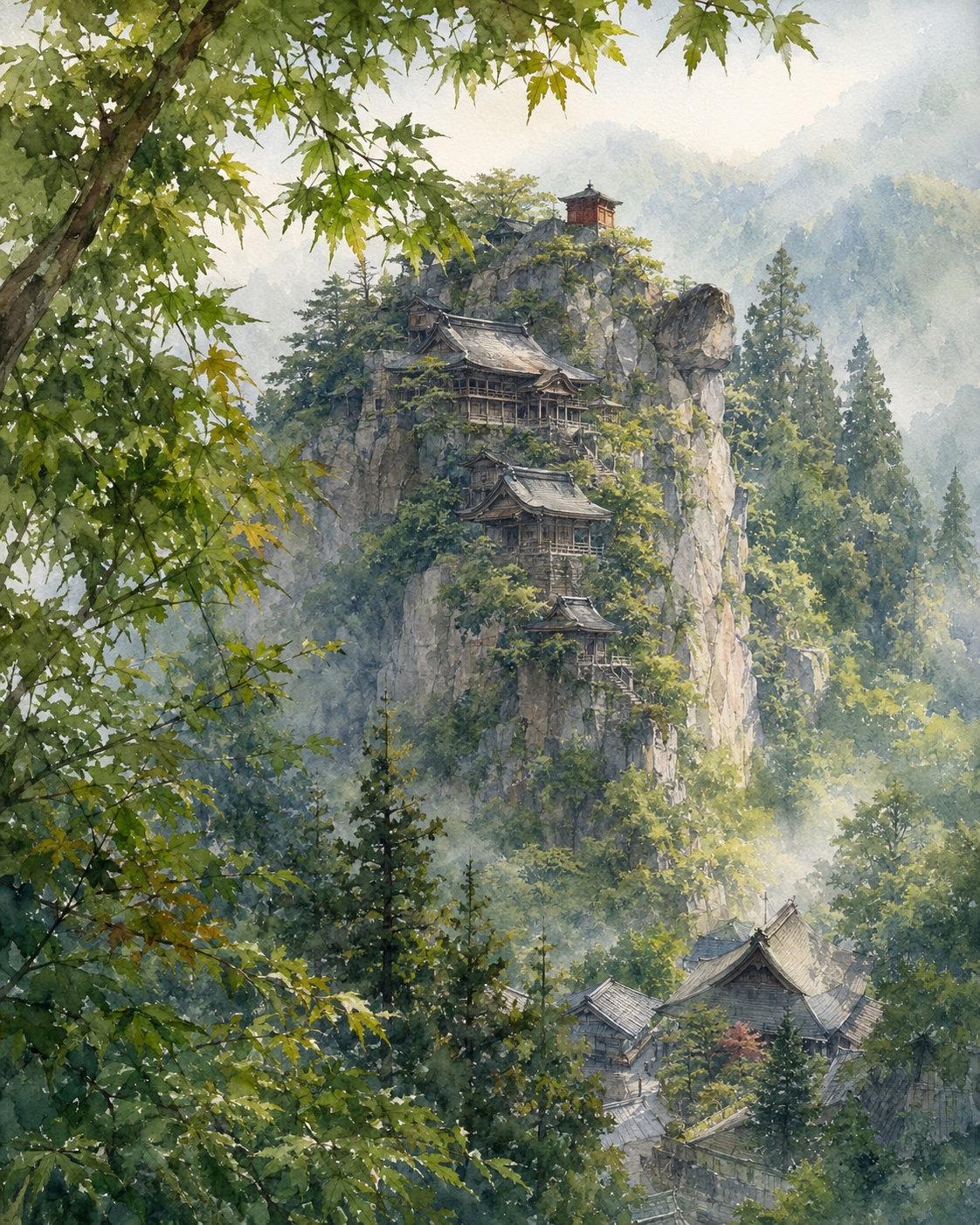
Every Roof Is Another Prayer
Critique
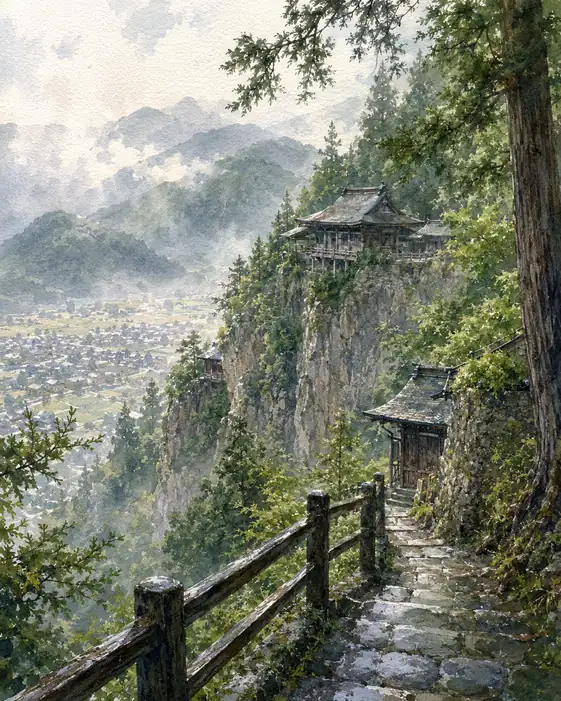
Introduction This landscape painting presents Yamadera, or Risshakuji, as a vertical complex embedded in a forested cliff. Multiple halls rise above a village in the Yamagata valley, emphasizing the close relation among sacred building, exposed rock, and mountain vegetation. Description Large green branches frame the upper left and open toward a pale central peak. Several timber halls occupy ledges on the tall rock face, with smaller roofs descending toward buildings at its base. Mist gathers between dark cedars, while the distant mountains remain softly illuminated. Analysis The composition is organized as a sequence of stacked architectural levels. The cliff supplies a firm vertical axis, and the surrounding branches form an irregular natural frame that keeps attention on the central complex. Warm brown roofs stand against cool green and gray washes, producing clarity without harsh contrast. Interpretation and Evaluation The upward accumulation of halls turns the mountain into a visible record of repeated ascent. Architecture and vegetation interlock so closely that neither appears complete without the other. Accurate spatial staging, varied textures, and controlled color support this reading, while the compressed height gives the familiar Yamadera motif a concentrated, almost diagrammatic force. Conclusion The painting connects the valley settlement to the highest pavilion through successive roofs and ledges. An initial impression of picturesque complexity becomes an understanding of sacred space organized by elevation. Its disciplined composition and atmospheric watercolor technique maintain coherence across a richly detailed scene.
Same Subcategory
Similar Artworks
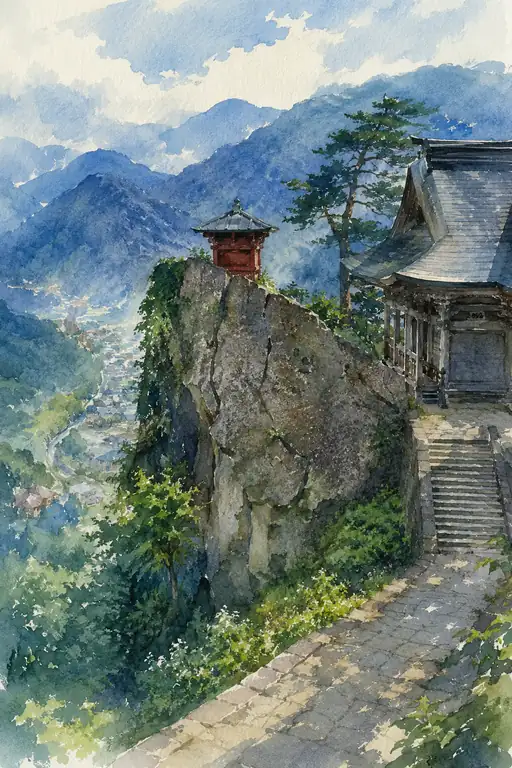 At the Edge Where Prayer Dwells
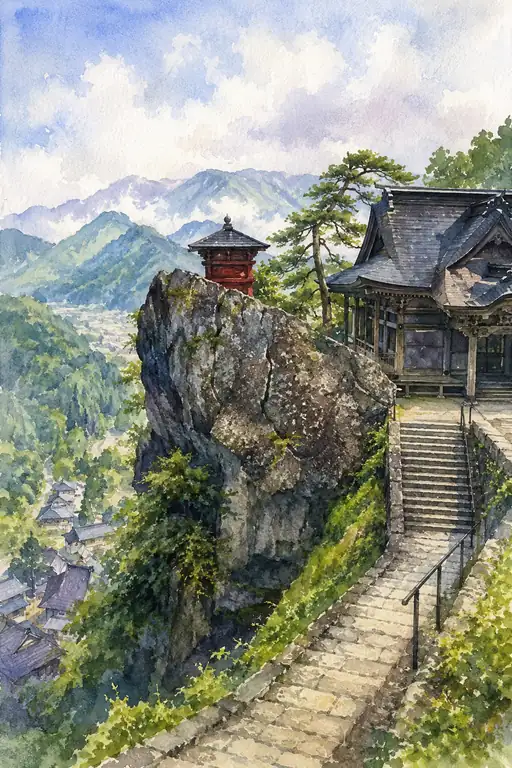 The Mountain Leaves No Easy Prayer
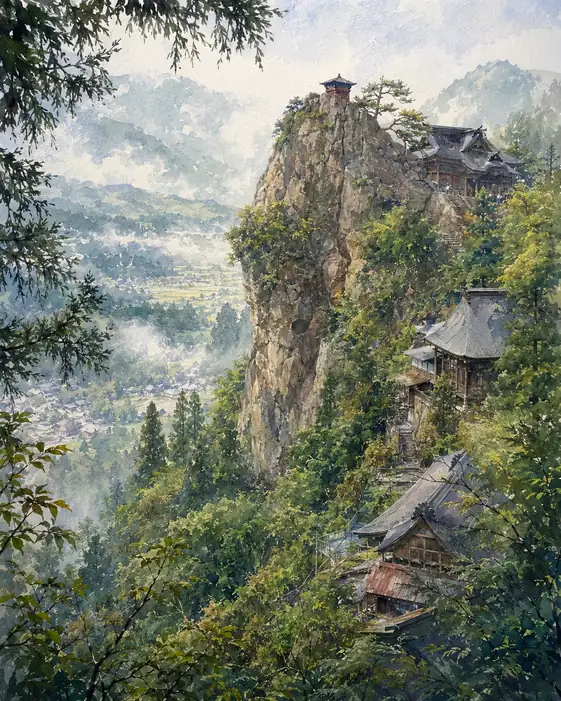 Faith Finds a Foothold in Stone
 The Path That Teaches the Sky
 Under the Cloud, the Sacred Door
 The Stone Remembers Every Ascent
 A Shrine Held Between Clouds
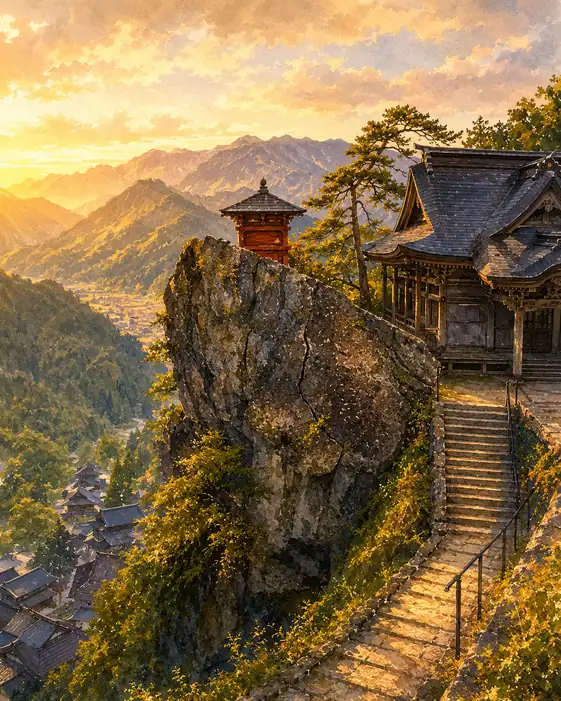 A Lone Vermilion Glow on Yamadera's Cliff Edge
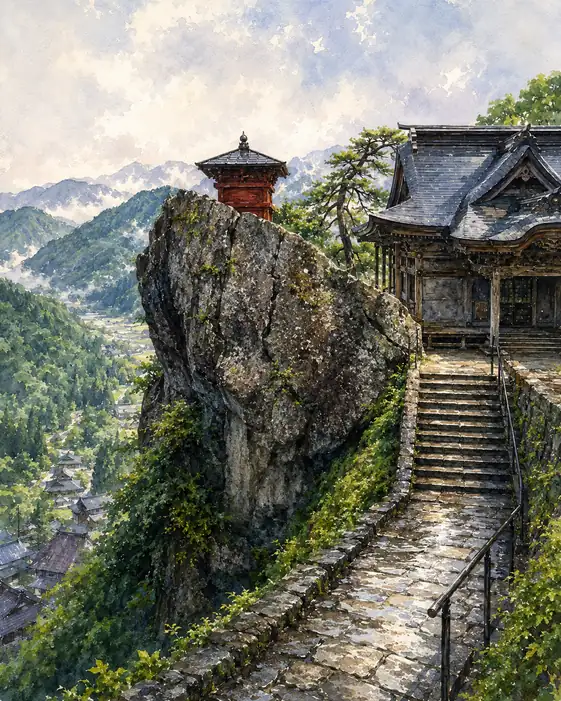 The Mountain Grants a Narrow Path
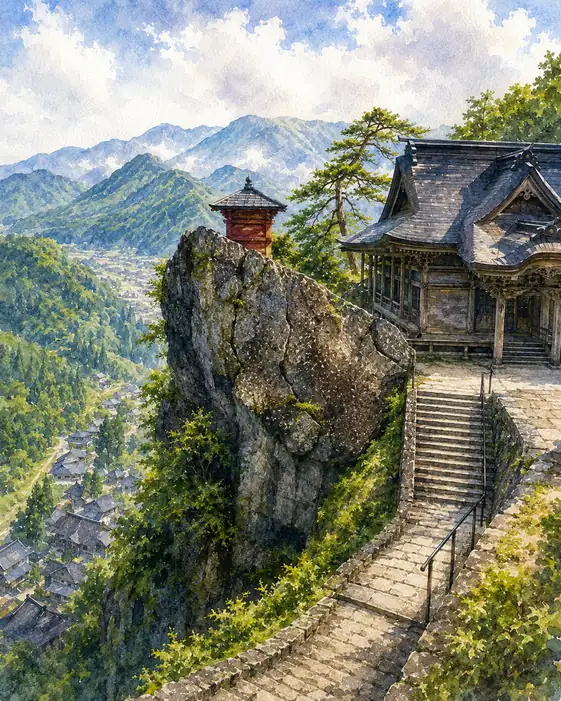 Where the Valley Learns to Pray