
Willows Write the Morning Twice
Critique
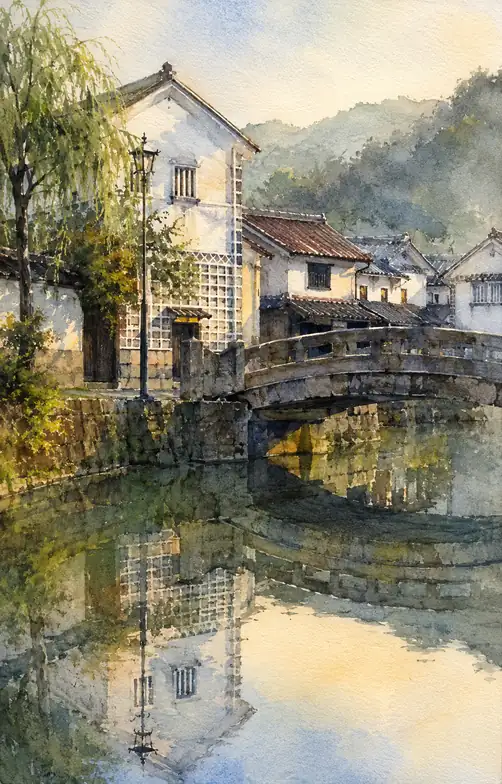
Introduction This landscape painting presents a quiet canal corner reflecting willow and white walls. Its first impact comes from storehouse-like houses at right running beside water that opens into a broad foreground reflection. Description The image shows storehouse-like houses at right running beside water that opens into a broad foreground reflection. Its palette consists of cream walls, blue-gray tiles, and young green foliage unified by pale light. Forms decrease in size and clarity from foreground to distance, so air and light also convey depth. Analysis Compositionally, building verticals meet the horizontal water plane while mirrored forms stabilize the design. An edge directs attention toward the principal motif and background. Technically, dry paper texture remains in the walls and transparent watercolor layers carry the reflections. Descriptive skill lies in coordinating light and dark, solid form and soft atmosphere. Interpretation and Evaluation The scene can be understood as everyday calm presented as the scene's value rather than picturesque display. Color carries stillness, tension, and passing time. Stable structure and selective accents keep the subject legible, while varied handling gives materials distinct presence. Conclusion The work succeeds by joining a clear subject to nuanced atmospheric painting. At first, attention rests on a quiet canal corner reflecting willow and white walls, but prolonged viewing reveals how repetition, shifts of temperature, and changing visual pace support the whole. Description, composition, color, and technique remain mutually consistent, transforming a scenic motif into a calm and persuasive encounter.
Same Subcategory
Similar Artworks
 The Town the Water Remembers
 The Boat That Waited for Evening
 Carp Carry the Old Street Forward
 The Boat Carries an Older Morning
 Red Dreams Beneath White Walls
 The Castle Dreams Beneath the Moat
 Ripples of Forgotten Time
 Willows Keep the Rain
 Dawn Finds Its Way Home
 The Canal Remembers Every Morning