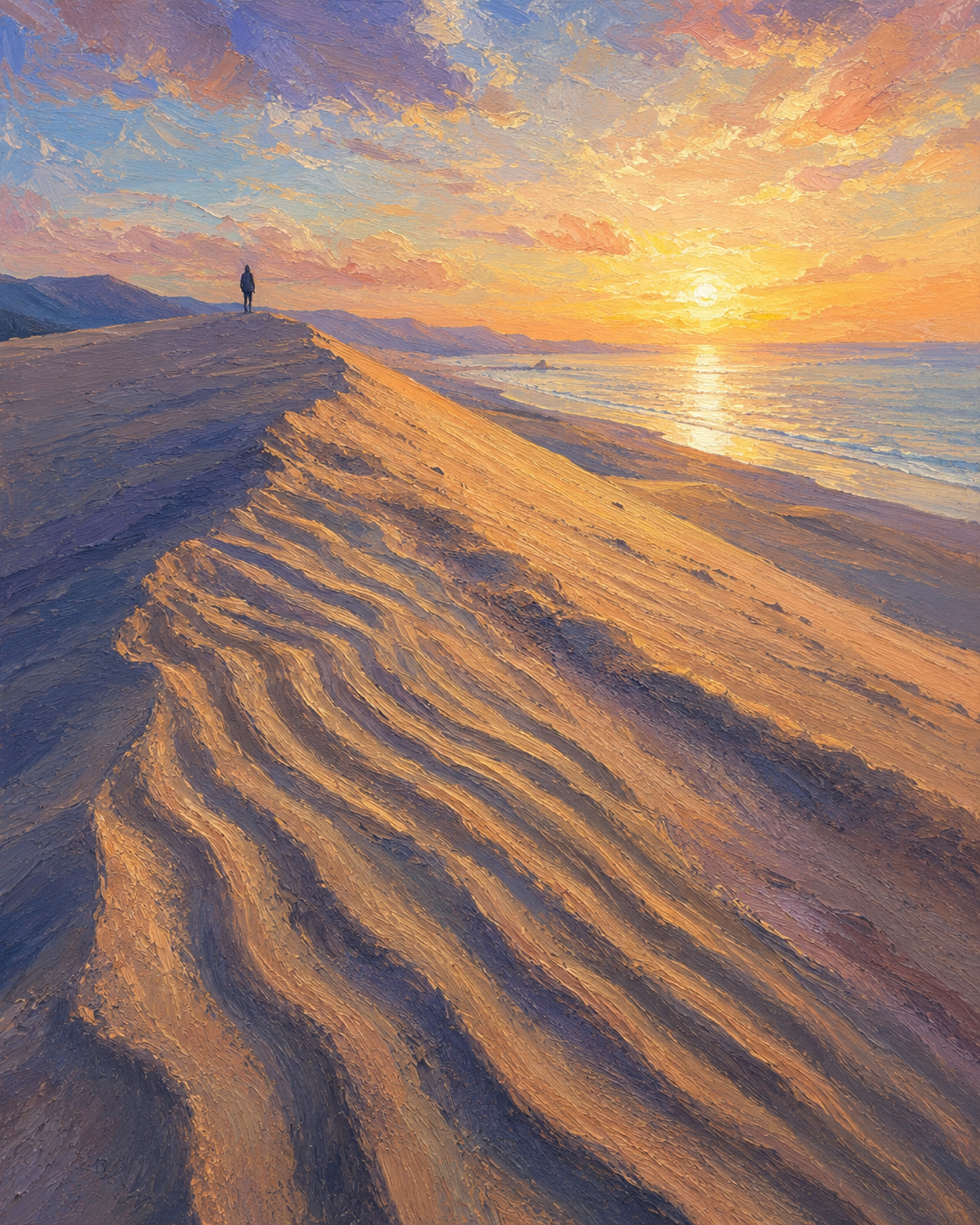
The Wind Leaves a Road to the Sea
Critique
Introduction This landscape painting presents a long dune ridge receiving the setting sun. Its first impact comes from foreground ripples converging on a crest where a tiny figure stands. Description The image shows foreground ripples converging on a crest where a tiny figure stands. Its palette consists of blue-violet shadow opposed to broad bands of golden light. Forms decrease in size and clarity from foreground to distance, so air and light also convey depth. Analysis Compositionally, the strong diagonal divides sea and sky while the minute figure makes the landscape measurable. An edge directs attention toward the principal motif and background. Technically, long strokes inscribe repeated wind patterns and thin color layers keep the sky open. Descriptive skill lies in coordinating light and dark, solid form and soft atmosphere. Interpretation and Evaluation The scene can be understood as quiet self-possession in confronting immensity rather than simple loneliness. Color carries stillness, tension, and passing time. Stable structure and selective accents keep the subject legible, while varied handling gives materials distinct presence. Conclusion The work succeeds by joining a clear subject to nuanced atmospheric painting. At first, attention rests on a long dune ridge receiving the setting sun, but prolonged viewing reveals how repetition, shifts of temperature, and changing visual pace support the whole. Description, composition, color, and technique remain mutually consistent, transforming a scenic motif into a calm and persuasive encounter.
Same Subcategory
 Golden Crest in the Silent Solitude
Similar Artworks
 Atop the Dune, Awaiting a Vision of You
 The Sun Passes Through Stone
 Where the Wind Traces Silence
 Emerald Sanctuary
 Autumn Kneels Before the Mountain
 Ripples of Eternal Time
 I Walked Home Through the Last Light
 A Thousand Blossoms Carry the Morning
 The Last Sunflower Holds the Horizon
 Where Yellow Meets Forever