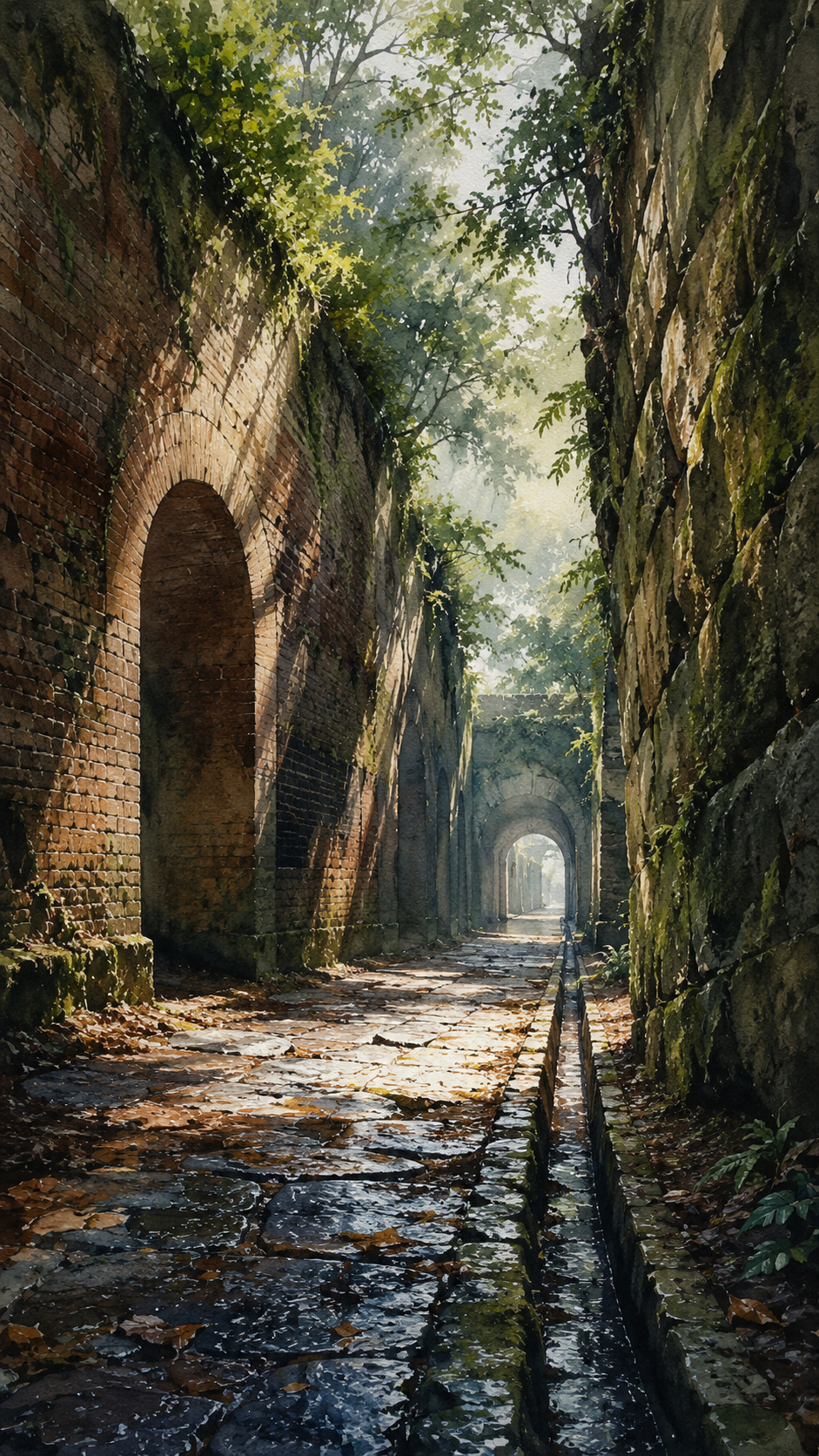
The Forest Reclaims the Forgotten Passage
Critique
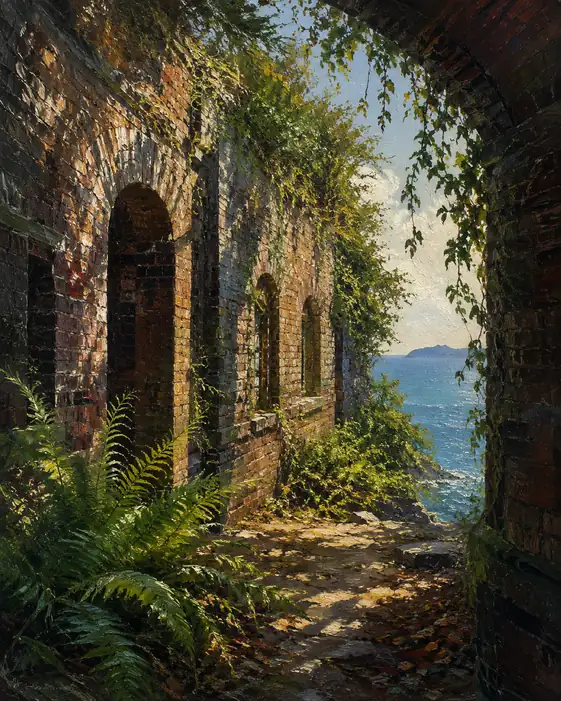
Introduction This landscape painting centers on a brick tunnel and former fortress passage covered with moss and vines. It translates a recognizable place into an ordered arrangement of light, color, and spatial intervals. Description The foreground contains wet paving stones and a narrow drainage channel. Beyond it, high retaining walls, repeated arches, and a pale opening in the distance establish a continuous movement from near space to the horizon. The palette is built from moss green, brick red, gray, and pale gold. Because filtered sunlight crosses the damp ruins diagonally, the highlights communicate a specific moment rather than functioning as decoration. Analysis In the composition, converging passage lines and repeated openings create strong depth. Forms near the principal subject are relatively distinct, while peripheral and distant contours become softer. This controlled focus guides the eye through the vertical format and strengthens depth. Interpretation and Evaluation The work's central idea concerns the action of time as nature quietly reclaims a human structure. Its clear design, restrained palette, and directional light support one another without reducing the site to a simple emblem. Originality lies less in distortion than in selecting the most effective relationships from observed scenery. Some contrasts are heightened, but they remain consistent with the atmosphere and clarify the subject. Conclusion The painting balances descriptive precision with a coherent pictorial structure. Gradations from foreground to distance, measured value contrasts, and recurring colors lead attention steadily toward the main motif. What first appears primarily picturesque gradually becomes an attentive study of time and environment. Its drawing, composition, color, and handling are successfully integrated into a unified visual experience.
Same Subcategory
 A Journey Beyond the Ruins
Similar Artworks
 Light Still Knows the Abandoned Way
 The Ivy's Silent Embrace of Time
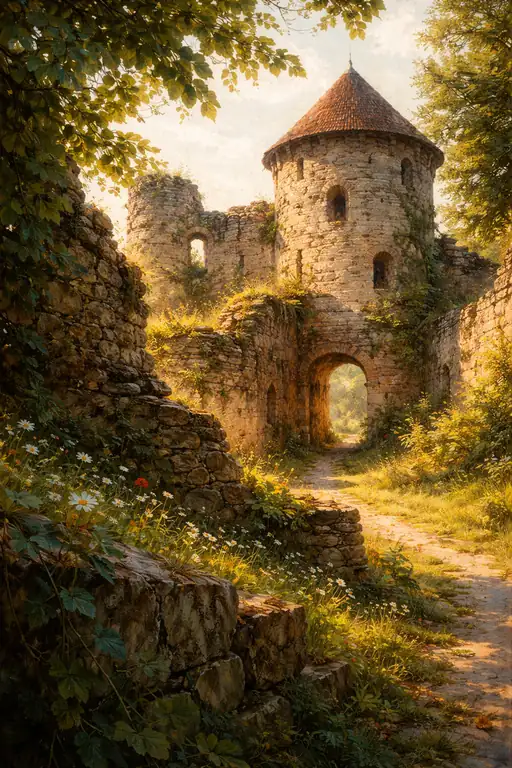 Nature's Embrace of the Ruined Tower
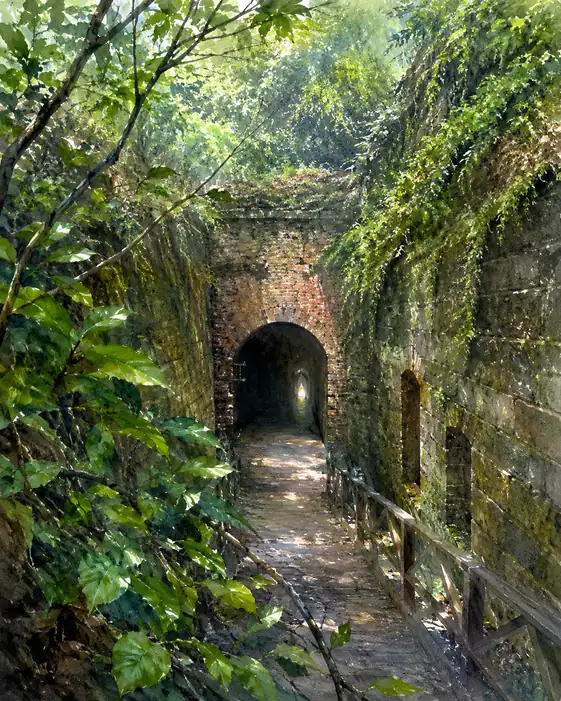 The Secret Path Through the Green Silence
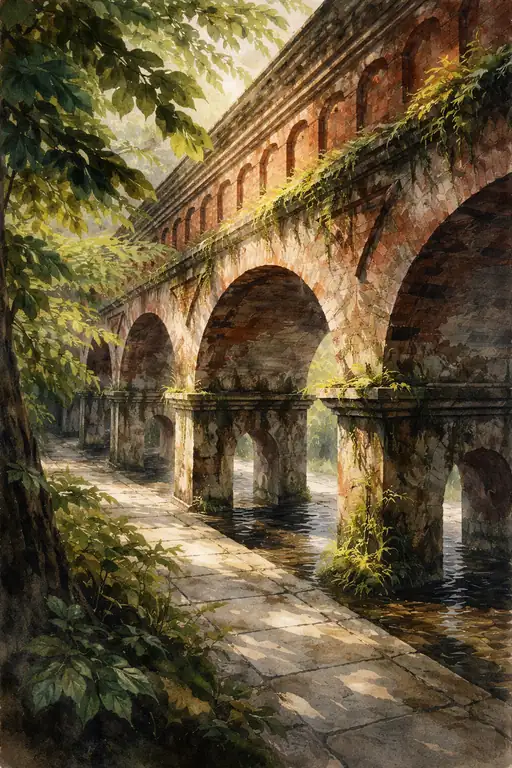 Time's Reclaimed Arches
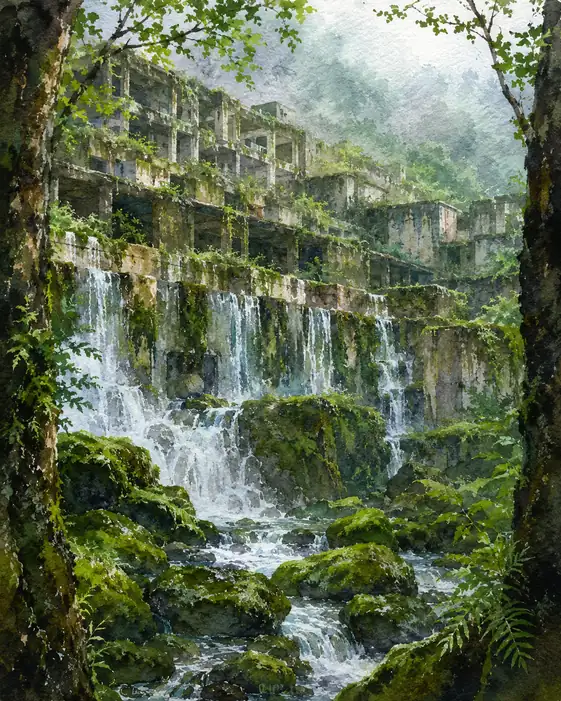 The Forest Builds with Falling Water
 Water Teaches the Ruins to Breathe
 Where Time Dissolves into Green
 The Golden Echoes of the Ruins
 Sentinel of the Fading Ages