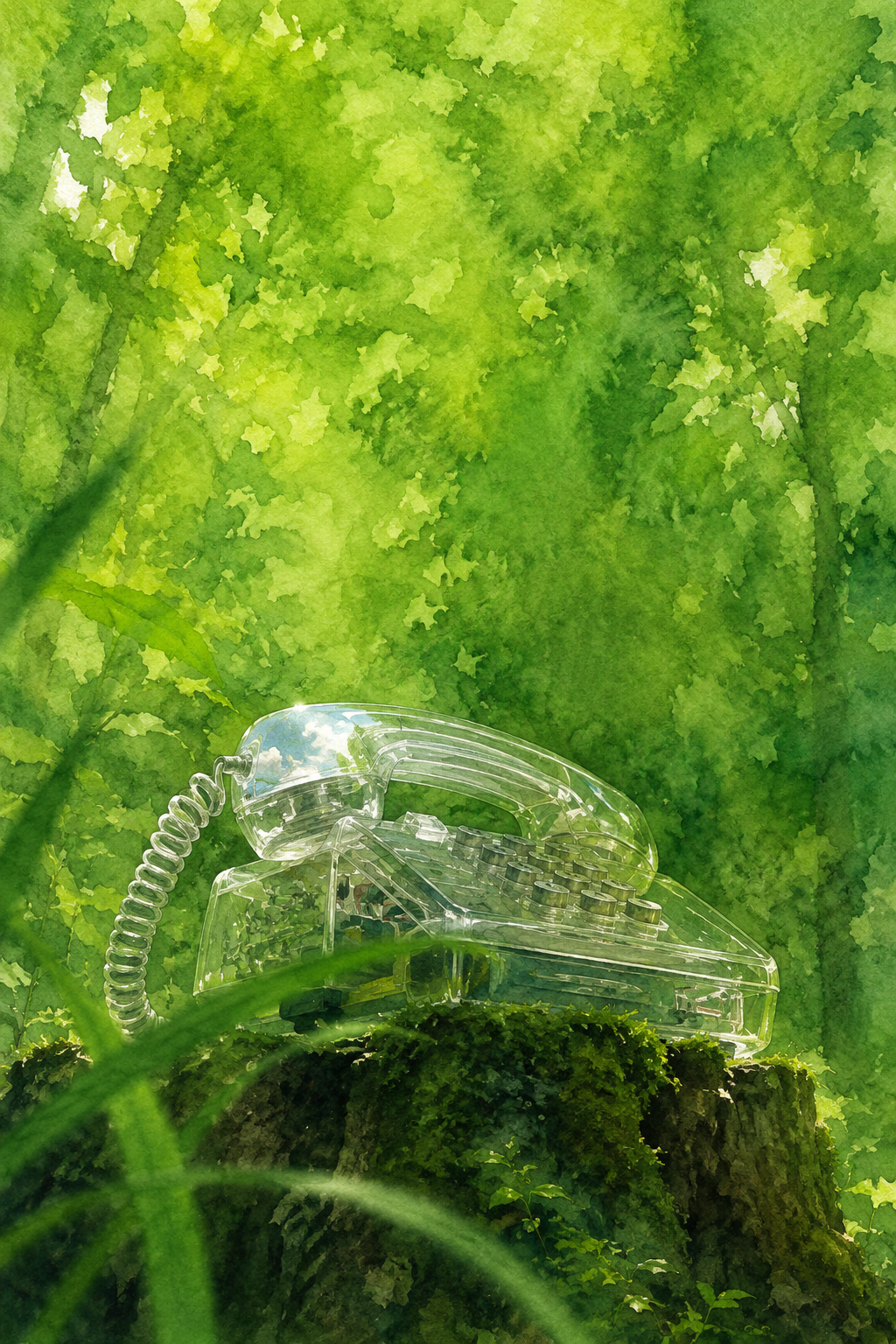
Calling the Silence
Critique
1. Introduction This painting depicts a transparent telephone placed in a green forest. Combining a moss-covered stump with a manufactured communication device, it presents an improbable encounter under convincing natural light. 2. Description At the center, a clear telephone with a handset, push buttons, and cord rests on the stump. Its internal parts appear through faint contours, while surrounding greenery reflects across its surface. Trees, ferns, and leaves overlap densely behind it, and light from above illuminates both machine and moss. 3. Analysis The direct central placement is immediately legible, and the circular stump provides a stable pedestal. Smooth, glasslike surfaces contrast with rough bark and moss, creating strong tactile interest. Within an overwhelmingly green palette, the transparent object gains presence almost entirely through edges and reflections. 4. Interpretation and Evaluation When a device made for conversation appears in an uninhabited forest, it raises the question of who might call whom. Transparency exposes the mechanism yet emphasizes the absence of any respondent and the uncertainty of connection. The rendering of unlike materials, the immediacy of the composition, and the modulated greens are all effective. 5. Conclusion At first, the unlikely pairing seems primarily playful and strange. Longer viewing reveals a more sustained concern with connection and isolation. The visible machine set against an impenetrable forest links material clarity with relational uncertainty, while controlled light, texture, and symbolism transform a simple still life into a reflective scene.
Same Subcategory
 The Ocean Brought Inside
Similar Artworks
 Symphony of the Emerald Stream
 Whispers of the Crystal Stream
 The Emerald Sanctuary of Whispering Roots
 The Emerald Cascade of the Hidden Sanctuary
 The Forest’s Crystal Veil
 The Emerald Melody of the Untouched Stream
 Whispers of the Emerald Canopy
 Dance of the Dappled Stream
 Whispers of the Emerald Stream
 The Soft Footsteps of Autumn