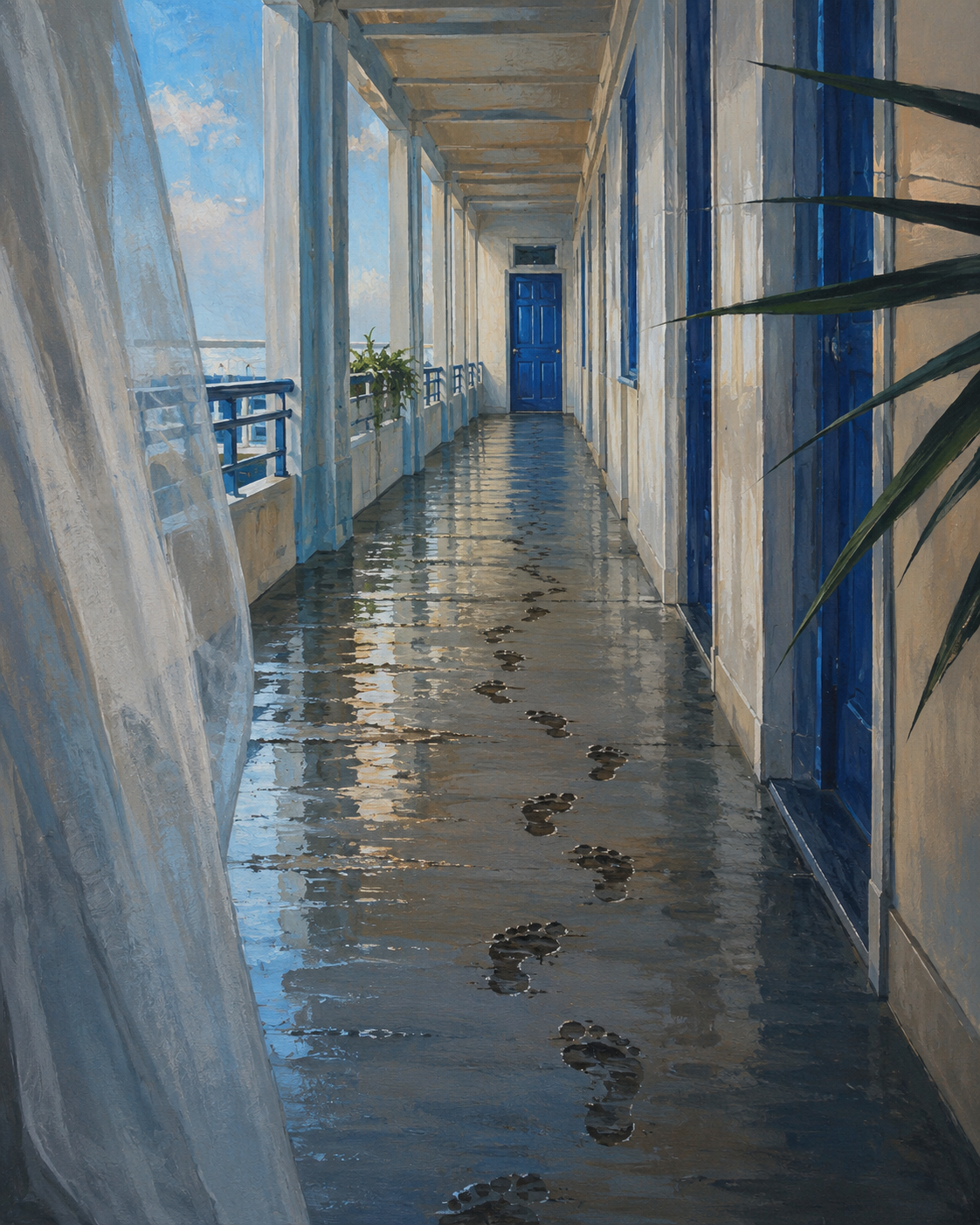
Steps to the Blue
Critique
1. Introduction This painting depicts bare footprints left along a white seaside corridor. A vivid blue door anchors the far end, while a wet floor and a wind-filled curtain define the atmosphere. 2. Description The narrow passage extends toward the central door, with dark footprints continuing from the foreground into the distance. Sea and sky appear through openings on the left, where a white curtain billows inward. A wall and green leaves border the right side, adding natural color to the architecture. 3. Analysis One-point perspective directs the eye forcefully toward the door, and the diminishing footprints reinforce that depth. Rigid columns and walls contrast with the curved curtain and irregular human traces. White functions as the dominant color, while cobalt in the sea and doorway supplies a concentrated focus. 4. Interpretation and Evaluation The footprints signify absence, but they also prove that someone has moved deliberately toward the end of the passage. The door, whose openness remains uncertain, can suggest a destination, threshold, or choice. The composition effectively combines architectural order with the changeable forces of wind and water, and its limited palette remains coherent. 5. Conclusion At first, the scene appears to be a bright and orderly coastal walkway. With longer viewing, uncertainty about the missing traveler begins to dominate. The opposition between immaculate space and wet marks introduces unease into openness, while perspective, color, and varied surface technique unite to make an unseen action memorable.
Same Subcategory
Similar Artworks
 Traces of a Silent Journey
 Summer's Hiding Place
 The Eternal Light of Learning
 Ascent to the Celestial Dome
 Whispers of Chios: Where Geometry Meets the Sun
 A Breath of Eternal Afternoon
 Luminous Whispers along the Coastal Arcade
 The Shadow of a Journey
 Windless Sail on a White Wall
 The Whispering Gallery of History