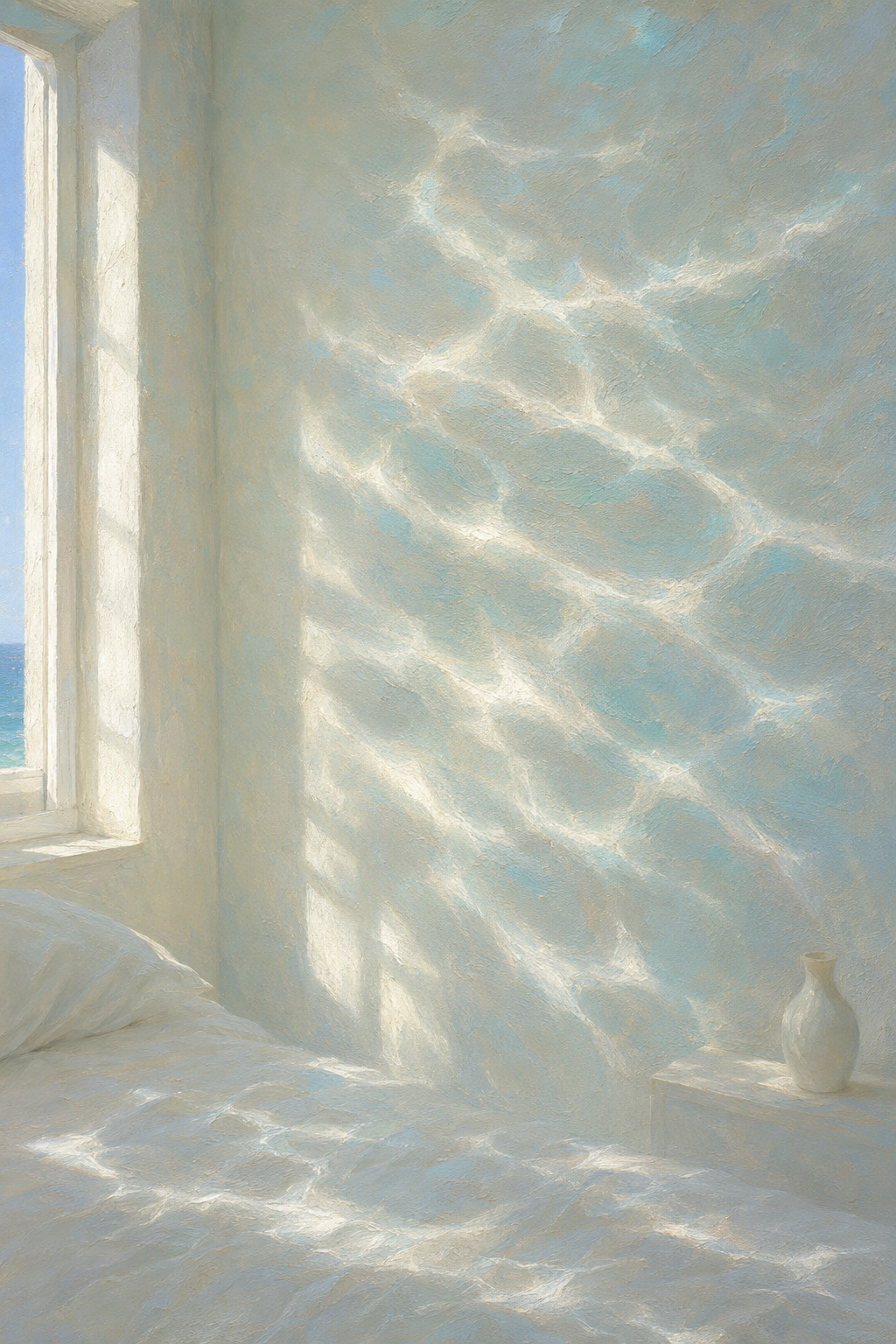
Where the Tide Enters
Critique
1. Introduction This painting presents a white room facing the sea, suffused with pale blue light. Its few elements—a bed, an open window, and a small vase—appear without any human figure. 2. Description A bed covered in white linen occupies the lower left, beneath a window opening onto blue water and sky. On a low block at the right stands a small white vase. Across the wall and bedding, wavering patterns resemble sunlight reflected from water. White dominates the floor, walls, and fabric, while pale blue and gray define the edges and shadows. 3. Analysis The window rectangle, the bed's horizontal lines, and the block's verticals establish a stable geometric order. Against them, irregular bands of light introduce movement and the passage of time. The restricted white-and-blue palette heightens atmospheric clarity, and slight tonal shifts create depth without disrupting the calm. 4. Interpretation and Evaluation The absence of a person need not indicate abandonment; it can suggest that someone has only briefly left the room. As the sea enters the interior through moving light, the boundary between outside and inside becomes less certain. The reduced composition, restrained color, and sensitive rendering of reflection are all accomplished. 5. Conclusion At first, the work seems chiefly to describe a cool, immaculate coastal room. With sustained attention, the changing light emerges as its true protagonist. The contrast between fixed furnishings and unstable reflections joins rest with transience, demonstrating how economical description and lucid spatial design can draw an experience of time from an everyday interior.
 The Morning Wind's Lace Embroidery
 Autumn Held in a Circle of Light
 Soft Awakening
 Inner Landscape
 Woven Sunshine
 Tears of the Windowpane
 Whispering Morning Breeze
 Sanctuary in the Morning Sun
 Morning Grace in the Bedroom
 Golden Hour Sanctuary
 Sanctuary of Morning Light
 The Quiet Summer Reflected in the Glass