
The Hand that Leads to Music
Critique
Introduction This intimate figurative painting shows a child receiving guidance at a piano keyboard. The scene is cropped tightly around the face, hands, and keys, concentrating attention on a small act of learning. Warm light gives the lesson a calm domestic character. Description The child wears a pale blue garment with a white textured collar and looks downward with careful concentration. One small hand reaches toward the white keys while an adult hand gently indicates the placement of a finger. The polished dark piano curves around the scene, forming a deep frame against the illuminated skin and fabric. Analysis The keyboard establishes a strong diagonal that leads from the lower right toward the paired hands and face. Contrasts between black lacquer, cream keys, and warm flesh clarify the essential action. Thick strokes model cheeks and cloth, while finer linear marks define eyelashes, hair, and fingers. The close cropping removes distraction and gives gesture greater expressive weight. Interpretation and Evaluation The image presents instruction as attentive cooperation rather than authority. The adult is represented only through a guiding hand, allowing the child's concentration to remain primary. Observant drawing makes the touch convincing, restrained color sustains intimacy, and the unusual framing is an effective compositional choice. Varied brushwork balances physical texture with emotional delicacy. Conclusion The painting unites precise gesture, focused composition, and luminous technique. What first appears to be a simple lesson gradually becomes a study of trust, patience, and knowledge transmitted through touch. Its quiet originality lies in making two hands carry the meaning of an entire relationship.
 The First Stroke of Wonder
 Where the Stories Sleep
 Harmony in the Lamp Light
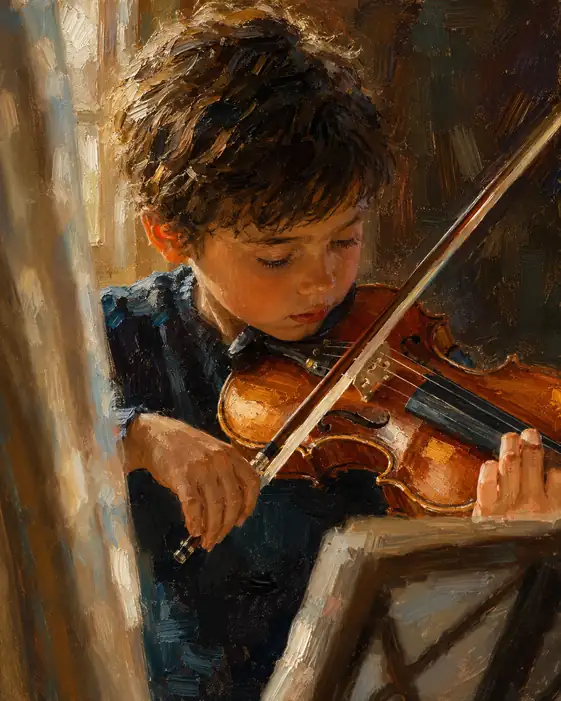 A Melody Only for the Light
 The Quiet Prelude
 Melody in the Golden Light
 Words Nurtured in the Golden Light
 Infinite World from a Small Brush
 Traces of a Gentle Hand
 Tracing the Heart's Line
 Before You Set Sail
 Four Hands, One Dream