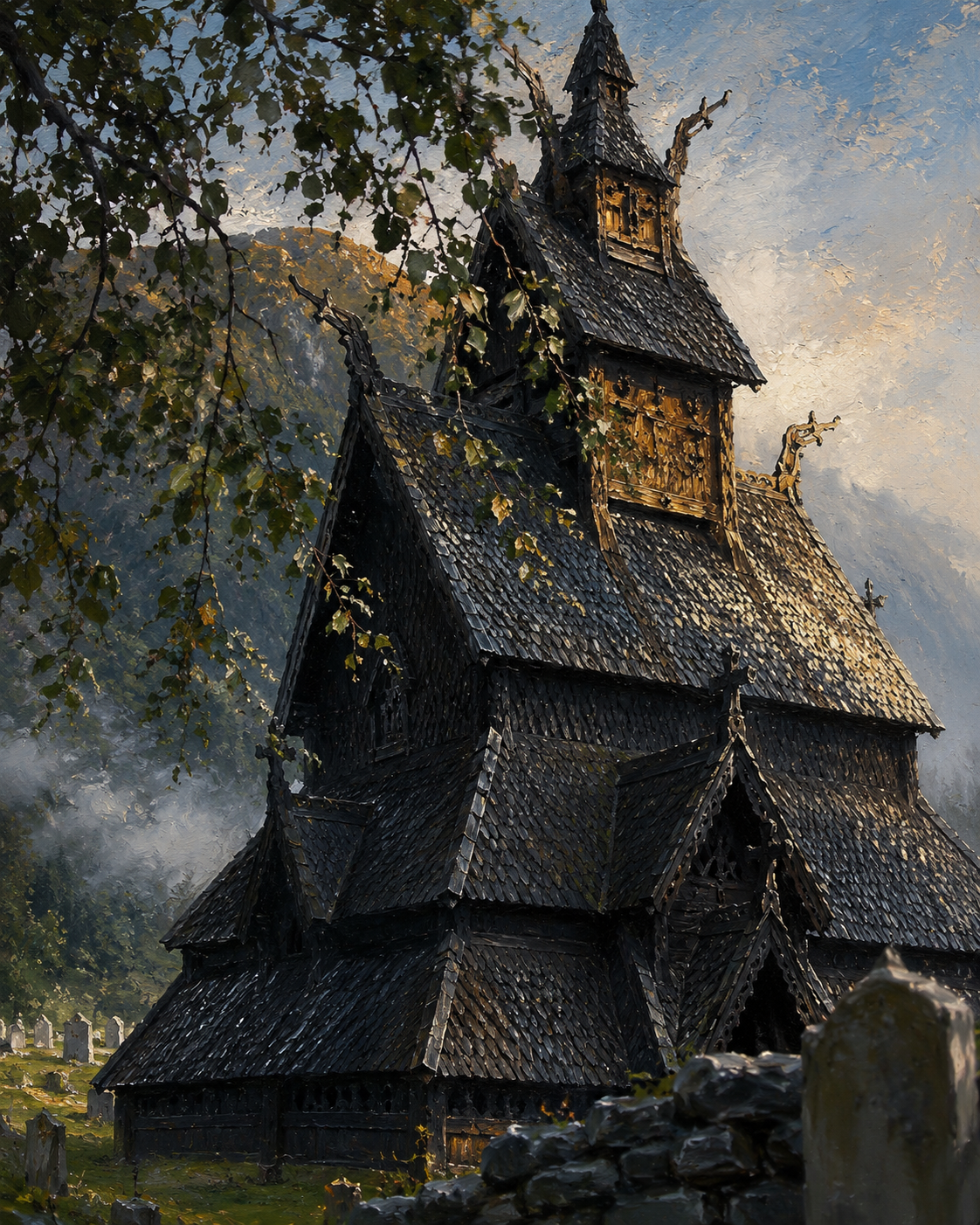
The Sacred Sentry of the Misty Valley
Critique
1. Introduction This vertical oil painting presents a detailed study of a traditional stave church, set against a rugged mountainous landscape. The composition focuses on the architectural complexity of the wooden structure, which occupies the majority of the frame. The work captures a specific historical and cultural atmosphere, utilizing a rich palette of earth tones and subtle lighting to define the form. It serves as an exploration of both structural endurance and the interplay between man-made heritage and the natural environment. 2. Description The primary subject is a multi-tiered wooden church characterized by steep gables and intricate shingle patterns that cover its entire surface. At the peaks of the roofs, ornate carvings resembling dragon heads extend into the sky, while several small crosses are also visible. In the foreground, a series of weathered stone monuments suggests a quiet graveyard, partially obscured by a stone wall and leafy branches. The background reveals a misty valley and a sunlit mountain peak, with a sky that transitions from pale blue to a warm, golden hue. 3. Analysis The artist employs a thick impasto technique, particularly evident in the sky and the highlights on the wooden shingles, which adds a tactile quality to the surface. The lighting is directional, striking the right side of the building and creating a strong contrast with the deep shadows on the left and within the gables. This chiaroscuro effect emphasizes the three-dimensional volume of the church and highlights the rhythmic texture of the timber. The vertical orientation and low-angle perspective grant the building a sense of monumentality and spiritual elevation. 4. Interpretation and Evaluation The choice of a stave church as the focal point invites an interpretation centered on the preservation of history and the resilience of organic materials. The dark, weathered wood appears almost as a natural outgrowth of the earth, standing firmly between the graveyard of the past and the enduring mountains. Technically, the work demonstrates exceptional skill in rendering varied textures, from the rough stone to the delicate leaves and the heavy, layered wood. The balance between the detailed foreground and the atmospheric background creates a convincing sense of depth and scale. 5. Conclusion While the painting initially appears as a straightforward architectural representation, a closer examination reveals a profound meditation on time and the sacred. The convergence of light and shadow on the ancient timber evokes a feeling of reverence that transcends the physical structure itself. The artist successfully integrates the structural complexity of the church into a unified, emotive landscape. Ultimately, the work stands as a powerful tribute to cultural heritage, rendered with a sophisticated understanding of light, texture, and compositional harmony.
Same Subcategory
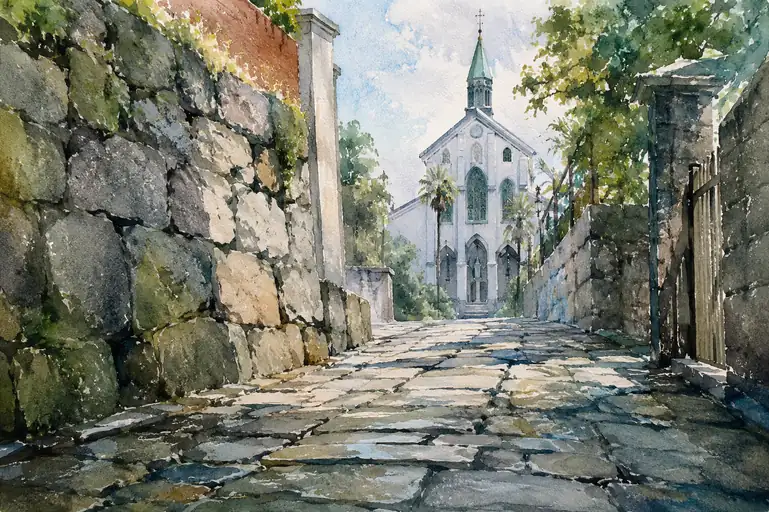 Stones That Remember the Light
Similar Artworks
 The Silent Prayers of the Forest
 Hope Carved in Ancient Timber
 Silent Prayers of the Weathered Wood
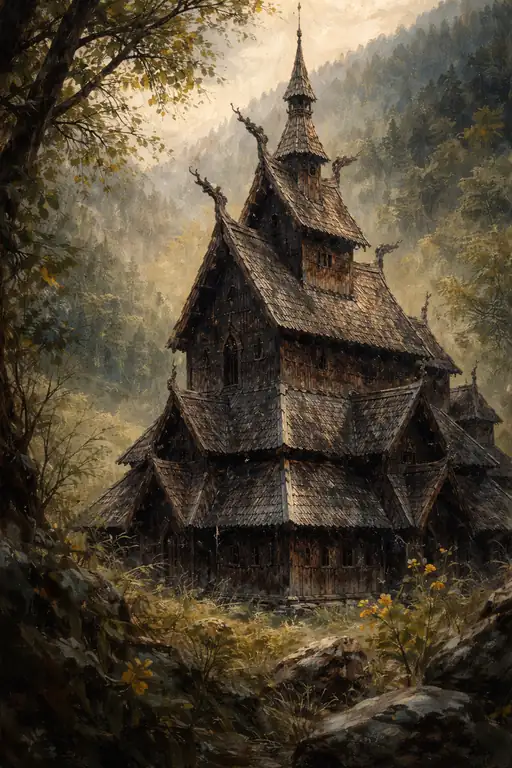 The Silent Spire in the Fog
 The Quiet Solitude under Twilight
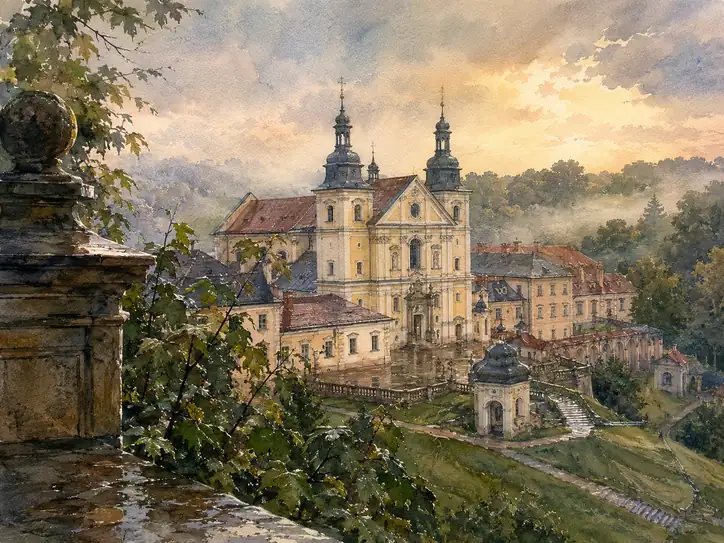 Grace After the Rain
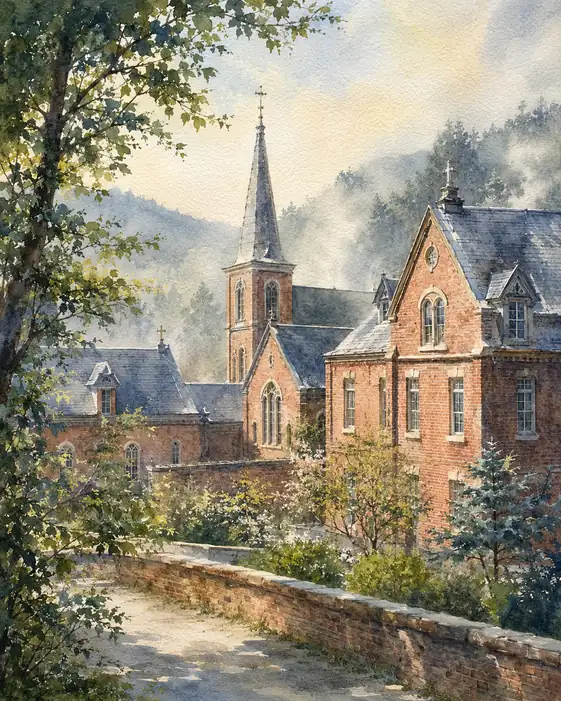 Sanctuary of Silence: Red Bricks in the Morning Mist
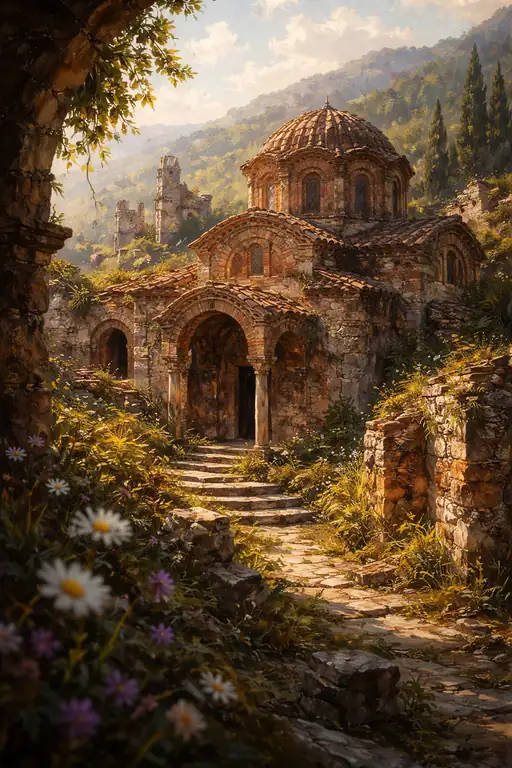 Footsteps of Time: The Sanctuaries' Slumber
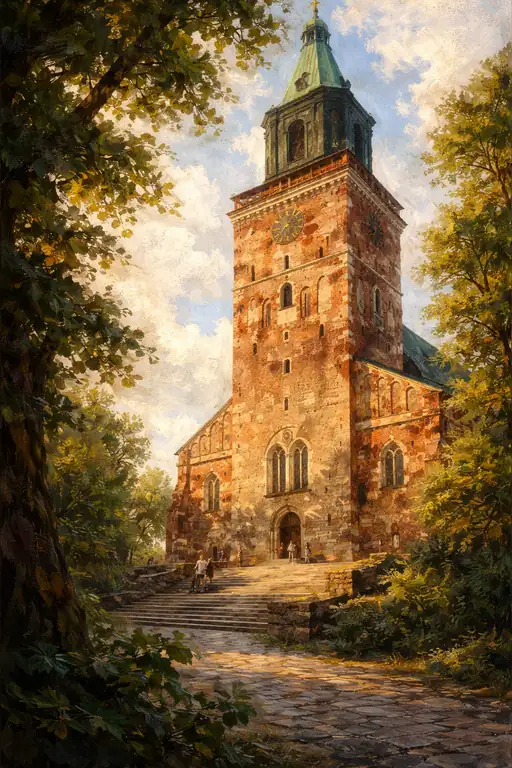 Sunlit Path to Turku Cathedral
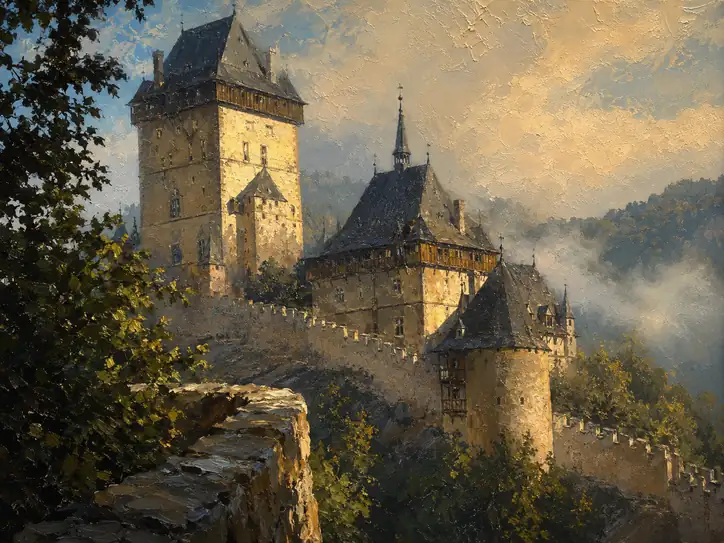 Guardian of the Silent Peaks