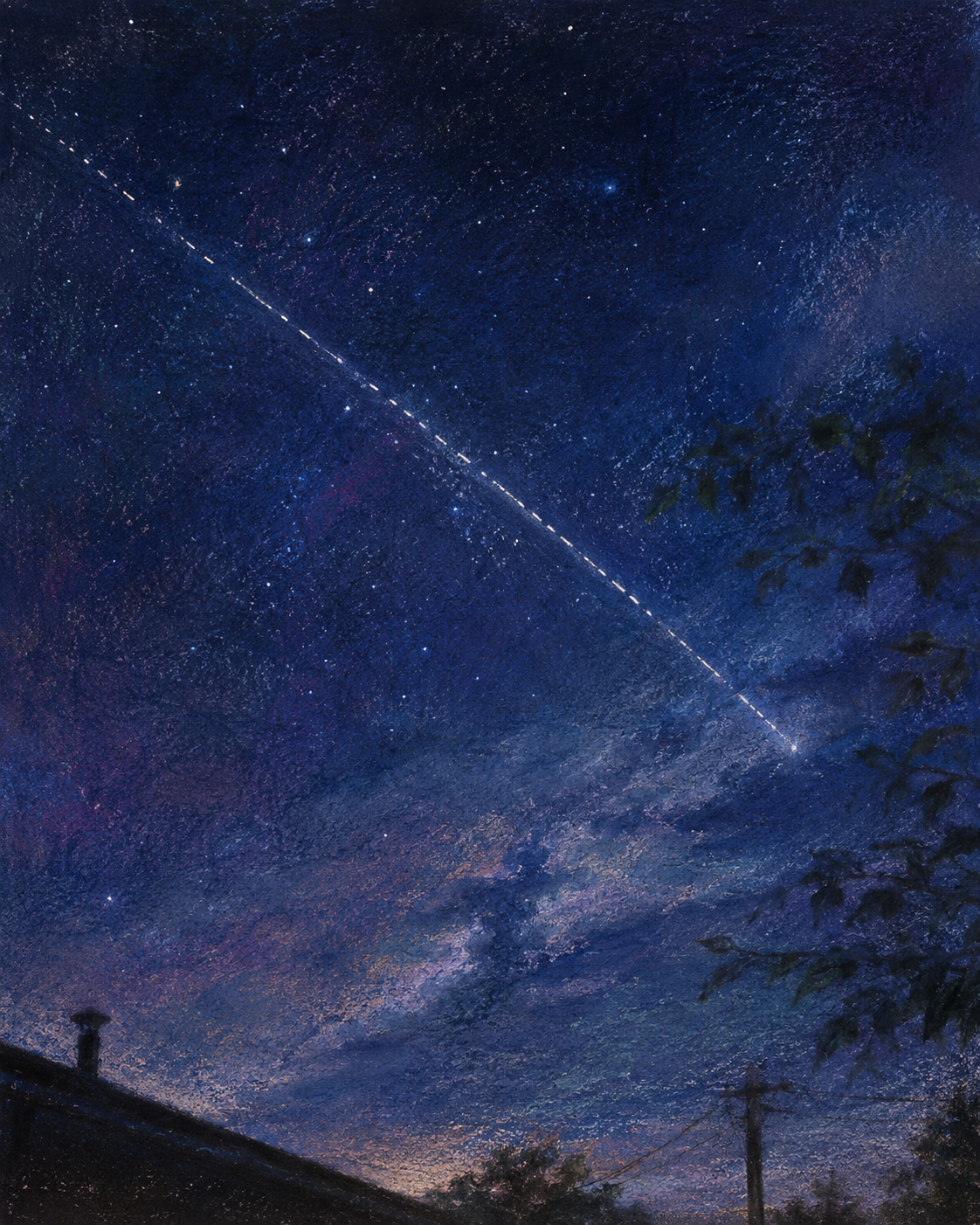
A Path Between the Stars
Critique
1. Introduction This painting captures a contemporary celestial phenomenon, blending traditional night sky imagery with the modern intrusion of human technology. The composition features a sprawling, star-filled sky over a quiet terrestrial setting, distinguished by a prominent, dashed line of light streaking across the celestial vault. By juxtaposing the timeless beauty of the constellations with the transient passage of a satellite train, the work invites a reflection on the changing nature of our nocturnal environment. It serves as a poignant document of the "New Space Age" and its visual impact on the global landscape. 2. Description The vertical canvas is dominated by a deep indigo sky, rich with textural variations and a multitude of stars. A sharp diagonal line, composed of a series of bright, evenly spaced white dots, extends from the upper left corner toward the center right, representing a satellite constellation in transit. In the lower portion of the frame, the dark silhouette of a rooftop with a chimney and the delicate branches of a tree frame the scene, providing a sense of scale and locality. Subtle hints of magenta and violet permeate the dark blue expanse, particularly in the lower center where the faint, glowing band of the Milky Way is discernible. 3. Analysis The artist utilizes a heavily textured impasto technique, where thick applications of paint create a physical topography on the surface of the canvas. This tactile quality enhances the luminosity of the stars, making them appear as if they are emerging from the deep layers of the sky. The diagonal trajectory of the satellite trail creates a strong directional force, cutting through the organic, scattered arrangement of the natural stars. This linear precision contrasts sharply with the soft, blended rendering of the distant nebulae and the rough, silhouetted forms of the foreground, establishing a clear hierarchy of space and distance. 4. Interpretation and Evaluation This work can be interpreted as an exploration of the evolving relationship between humanity and the cosmos. The satellite trail, while visually striking, also symbolizes the increasing density of orbital objects and their potential to obscure our view of the natural universe. The artist's decision to include terrestrial elements like the roof and trees grounds the viewer, transforming a distant astronomical event into a personal, observed experience. The technical skill is evident in the sophisticated handling of low-light color palettes and the convincing representation of astronomical depth through layered textures rather than traditional linear perspective. 5. Conclusion In conclusion, the painting offers a compelling and relevant take on the classic nocturne, updated for the twenty-first century. Through its masterful orchestration of color and texture, the work captures both the enduring majesty of the stars and the fleeting, artificial brilliance of modern satellites. While the initial impression may be one of simple beauty, the underlying contrast between the natural and the artificial provides a layer of conceptual depth that lingers. The piece successfully bridges the gap between the terrestrial and the celestial, encouraging the viewer to look upward with a renewed sense of curiosity and concern.
Same Subcategory
 Night Garden Golden Lantern
 A Silent Conversation on a Starry Night
Similar Artworks
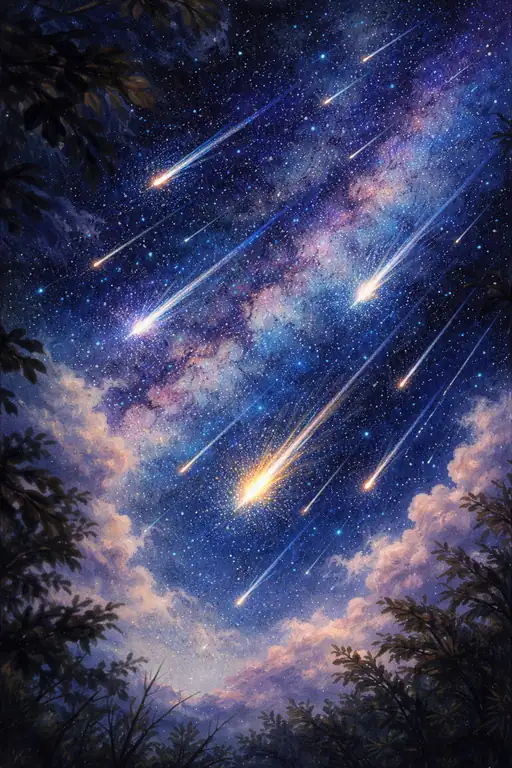 Tears of the Starry Expanse
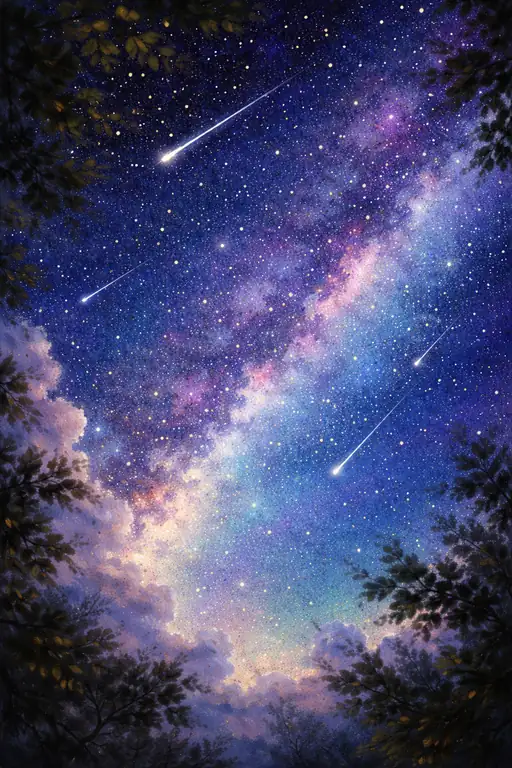 Meteor's Dance Through the Violet Veil
 Meteor Shower in the Cosmic Sky
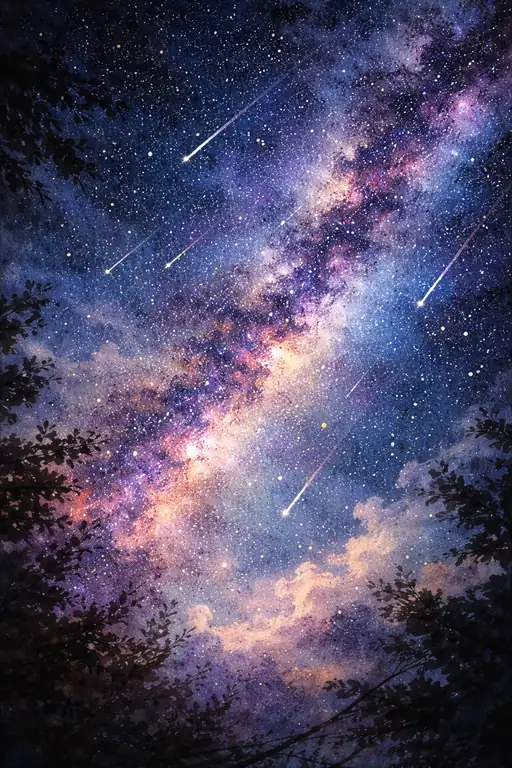 Galaxy Beyond the Clouds
 Shooting Stars Over the Milky Way
 A Cosmic Whisper in the Pines
 The Silent Watcher of the Cosmos
 A Fleeting Promise Across the Dark
 Dialogue with the Cosmos
 Midnight Soliloquy: The Moon's Deep Gaze