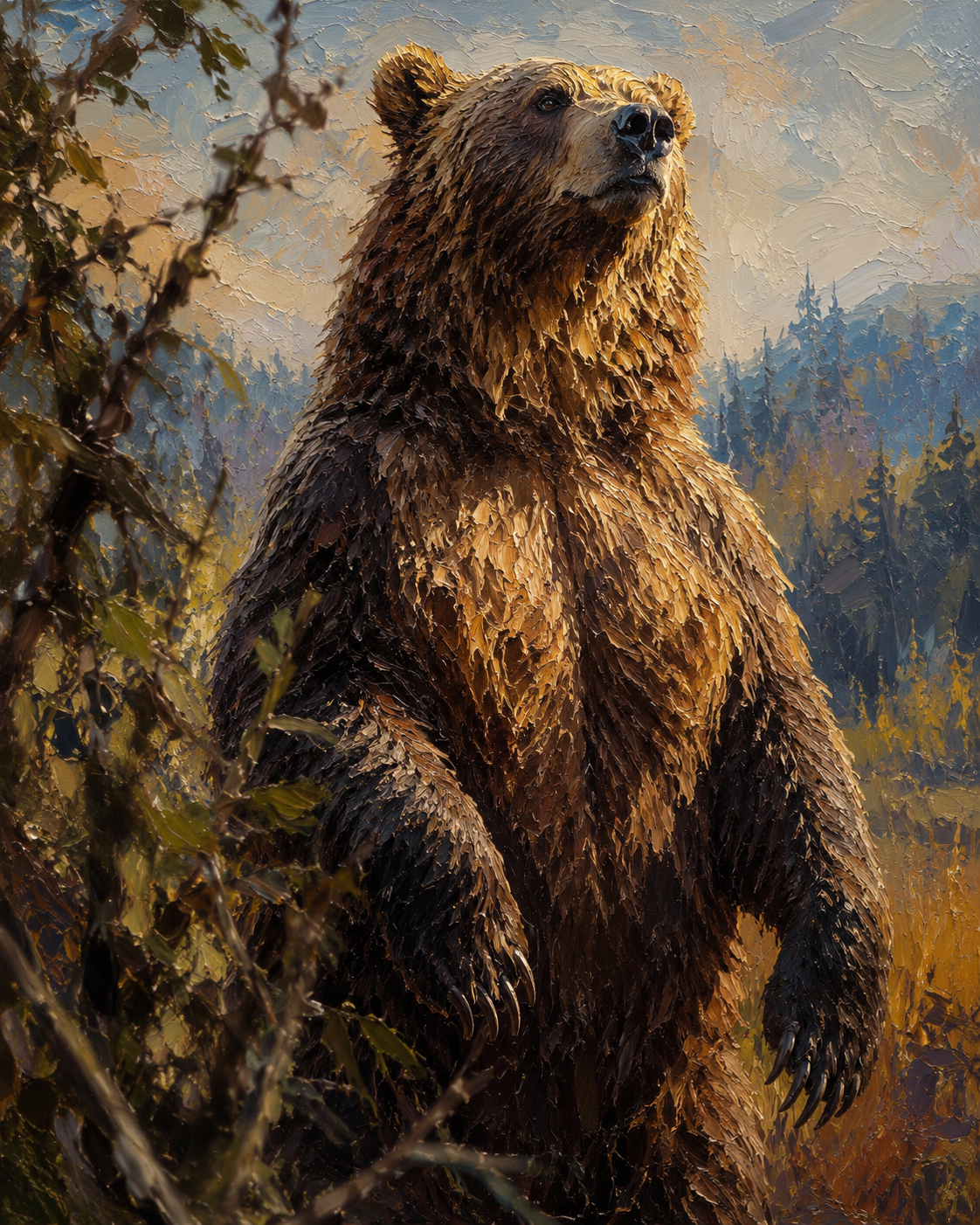
Sovereign of the Golden Forest
Critique
1. Introduction This vibrant oil painting captures a commanding moment in the wilderness, depicting a large brown bear standing on its hind legs within a dense forest. The artist utilizes a bold impasto technique, applying thick layers of paint to create a highly tactile and sculptural representation of the animal. Set against a backdrop of distant evergreens and a hazy sky, the work emphasizes the monumental presence of the bear and its alertness to its surroundings. By celebrating the physical properties of the oil medium, the piece offers a powerful exploration of the animal's raw strength and the rugged beauty of its natural habitat. 2. Description The central subject is a massive grizzly bear, rendered in a rich palette of burnt sienna, golden ochre, and deep umber. Its fur is composed of heavy, rhythmic brushstrokes that catch the light, suggesting a thick, undulating texture that covers its entire body. The bear's head is tilted upward and slightly to the right, with a dark nose and small, attentive eyes that suggest a keen sense of awareness. In the lower portion of the frame, its powerful front paws are visible, complete with sharp, dark claws. The background consists of a layered forest of bluish-green conifers that recede into a pale, golden-toned sky, while leafy branches frame the left foreground. 3. Analysis Technically, the painting is defined by its expressive use of texture, where the thickness of the paint creates actual physical depth and shadow on the canvas. The color palette is masterfully balanced between the warm, luminous tones of the bear's fur and the cool, atmospheric greens and blues of the forest. This contrast not only highlights the subject but also establishes a sense of spatial depth through color temperature. The strong vertical orientation of the bear, combined with the verticality of the surrounding trees, creates a sense of stability and grandeur. Light appears to be filtering through the forest canopy from the upper right, casting dramatic highlights on the bear's shoulder and head. 4. Interpretation and Evaluation The work successfully interprets the bear as a sovereign presence within the forest, moving beyond a simple naturalistic study to capture its inherent dignity. The choice of the impasto technique is particularly appropriate for this subject, as the heaviness of the paint mirrors the physical weight and power of the animal itself. Artistically, the piece is exceptional in its ability to maintain anatomical accuracy while embracing such an expressive and gestural style. The inclusion of the foreground branches provides a sense of depth and immersion, making the viewer feel as though they are observing the bear from a hidden vantage point. This painting is a testament to the enduring power of traditional media to convey the vitality of the natural world. 5. Conclusion In summary, the painting offers a visceral and visually arresting portrayal of a brown bear in its element. The initial impression of a powerful wildlife encounter is deepened upon closer inspection by the artist's sophisticated command of light, color, and texture. Through the deliberate build-up of pigment and the careful orchestration of compositional elements, the work achieves a rare balance between physical intensity and atmospheric realism. It remains a significant example of how a textural approach can be used to celebrate the weight and spirit of a subject, ultimately leaving the viewer with a lasting sense of the forest's untamed majesty.
Same Subcategory
 Shimmering Whiskers
Similar Artworks
 Echoes from the Edge of the World
 Monarch of the Golden Frost
 Dancing Shadows in the Morning Light
 Gentle Eyes in a Golden Kingdom
 Golden Reverie of the Fields
 Tender Embrace of the Bamboo Forest
 Monarch of the Winter Dawn
 Quiet Dignity in the Frost
 Guardian of the Sunlit Silence
 Fierce Shadows of the Untamed Forest