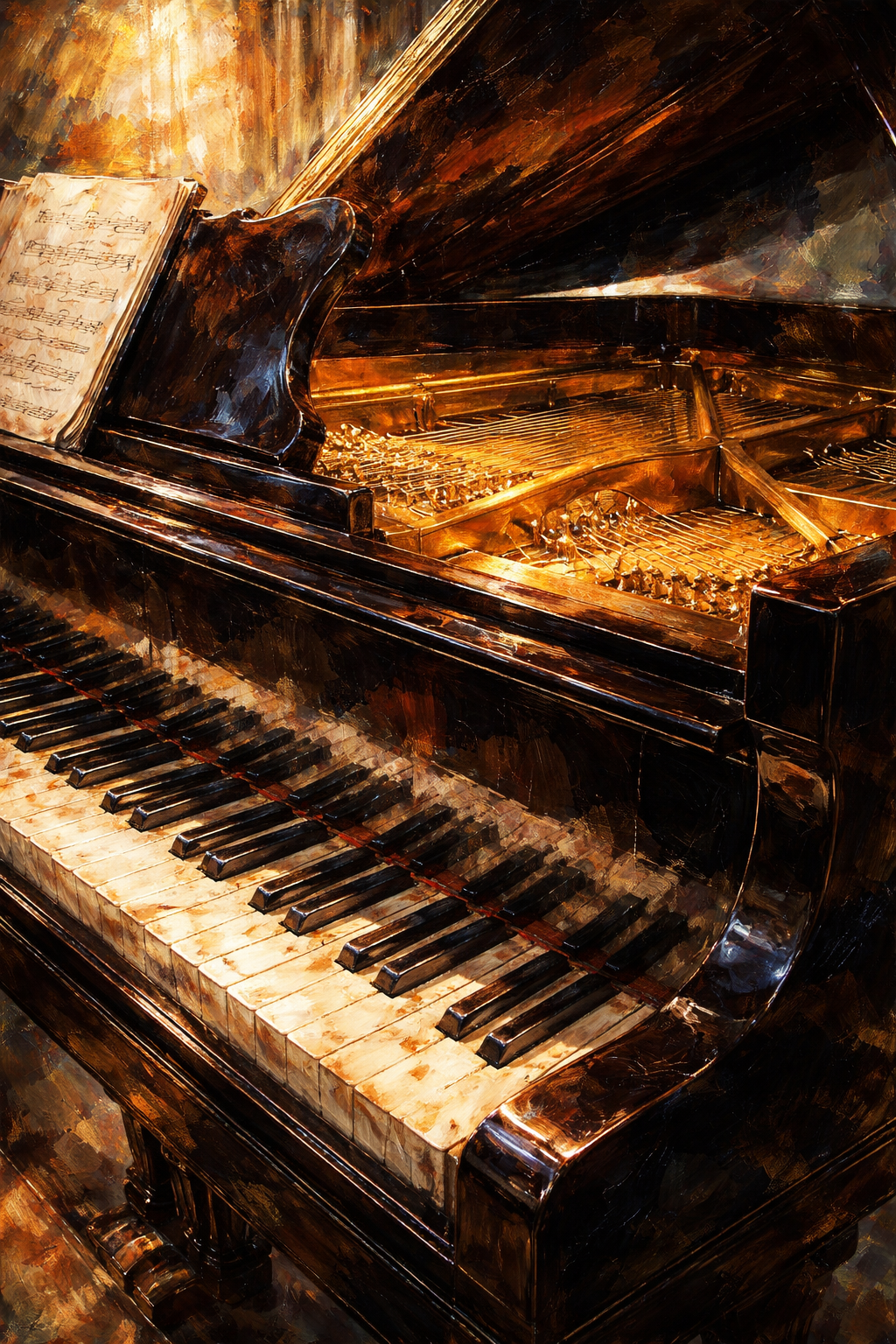
The Majestic Silence of the Keys
Critique
1. Introduction This painting presents a grand piano in an intimate and dynamic close-up, capturing the majesty of the instrument's form and its complex internal mechanism. The work emphasizes the tactile qualities of the piano, from the polished wooden exterior to the golden strings within. By focusing on these intricate details, the artist invites the viewer to appreciate the piano not just as a tool for music, but as a masterpiece of craftsmanship and a silent vessel for artistic expression. 2. Description The composition is dominated by the keys and the open lid of a grand piano. The black and white keys in the foreground show signs of wear and age, with subtle stains and variations in texture. Inside the open lid, the metallic strings and tuning pins glow with a brilliant golden light, reflecting the surrounding environment. A sheet of musical score rests on the stand to the left, its lines of notes partially obscured by the dramatic play of light and shadow that defines the instrument's interior. 3. Analysis The artist employs a vigorous, painterly style characterized by bold, directional brushstrokes that create a sense of movement. The color palette is rich and warm, featuring deep browns, burnt sienna, and brilliant gold, which contrast with the cool highlights on the piano's polished surface. Strong directional lighting from the upper left creates a dramatic chiaroscuro effect, emphasizing the depth of the piano's interior and the geometric rhythm of the keys. The perspective is steeply angled, enhancing the monumental presence of the instrument. 4. Interpretation and Evaluation The visible internal mechanism of the piano serves as a metaphor for the hidden complexity behind artistic performance. This juxtaposition of the external keys and the internal strings suggests the dual nature of music—both the physical action of playing and the ethereal resonance of sound. The technical execution is exceptional, particularly in the rendering of the reflective wooden surfaces and the glowing metallic strings. The artist successfully conveys a sense of history and gravitas, making the instrument feel like a living participant in a musical tradition. 5. Conclusion Through this focused study, the artist transforms a familiar musical instrument into a profound meditation on the beauty of complex structures. The harmony between the solid exterior and the delicate interior creates a compelling visual narrative about the nature of creativity. This painting reminds us that even in silence, a grand piano possesses a powerful and resonant presence. The initial observation of a musical instrument evolves into a deeper appreciation for the intricate relationship between form, function, and the potential for sound.
 The Silent Potential of Strings
 Golden Strings of Harmony
 Echoes of a Golden Melody
 Breath of the Woodwind
 The Cello's Golden Silence
 The Silent Song of Sunset
 Sunlit Morning Harmonies
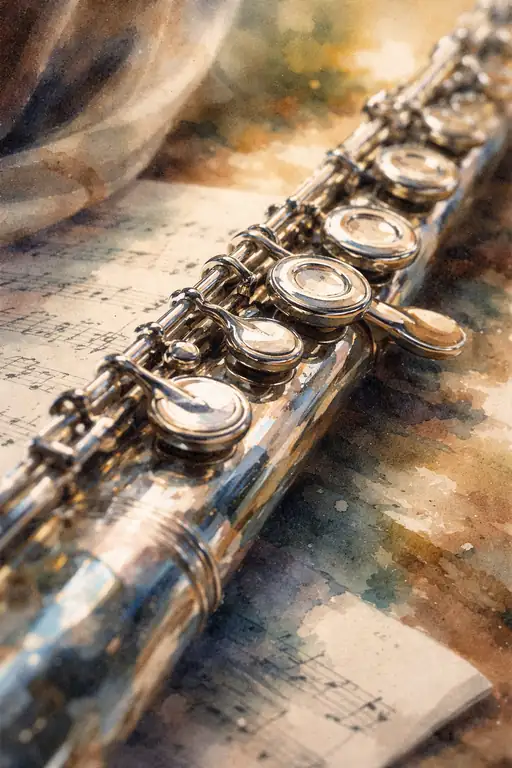 Sonata of the Silver Soul
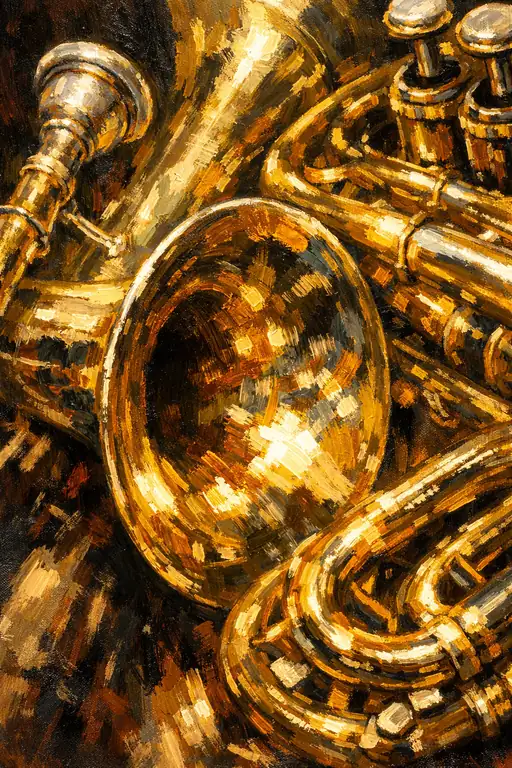 Resounding Symphony of Gold
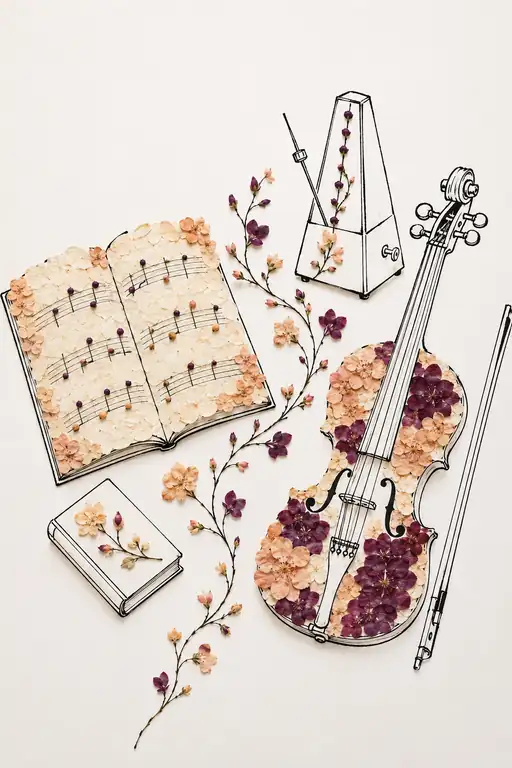 Violin of Petals and the Metronome of Beats