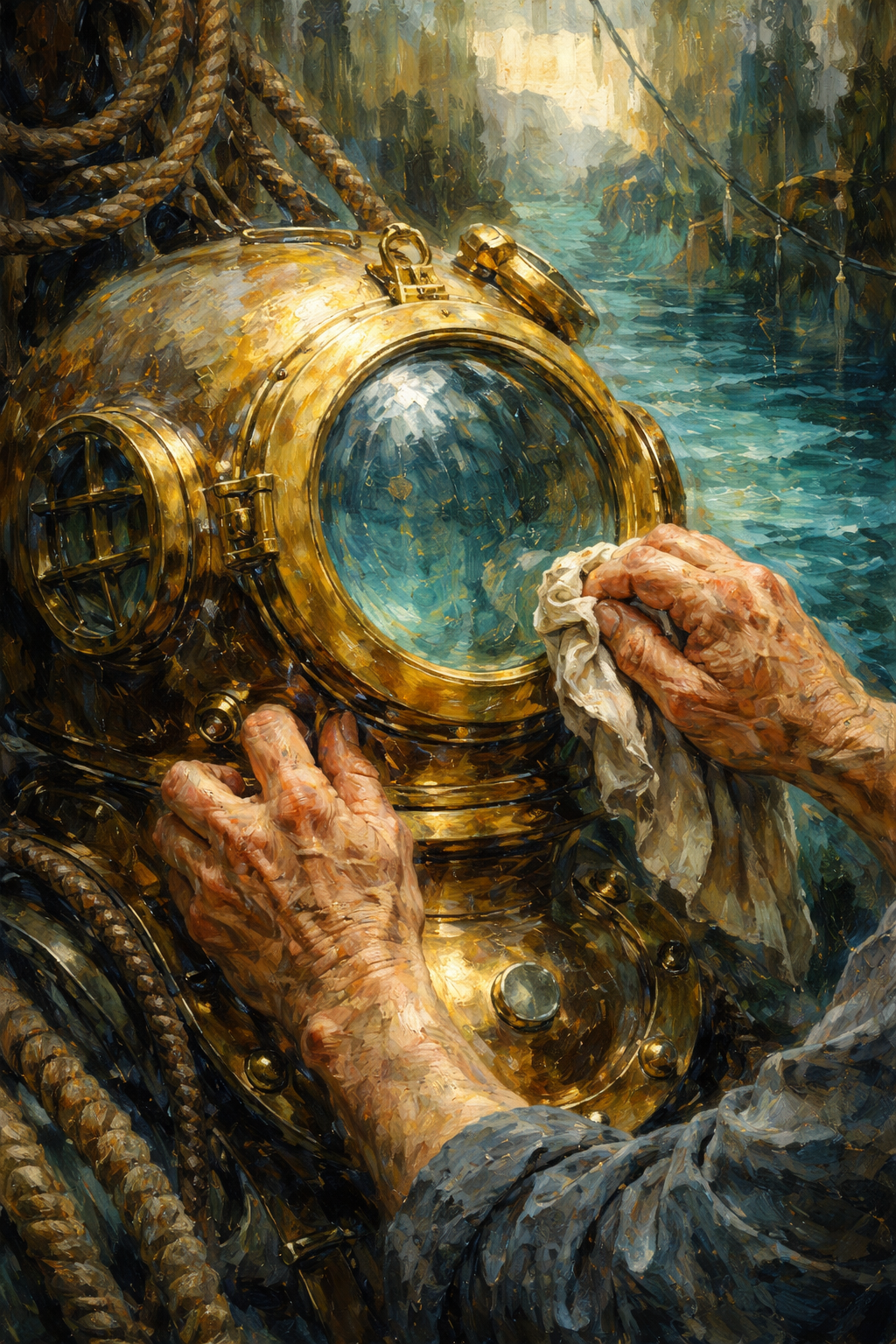
Echoes of the Abyss: Reviving the Ocean's Relic
Critique
1. Introduction This oil painting features a close-up view of a vintage brass diving helmet, being carefully tended to by a pair of weathered hands. Set against a backdrop of turbulent blue-green water and heavy ropes, the work captures a moment of preparation or maintenance. The painting emphasizes the rugged beauty of historical maritime equipment and the physical labor associated with it. 2. Description The focal point is the large, circular glass window of the helmet, which reflects the surrounding water. The hands are depicted with deep wrinkles and a tan complexion, one hand resting on the side while the other uses a white cloth to wipe the glass. Thick, coarse ropes are coiled in the upper left, and the background consists of abstract, vertical strokes of teal and grey, suggesting a dock or a ship's interior near the sea. 3. Analysis The artist employs a heavy impasto technique, where thick layers of paint create a tactile surface that mimics the weathered texture of the helmet and the skin. The color palette is dominated by warm ochre and gold for the metal, contrasted sharply with the cool, aquatic tones of the background. The lighting highlights the top of the helmet, creating a strong sense of volume and directing the viewer's eye to the central interaction between the hands and the glass. 4. Interpretation and Evaluation This work is a compelling study of texture and material. The choice to focus on the hands adds a human element to the industrial subject, evoking themes of craftsmanship and the relationship between man and machine. The technical execution of the metallic reflections is particularly noteworthy, as it conveys the weight and age of the equipment without relying on fine lines. The composition is dynamic, using the diagonal lines of the arms and ropes to create a sense of tension. 5. Conclusion What initially appears as a straightforward depiction of an object transforms into a rich narrative about maritime history and human touch. The painting succeeds in elevating a functional piece of equipment to a subject of artistic reverence. Ultimately, the work provides a powerful sensory experience that honors the legacy of deep-sea exploration.
Same Subcategory
 Breathing Life into Unyielding Stone
Similar Artworks
 Polishing the Echoes of Time
 The Master's Touch: Awakening the Azure Bloom
 Polishing the Dream: The Silent Labor of a Future Knight
 The Artisan's Devotion in Silver and Gold
 The Artisan's Gaze: Adjusting Gears in an Antique Workshop
 Floating Sanctuaries
 Prayer in the Grain
 The Watchmaker's Infinite Patience
 Bathed in the Amber Glow of Labor
 Gentle Hands of the Blue Heritage