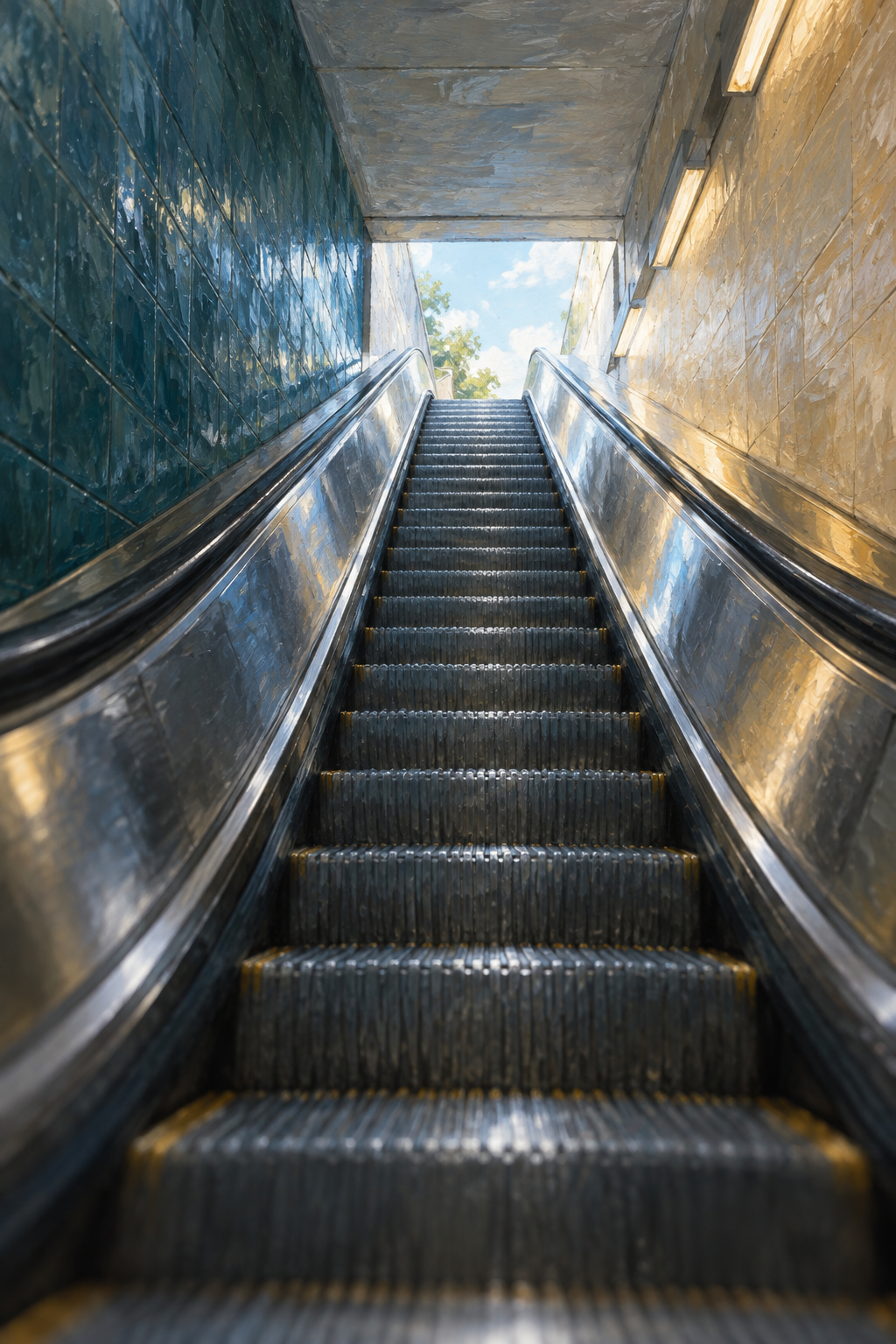
Ascent Toward the Open Sky
Critique
Introduction This painting looks up an empty escalator toward a rectangular opening of daylight. The centered viewpoint gives an ordinary passage a clear directional purpose. Dark steps rise between reflective side panels, while contrasting walls transform the enclosed ascent into a study of perspective, repeated structure, and changing illumination. Description Deep teal tiles line the left wall, and cream-colored tiles occupy the right beneath elongated lights. Black handrails follow the sloping metal sides. Closely spaced ridges articulate the steps, with small yellow edges marking their limits. At the top, pale blue sky, white clouds, and fragments of green foliage appear. Analysis Converging rails and diminishing step intervals carry the eye toward the opening. The ceiling's broad horizontal divisions slow this upward movement and emphasize enclosure. Cool blue reflections on the left oppose warm gold reflections on the right, allowing the metal panels to gather both sides of the corridor into their surfaces. Interpretation and Evaluation The absence of people directs attention to the experience of passage itself. Daylight and foliage suggest a transition from built interior to open air, grounded in the visible change of space. The composition is deliberately regular, but varied reflections and textured wall surfaces prevent its symmetry from becoming entirely mechanical. Conclusion What initially seems a straightforward view of transport becomes an organized progression from darkness toward brightness. Repeated treads establish distance through gradual compression, while the side panels connect architecture with light. The image gives a familiar route visual significance through measured geometry, contrasting color temperatures, and an unobstructed destination.
Same Subcategory
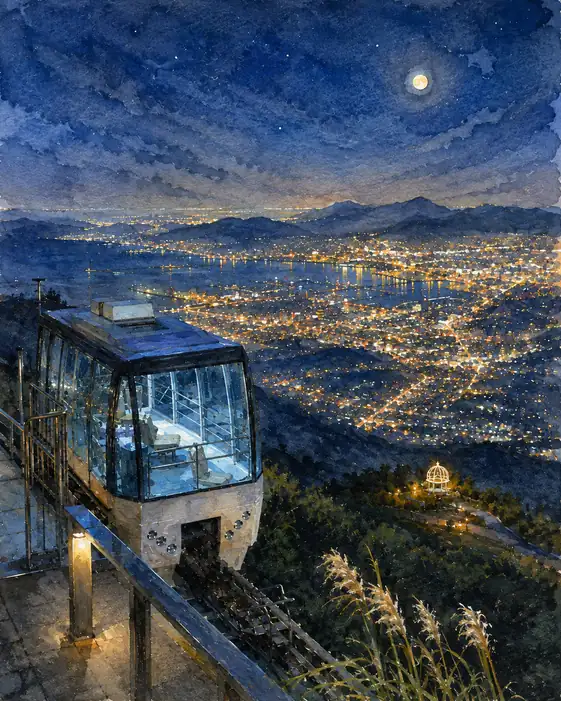 As Night Deepens, Toward the Traces of Dreams, a Sea of Light
Similar Artworks
 The Mountain Waiting Beyond the Circle
 Where All Journeys Pause
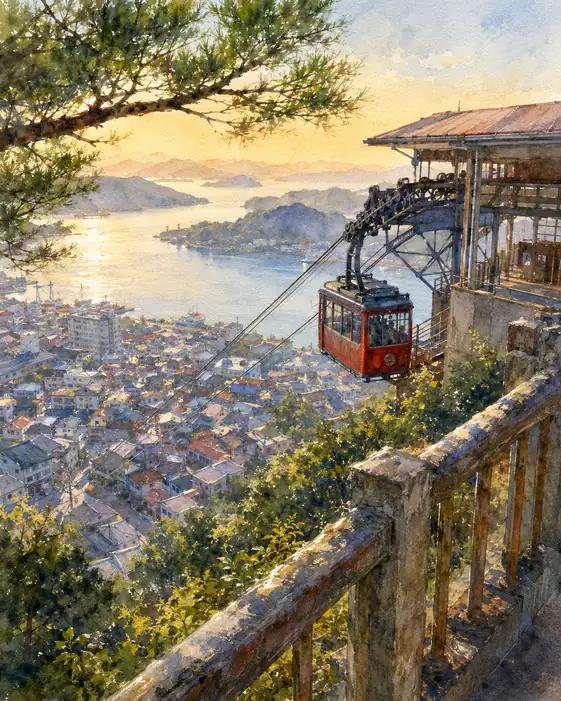 Where the Red Bird Flies Over a Sea of Light
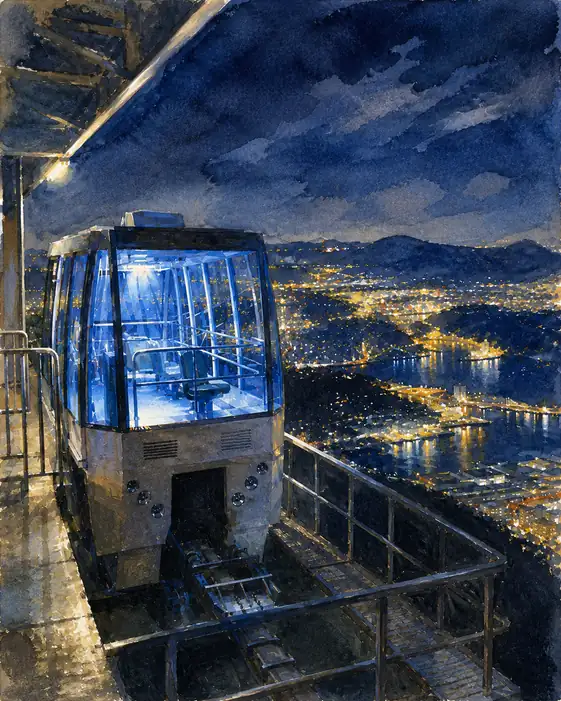 Nocturnal Glow and the Hillside Car
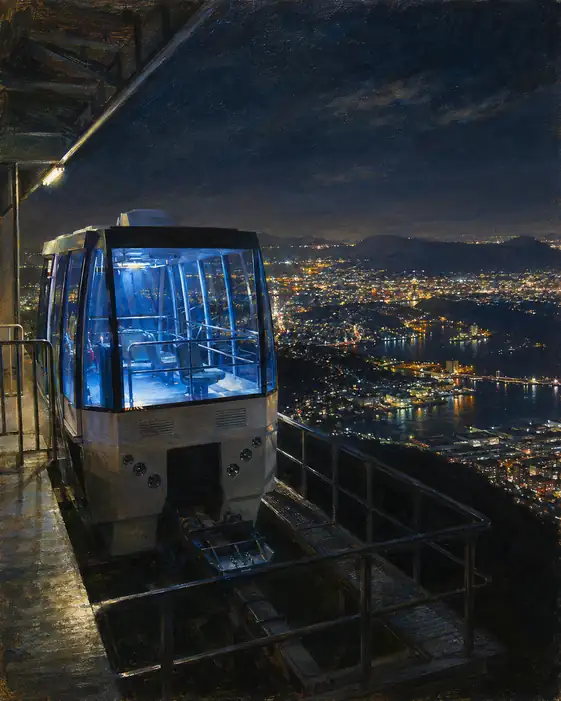 Azure Car at the Mountaintop Terminal
 The City Glows in a Cobalt Window
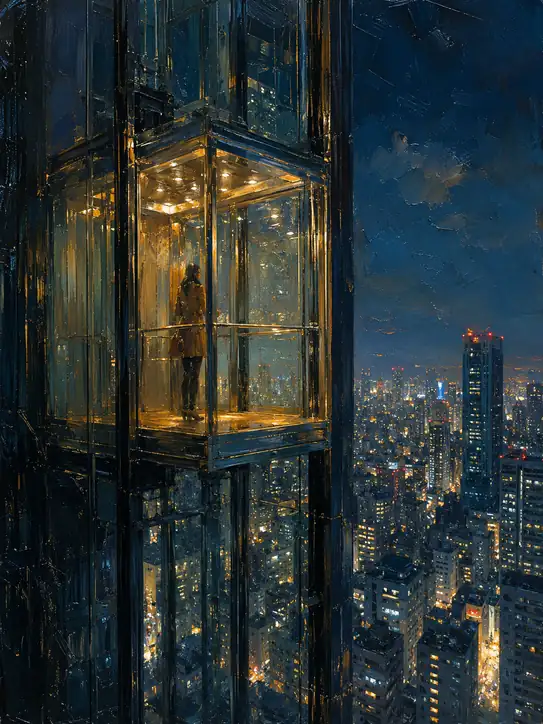 A Silent Journey Above the Night
 Walking in the Shadow of the Giant
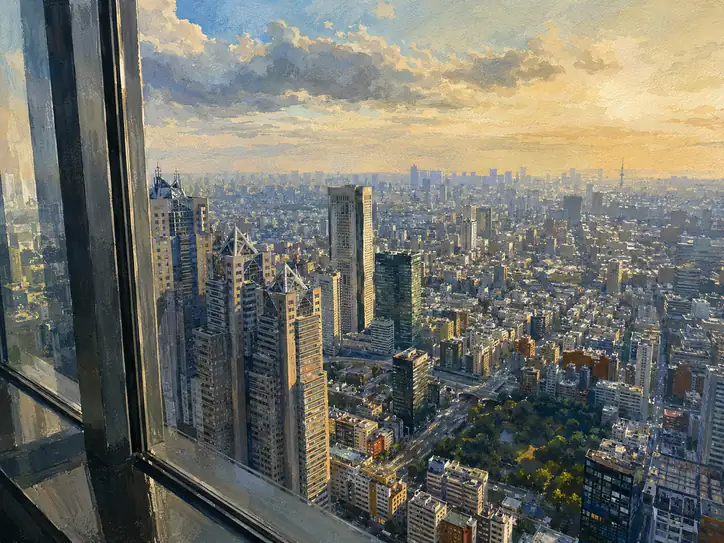 Echoes of a Gilded Metropolis
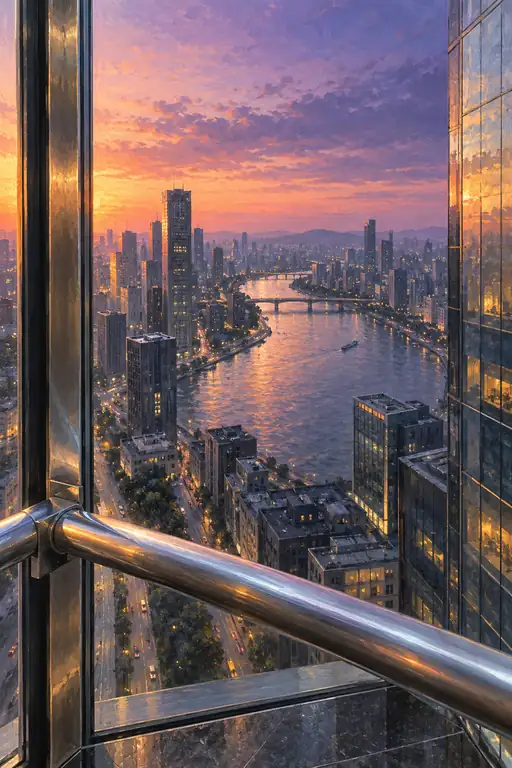 Amber River of the High Terrace