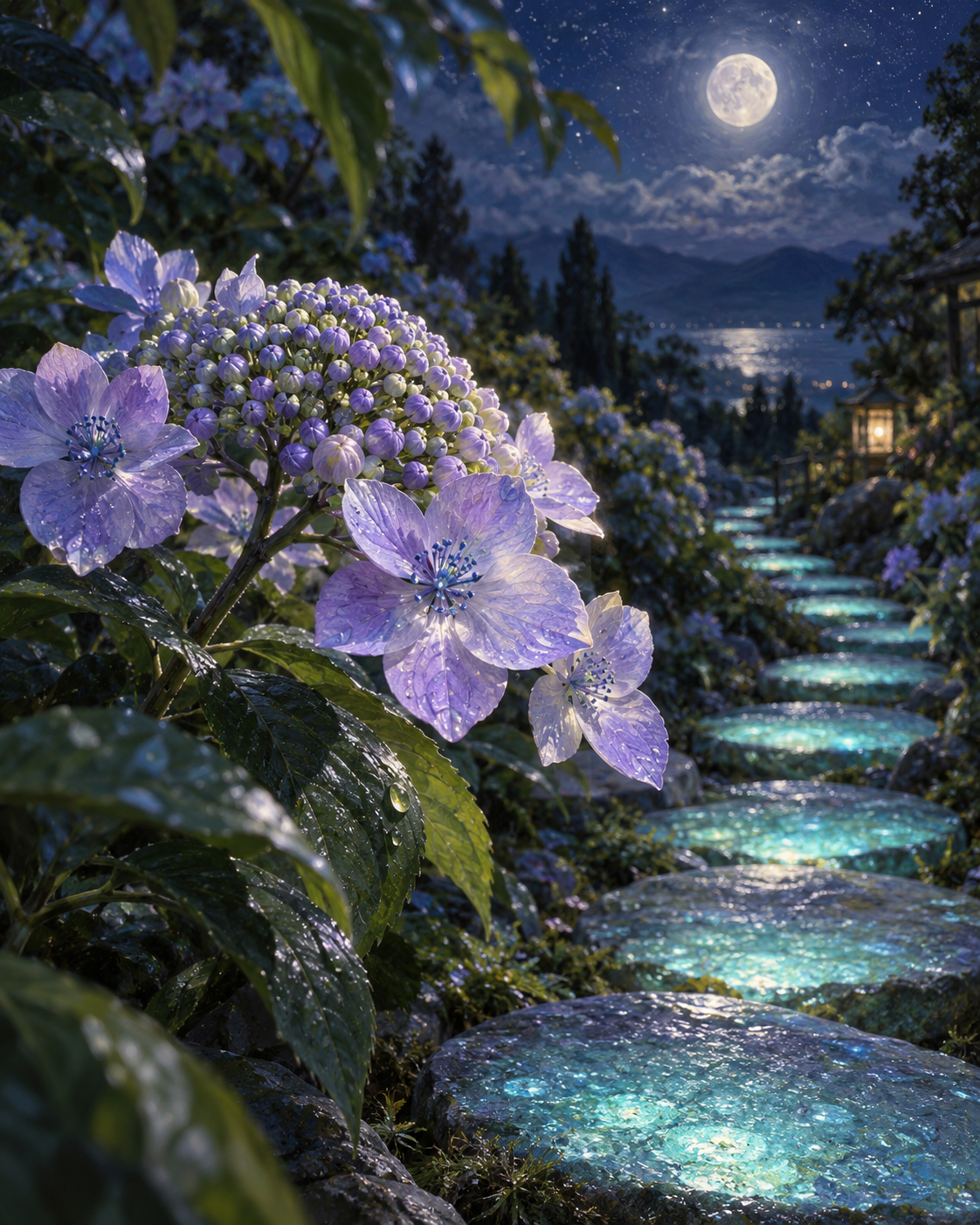
Moonlit Path of Glowing Stones and Hydrangeas
Critique
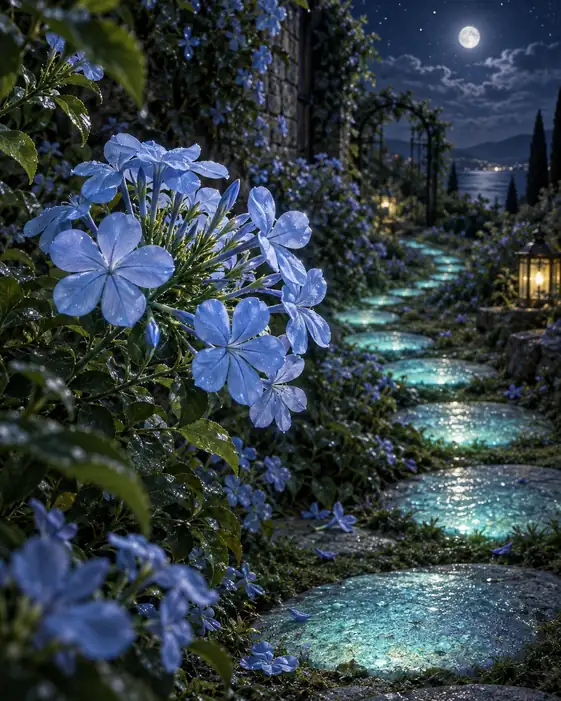
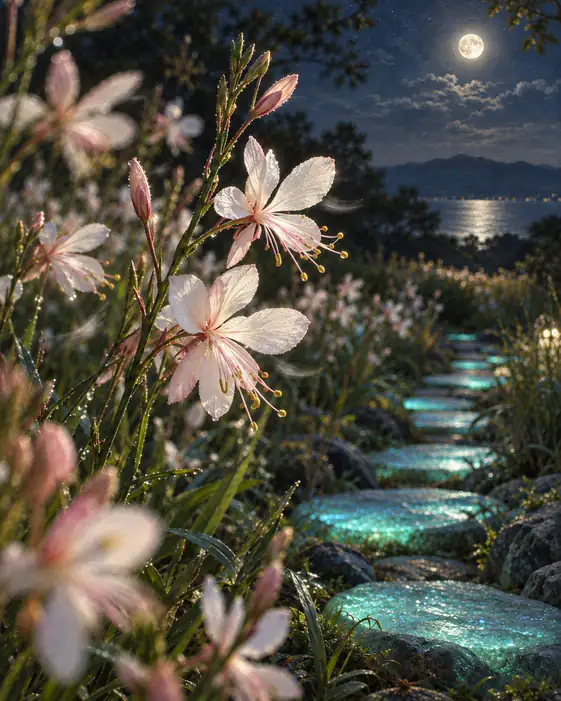
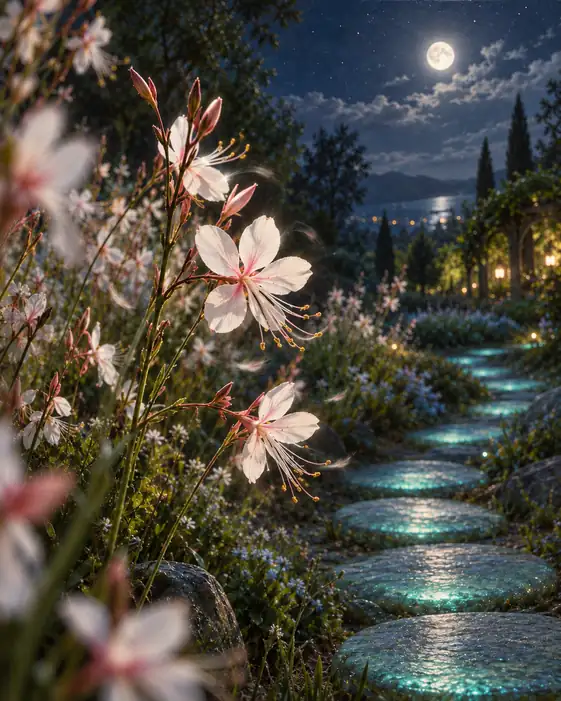
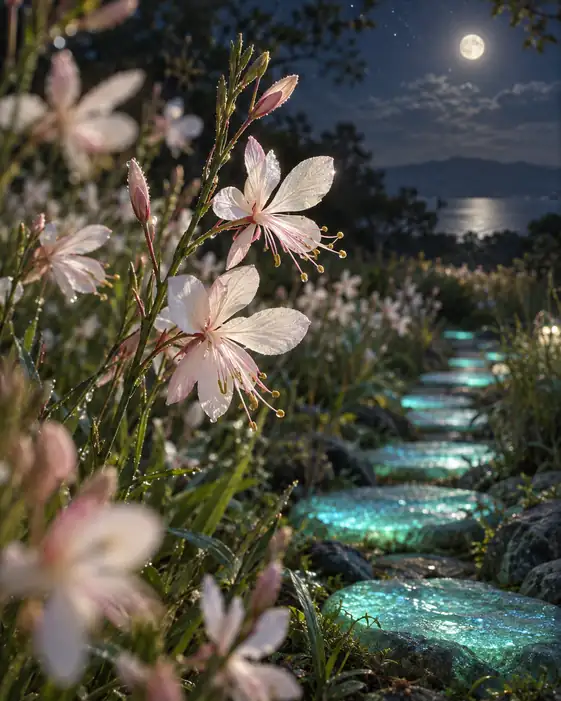
1. Introduction This moonlit garden places a lacecap hydrangea beside a long sequence of turquoise stepping stones descending toward a lake. The scene combines abundant floral detail with a strongly directed route, making contemplation feel like physical travel through darkness. 2. Description Lavender sepals and a dense dome of green-purple buds fill the left foreground above wet, serrated leaves. Broad rounded stones begin near the lower right and diminish toward the center, each holding blue-green light. Lanterns glow beside the path among rocks and flowers. Beyond dark cypress-like trees lies a lake reflecting the full moon, with mountains and shoreline lights beneath a clouded, starry sky. 3. Analysis The hydrangea provides a bright mass against the stones' deep recession. Buds, stones, lanterns, moon, and reflection repeat circles at several scales. Turquoise links path to water, while amber marks human intervention. Nearby stone and leaves are tactile; distance softens toward mountains. The central curve prolongs visual travel. Dark foliage frames the moonlit opening. 4. Interpretation and Evaluation The stones illuminate steps but not the destination, proposing knowledge as gradual revelation. Many hydrangea buds remain closed beside open sepals. The path leads toward reflective water, shifting from solid footholds to an unstable sky image. Lanterns offer familiar guidance, while turquoise seems to arise from earth. Moisture coherently distributes every glow. The large flower preserves intimacy within nocturnal breadth. 5. Conclusion By coordinating botanical stages, successive stones, and the moon's distant reflection, the work turns a garden descent into a meditation on partial knowledge. Its rhythmic circles and wet luminosity make each visible step feel sufficient, even when the route beyond remains uncertain.
Same Subcategory
Similar Artworks
 Moonlit Garden, Aquamarine Stones and Hydrangeas
 Night Blooming Princess Flower, Path of Glowing Stones
 Moonlit Promenade of Azure Blooms
 Luminous Steps in the Night Garden
 Luminescent Stepping Stones
 Moonlit Path of Glowing Stepping Stones
 Moonlit Trail of Emerald Stones
 Moonlit Stepping Stones to the Deep
 Sanctuary Along the Moonlit Path
 Luminescence in the Dewlit Quiet