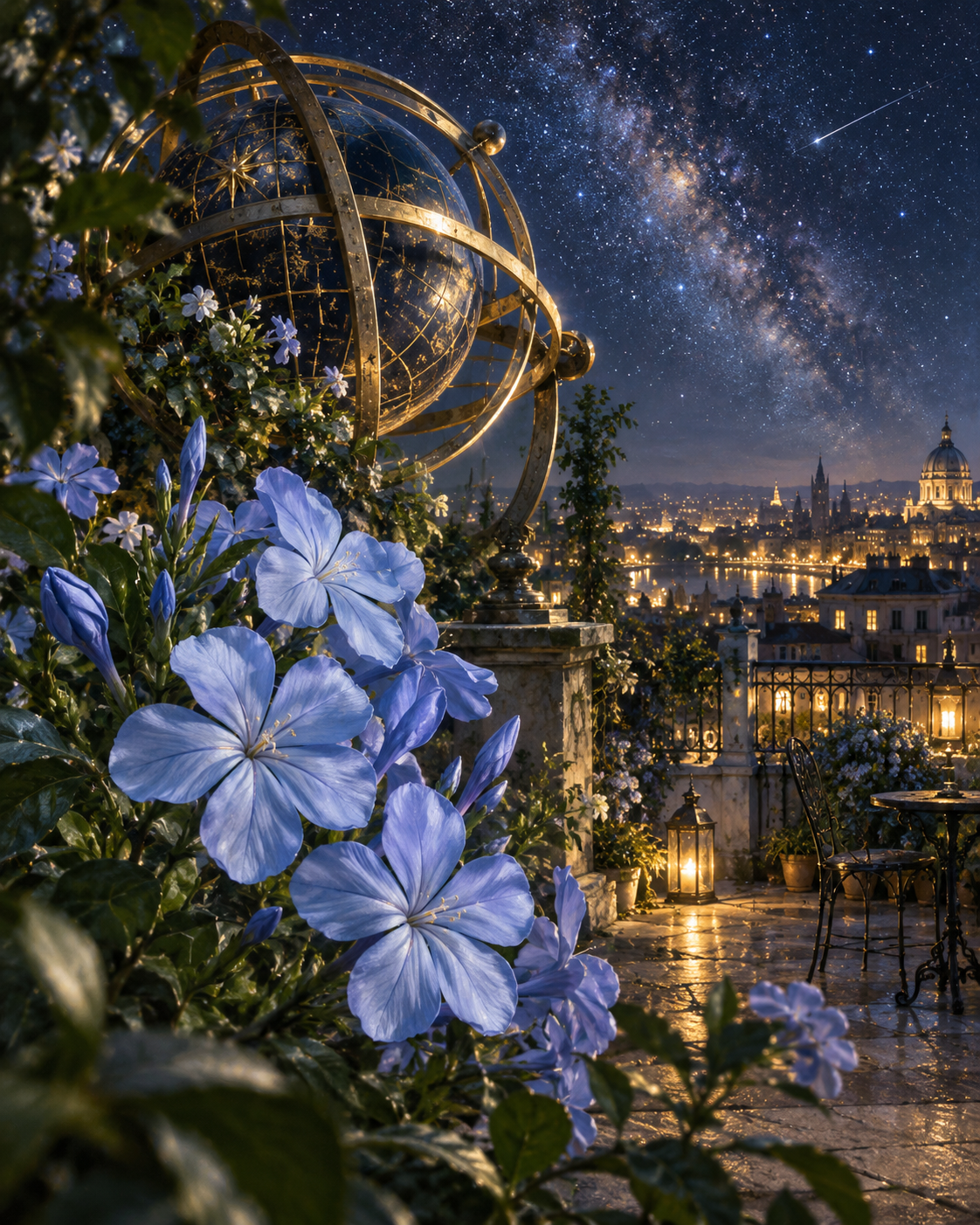
Nocturne on the Starlit Terrace
Critique
1. Introduction This elevated night garden pairs a monumental armillary sphere with blue flowers, a luminous city, and the Milky Way. Instruments of imagined measurement meet an unbounded sky, turning the terrace into both observatory and intimate retreat. 2. Description Large pale-blue blossoms rise across the lower left beneath a dark globe encircled by gilded rings and markings. Wet paving leads past a lantern to a small table and chair. Beyond an iron railing, a river curves through a dense city of warm windows, towers, and a bright domed building. Stars crowd the sky, where the galactic band and a meteor appear overhead. 3. Analysis The sphere dominates the upper left, balanced by the distant illuminated dome. Its circles contrast with the city's spread and echo flower centers and celestial orbits. Blue petals mediate between foliage and indigo sky. Gold travels from metal rings through lantern reflections to urban lights, linking depth. Overlap, diminishing buildings, and haze create recession. The meteor's diagonal releases the circular composition into open space. 4. Interpretation and Evaluation The sphere embodies a wish to map the heavens, yet the stars exceed its frame. Measurement becomes a beautiful form of attention rather than failed mastery. Flowers overgrow the instrument, placing organic time beside astronomical order. An empty chair invites contemplation, while the city shows collective life below. Blue and gold organize abundant detail, keeping the result learned but warm and spectacular yet human. 5. Conclusion By threading circular forms and shared light through garden, instrument, city, and sky, the work unites observation with wonder. It presents knowledge as a hospitable terrace: structured enough to orient us, yet open to immensities beyond any diagram.
Same Subcategory
Similar Artworks
 Armillary Sphere and the Midnight Amaranth
 Observatory of Celestial Blue
 Nocturne of the Celestial Wheel
 Luminous Steps in the Night Garden
 Station of Stars and Rain
 Celestial Chart Beyond the Scented Window
 Moonlit Promenade of Azure Blooms
 Pages of Light in the Twilight Study
 Constellation Window and Glowing Crocuses
 Luminous Pages, Twilight Study and Hydrangeas