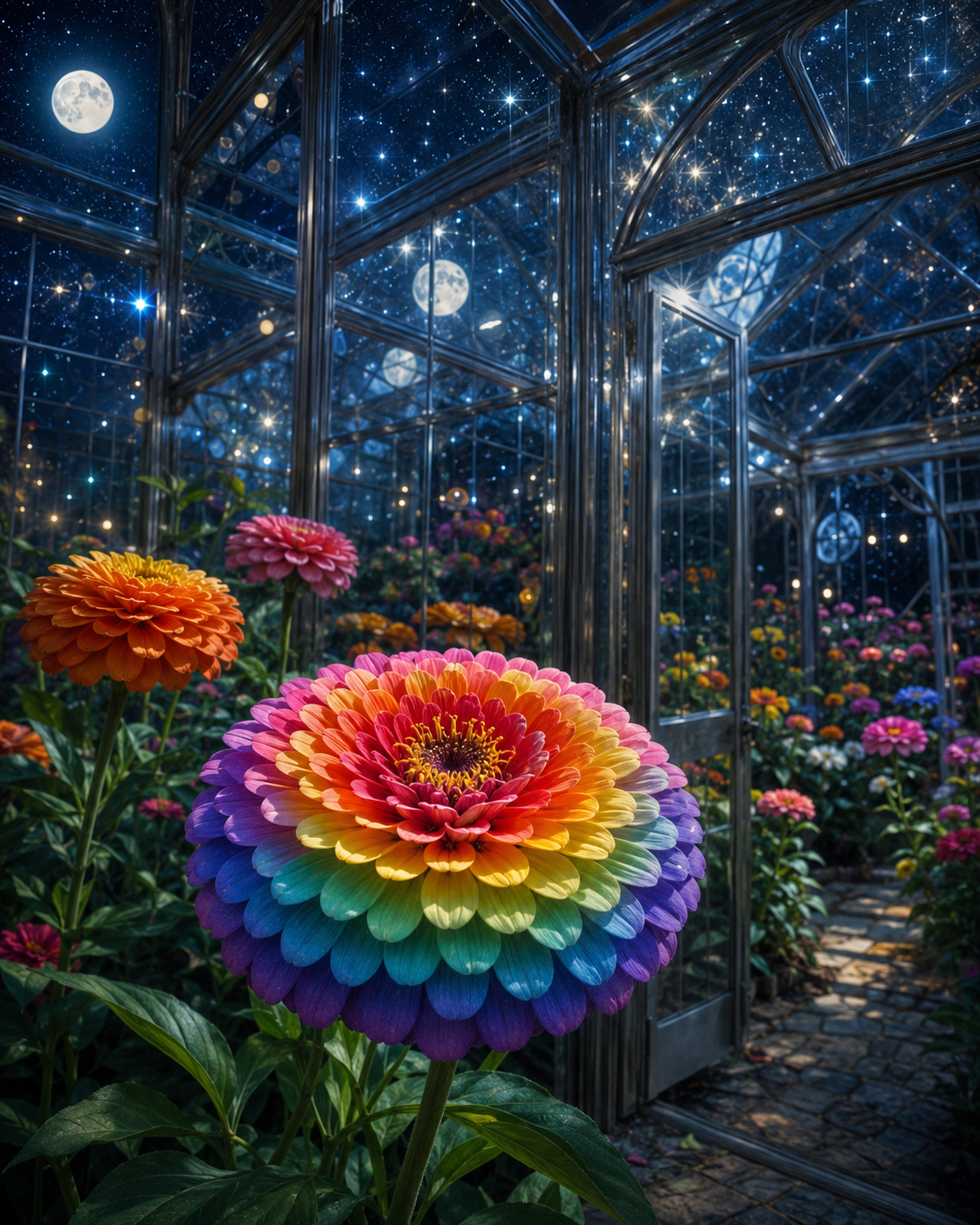
Prism Under a Mirrored Moon
Critique
1. Introduction This moonlit glasshouse places a large rainbow-colored flower within a maze of reflective metal frames and open doors. The bloom fills the lower center, while repeated panes multiply the moon and stars above. Botanical color, transparent architecture, and celestial reflections create a complex but ordered nocturnal interior. 2. Description Concentric petals shift from violet and blue through green, yellow, orange, and red toward a dark center. Smaller orange, pink, and yellow flowers fill beds behind it. Tall glossy mullions, pointed roof frames, and an open glass door divide the space. Several apparent moons and countless star points appear across overlapping panes and reflections. 3. Analysis The frontal circle of the flower contrasts with the angular greenhouse grid. Petal bands concentrate the spectrum, while blue-black glass disperses white and gold lights. The open door creates a narrow route into the right background, and repeated frames establish layered depth. Dark leaves ground the luminous bloom; metal reflections echo the crisp edges of its petals. 4. Interpretation and Evaluation The glasshouse becomes an optical instrument as well as a shelter, multiplying the sky around cultivated plants. The rainbow flower seems to condense colors implicit in the reflected night. The structural perspective, mirror logic, saturated yet controlled palette, and rendering of petals, leaves, glass, and metal are technically accomplished. Complexity remains navigable through the open doorway. 5. Conclusion At first the multicolored bloom dominates as a singular marvel, but the multiplied moons gradually make perception itself the larger subject. The image becomes a study of seeing through and across surfaces. Through clear geometry and layered reflection, it links protected growth to an apparently limitless night.
Same Subcategory
 Lantern Light in the Greenhouse Garden
Similar Artworks
 Gothic Conservatory Under the Harvest Moon
 Constellation in the Glass Pavilion
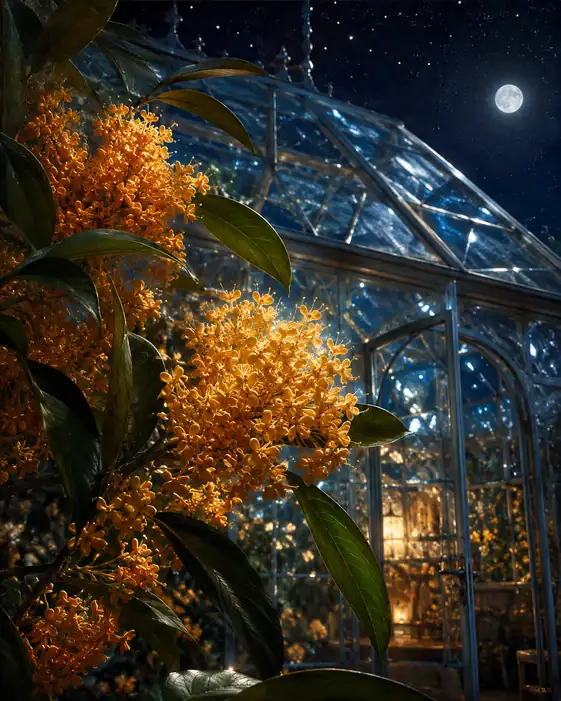 Threshold of the Moonlit Glass
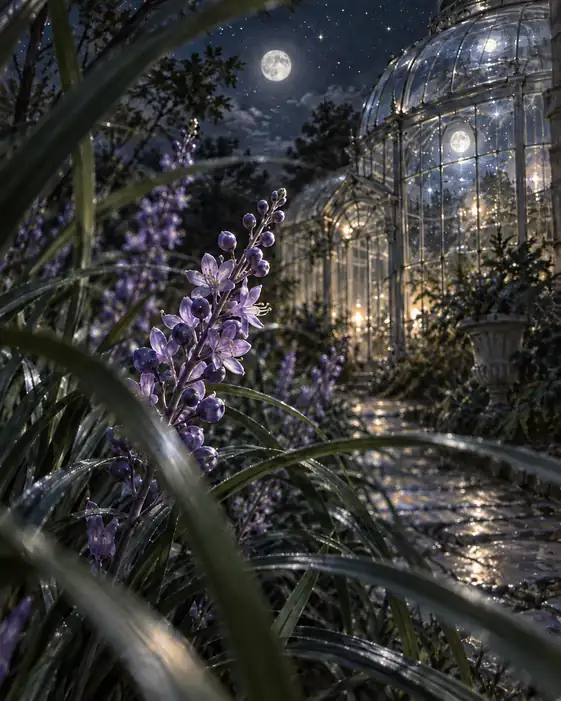 Palace of Starlight and Glass
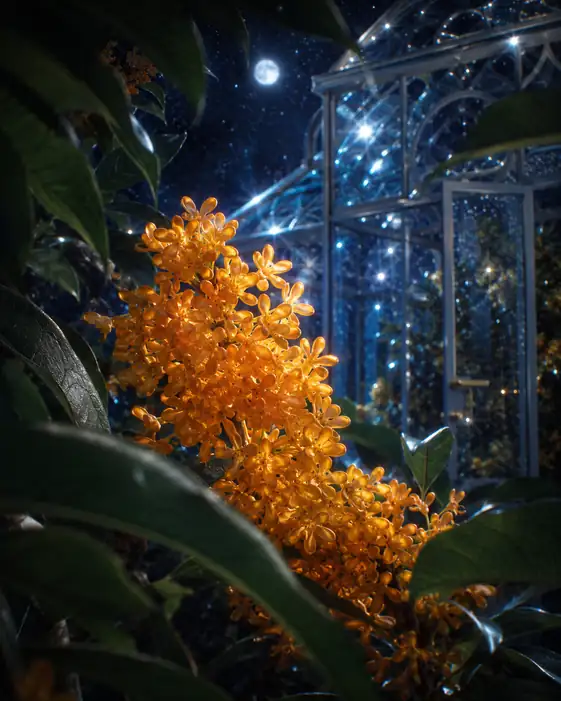 Amber Bloom Beneath the Midnight Glass
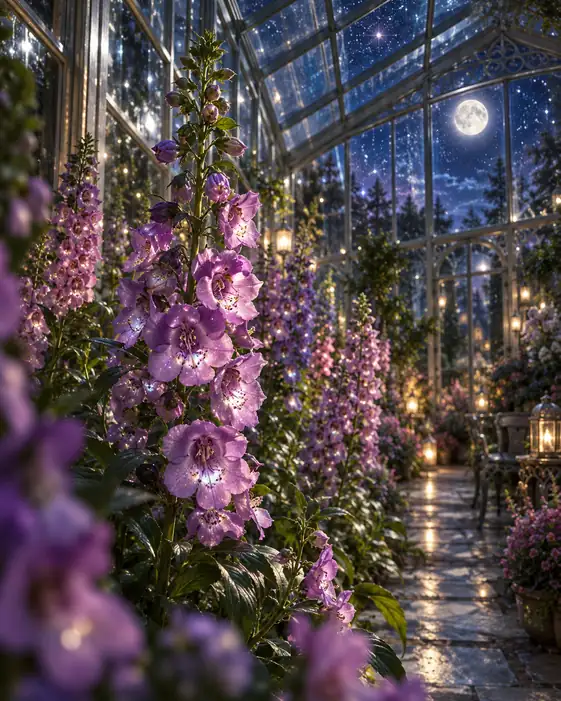 Constellations Within the Glasshouse
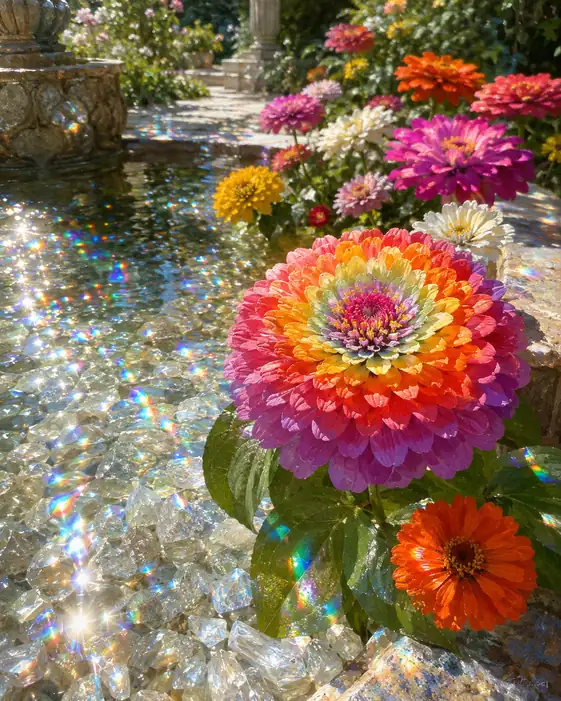 Prisms Across the Crystal Fountain
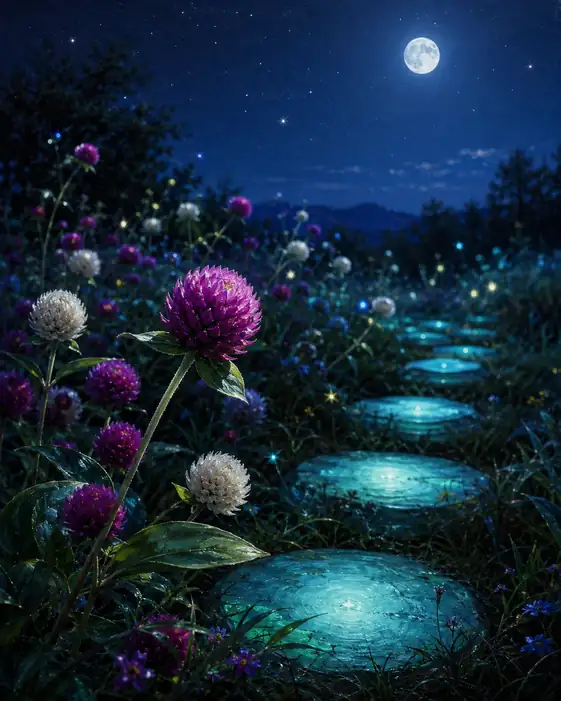 Luminous Path and the Midnight Blooms
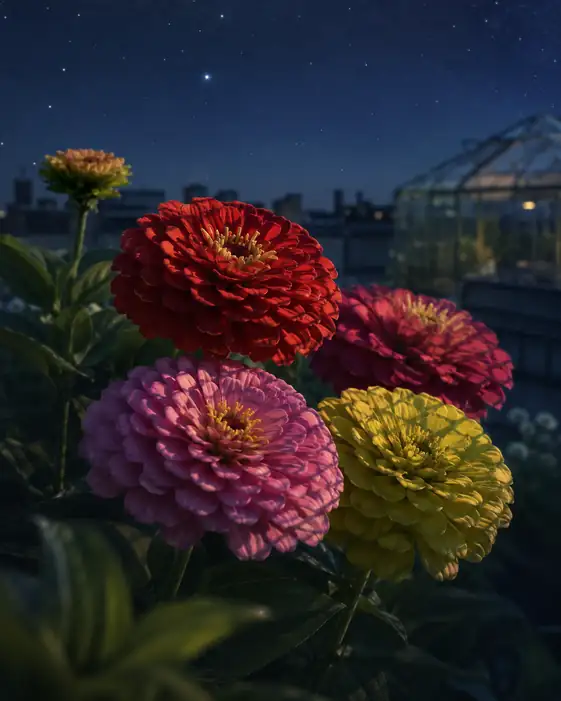 Zinnias beneath the Starlit Sky and Greenhouse
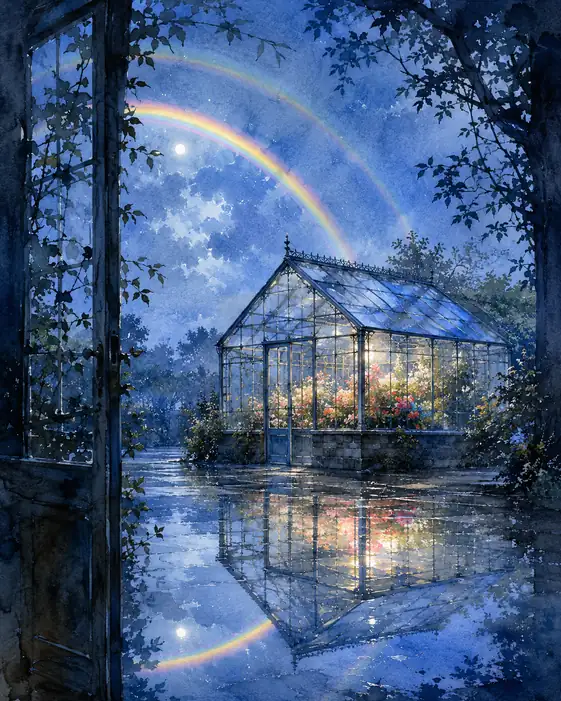 The Moonbow Greenhouse at Midnight