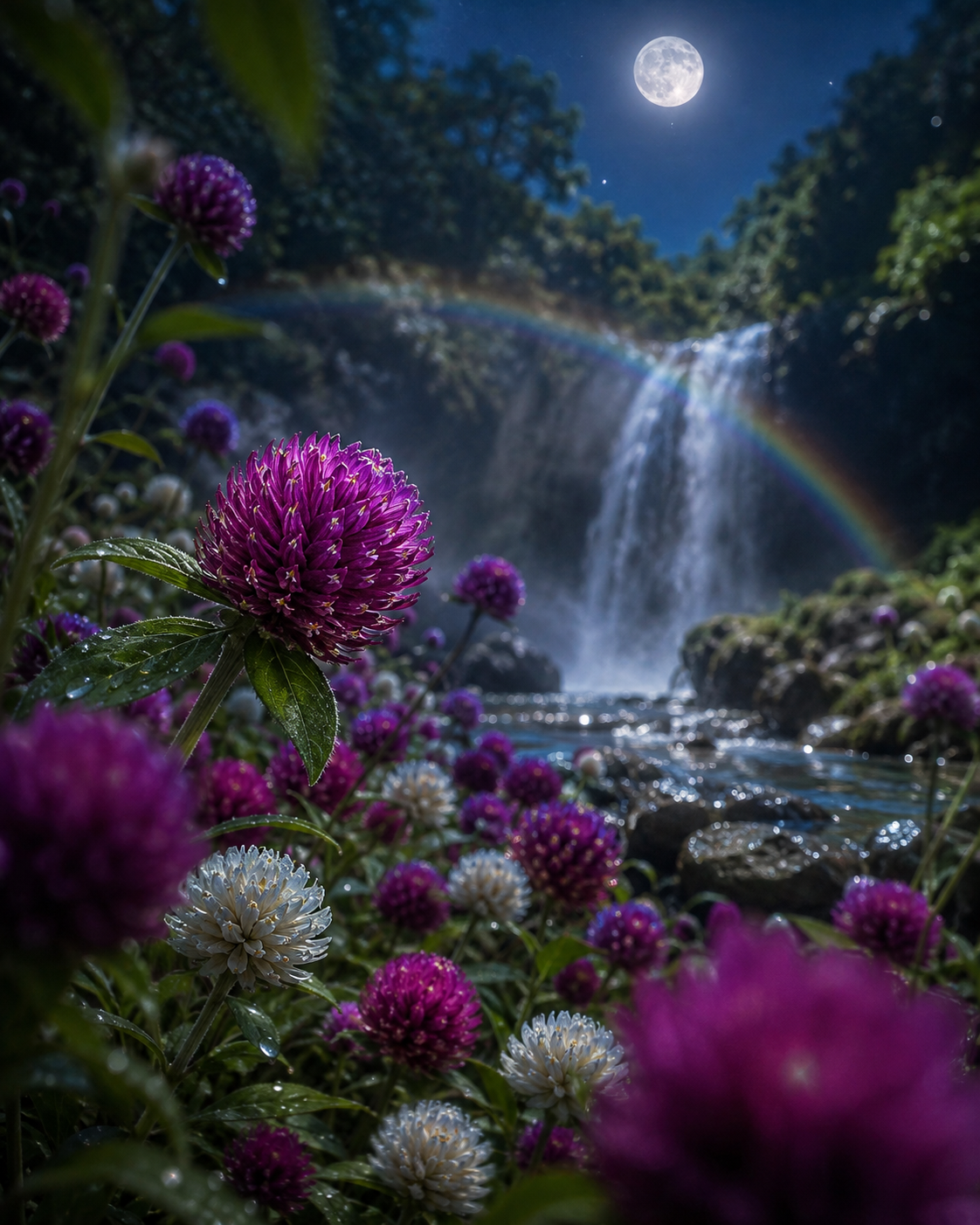
Nocturne in Lunar Prisms
Critique
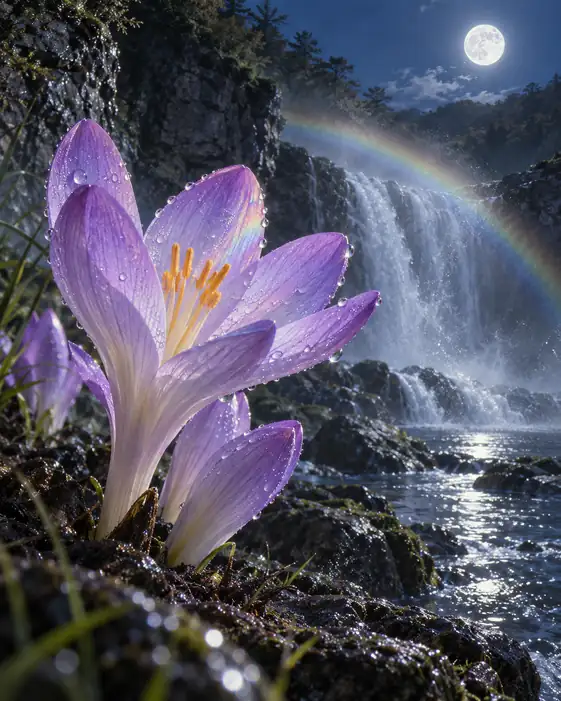
1. Introduction This moonlit waterfall scene places purple and white globe flowers throughout a wet rocky foreground. The largest violet bloom rises at left center, while a broad fall descends beneath the full moon and a rainbow crosses its mist. The work relates detailed garden-scale life to a powerful landscape event. 2. Description Round blossoms stand on slender stems among glossy leaves and dark stream rocks. The main flower carries pointed violet bracts tipped by tiny pale centers, and cream blooms punctuate the lower field. Water drops from a wooded ledge into a shining river. A faint rainbow arcs from left foliage through the falls toward the right bank. 3. Analysis The rainbow’s curve spans the horizontal middle, while the waterfall provides a bright vertical axis. The main stem leans upward toward their intersection. Purple concentrates spectral color; white flowers repeat moon, spray, and water highlights. Blurred blooms at both lower corners frame a sharp middle distance, and wet reflections lead from plants into the current. 4. Interpretation and Evaluation The flowers appear to receive in miniature the light dispersed by the mist. Moon, rainbow, fall, and droplets present a sequence of illumination across different scales and states of water. The focal hierarchy, cool palette, botanical surfaces, rock weight, and flowing water are technically controlled. The rainbow remains integrated rather than ornamental because its source is visibly supported by spray. 5. Conclusion At first the falls and moon seem to define the spectacle, but the prominent flower gradually gives the event a close, bodily scale. The image becomes a study of how distant forces register on small living forms. Through layered moisture, directional curves, and restrained spectral color, it balances wonder with precise natural observation.
Same Subcategory
Similar Artworks
 Moonbow Over the Falls and Wild Amaranth
 Dewdrops Under the Moonbow
 Moonbow Over the Midnight Falls
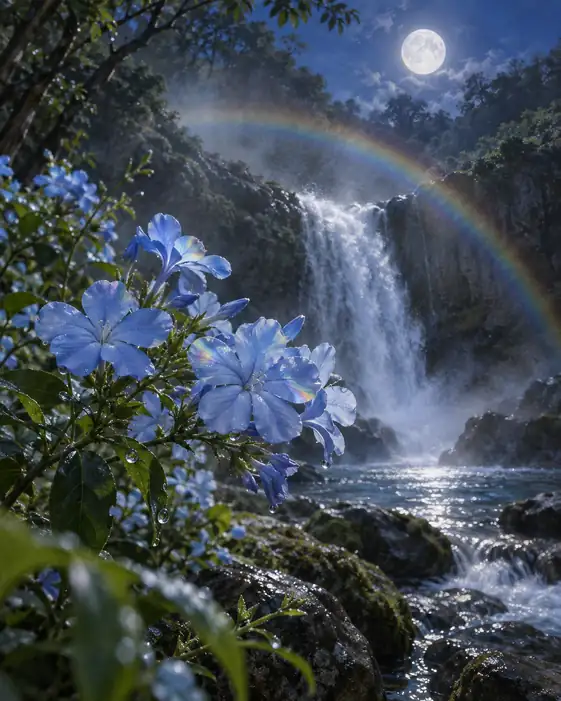 Moonbow Over the Falling Mist
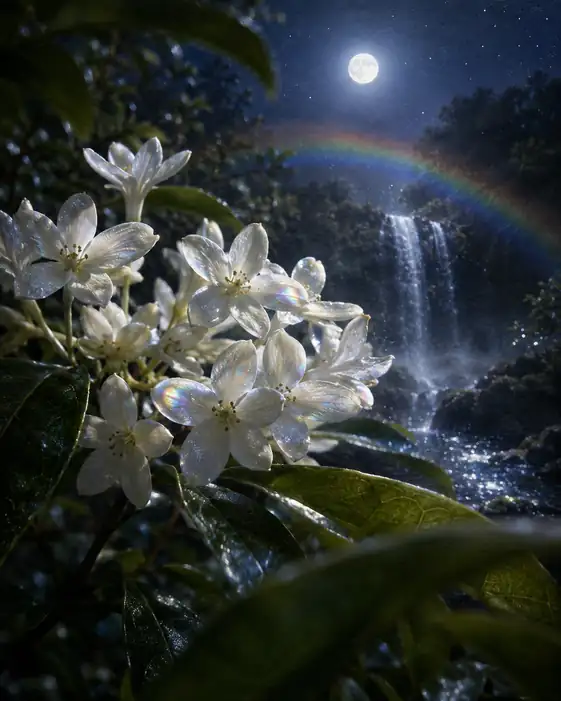 Lunar Rainbow and the Iridescent Petals
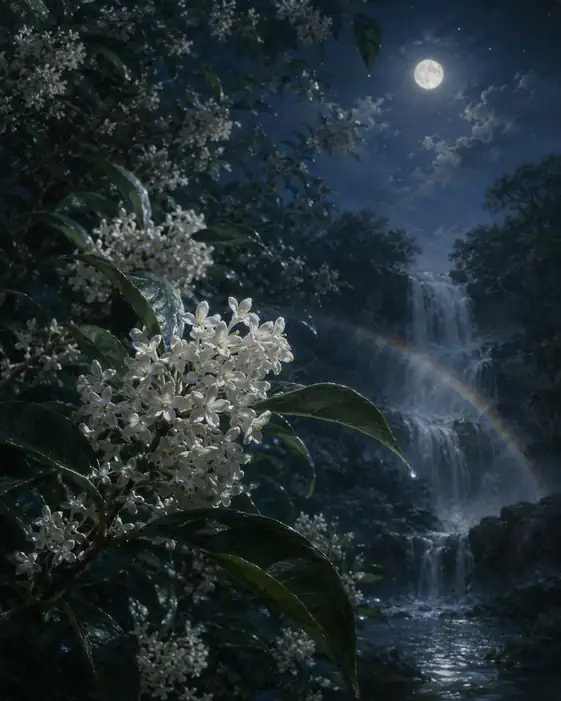 Dewdrop Beneath the Lunar Arc
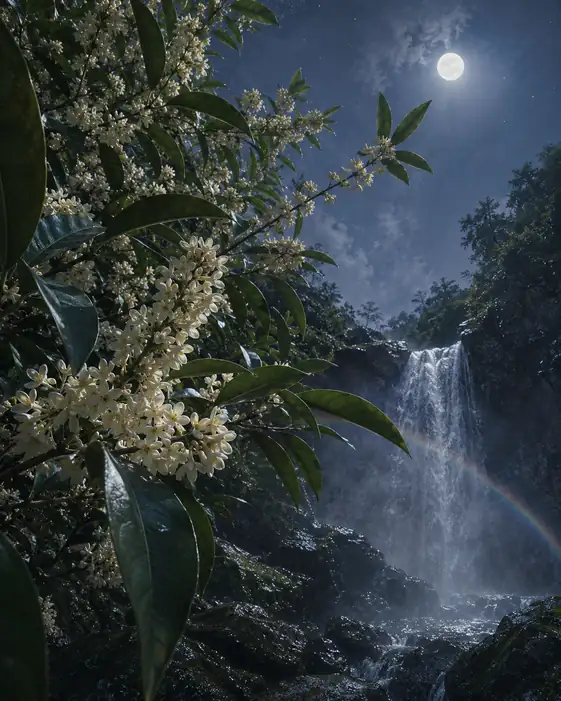 Lunar Arc Across the Midnight Falls
 Moonbow over the Waterfall and Crocus
 Luminous Path and the Midnight Blooms
 Midnight Station on the Galactic Line