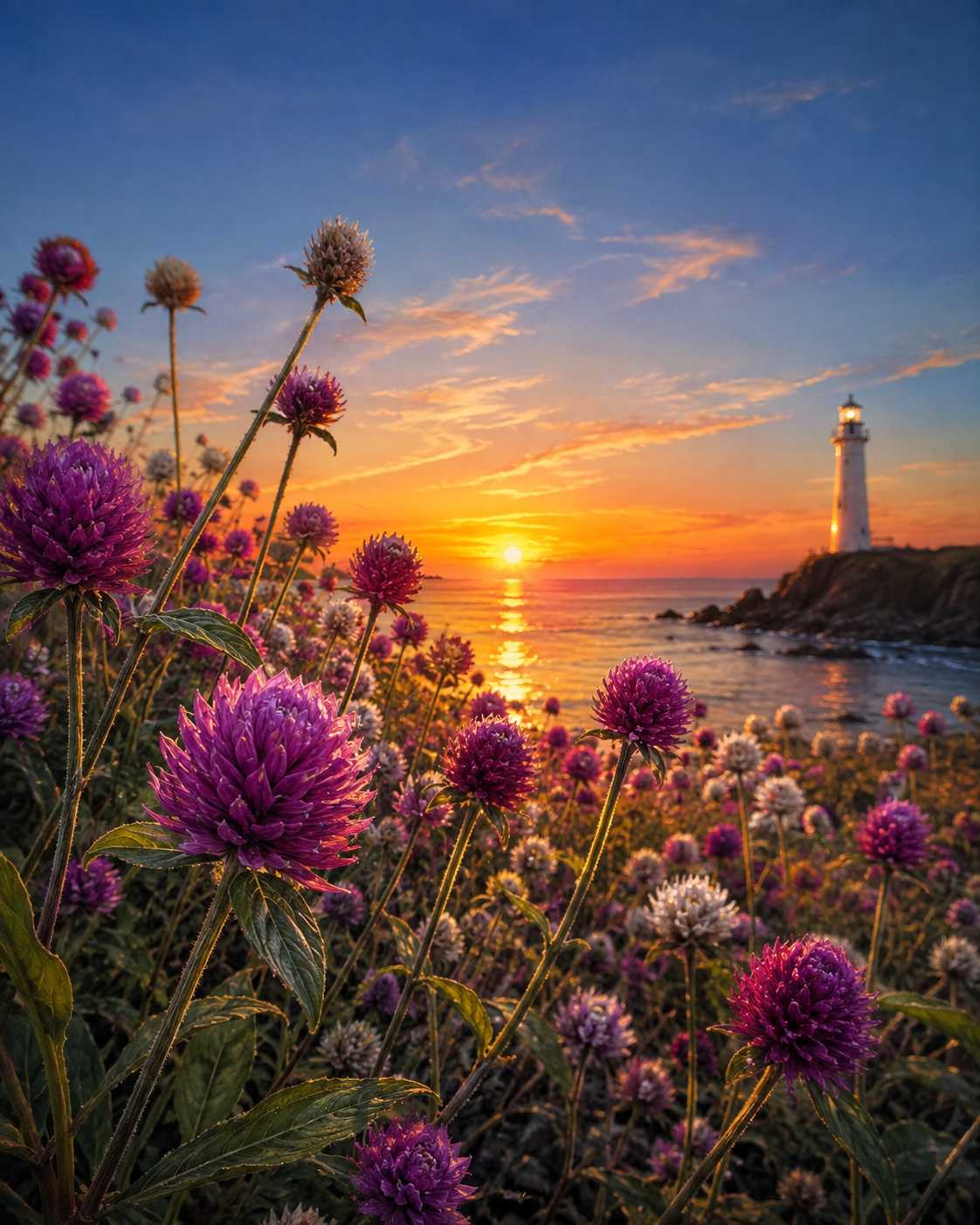
Sunset Beacon and the Amaranth Slope
Critique
1. Introduction This coastal sunset places a field of purple and white globe flowers before a lighthouse on a rocky point. Large violet blooms fill the left and lower foreground, while the sun sits above the sea near center and the tower rises at upper right. The work organizes seasonal abundance around two distant sources of orientation. 2. Description Dozens of round flower heads stand at varied heights among long stems and dark leaves. The nearest bloom reveals densely layered purple bracts edged by warm light; taller white heads silhouette against the sky. Orange clouds cross a blue upper field, and the sun casts a vertical reflection over calm water toward the flowered shore. The lighthouse lamp is lit. 3. Analysis Tall stems form irregular diagonals that animate the stable sea horizon. The prominent lower-left flower, sun, and lighthouse create a broad triangular structure. Purple complements the orange sky, while white blooms repeat the lighthouse body and solar disk. Selective focus separates the detailed foreground from softened coastal architecture, and rim light unifies numerous stems without merging them. 4. Interpretation and Evaluation The meadow distributes light among many temporary living forms, whereas the lighthouse concentrates it in one durable signal. Their coexistence suggests several ways a landscape can offer direction. The color balance, low viewpoint, botanical texture, atmospheric recession, and reflected sunlight are skillfully handled. Crowded flowers remain legible because height, focus, and hue provide a clear hierarchy. 5. Conclusion At first the nearest violet blooms seem to define the scene, but the sunlit water gradually leads attention toward the distant tower. The work shifts from flower study to a layered account of orientation and duration. Through rhythmic stems, complementary color, and measured depth, it joins fleeting seasonal growth with a stable coastal marker.
Same Subcategory
Similar Artworks
 The Beacon and the Amaranth Meadow
 Beacon of Light, Petals of Blue
 Where the Beacon Greets the Sunset
 Vigil Beside the Distant Beacon
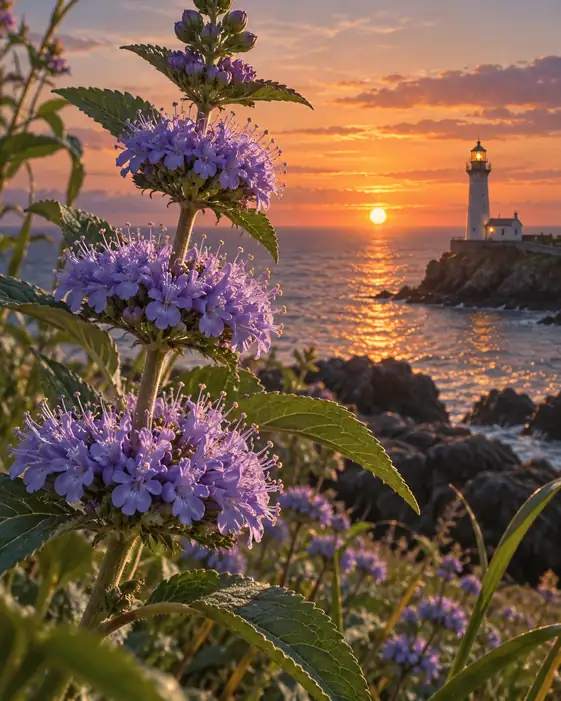 Cape Lighthouse and Sunset Caryopteris
 Beacon Beyond the Coastal Blooms
 Beacon Over the Sunset Shore
 Twilight Cape, Lighthouse and Hydrangeas
 Beacon in the Fragrant Sunset
 Lighthouse Beam and Sunset Caryopteris