
The Beacon and the Amaranth Meadow
Critique
1. Introduction This coastal sunset view places purple and white globe flowers before a lighthouse on a rocky headland. A large magenta bloom occupies the lower-left center, while the sun glows above the sea and the lighthouse rises at upper right. The image balances seasonal meadow abundance with two distinct forms of guidance. 2. Description Round flower heads at varied heights fill the foreground, some deep violet and others cream white, supported by thin stems and pointed leaves. The nearest purple bloom reveals many small tubular petals tipped with yellow. Beyond, orange water reflects the sun in a vertical path. A white tower with a lit lantern stands on the dark cliff. 3. Analysis The main bloom, sun, and lighthouse form a broad triangle across the vertical composition. Sharp foreground texture yields quickly to softened stems, rocks, and tower, producing a pronounced atmospheric transition. Purple flowers complement the orange sky, while white heads repeat the lighthouse body and its lamp. Numerous thin stems create upward movement that echoes the tower. 4. Interpretation and Evaluation The meadow offers a natural field of many small signals beside the singular constructed beacon. Both flowers and lighthouse catch the last light, but one is dispersed and seasonal while the other is concentrated and dependable. The color design, selective focus, and rendering of intricate flower structure are accomplished. The familiar sunset motif gains originality through the low, crowded botanical viewpoint. 5. Conclusion At first the nearest purple flower commands attention, but the sun’s reflection and lighthouse gradually extend the gaze toward the horizon. The scene shifts from a close meadow study to a reflection on varied forms of orientation. Through clear focal hierarchy, warm-cool contrast, and repeated circular forms, the work joins fragile growth to an enduring coastal marker.
Same Subcategory
Similar Artworks
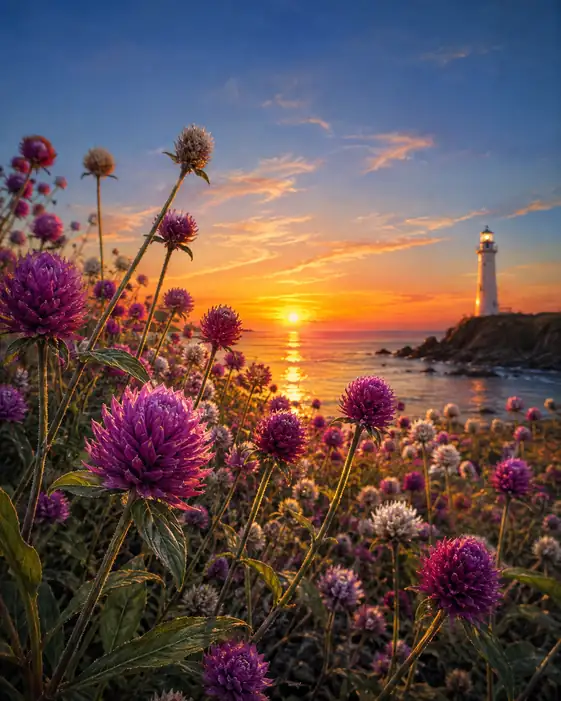 Sunset Beacon and the Amaranth Slope
 Beacon of Light, Petals of Blue
 Where the Beacon Greets the Sunset
 Vigil Beside the Distant Beacon
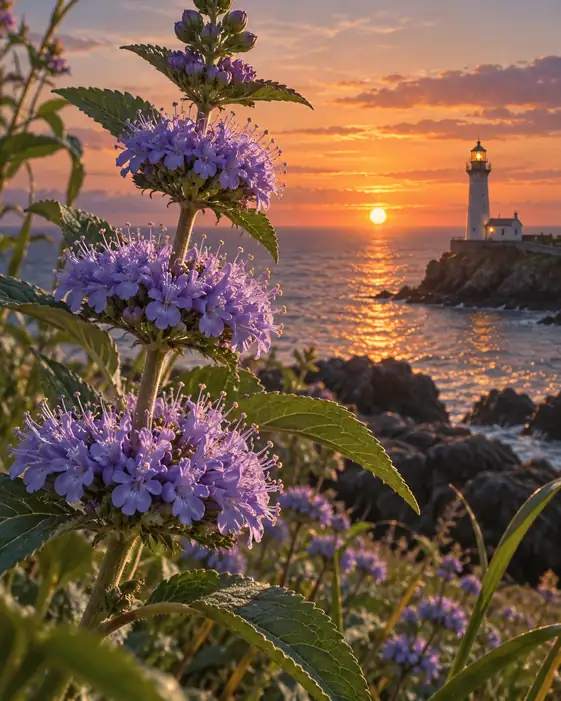 Cape Lighthouse and Sunset Caryopteris
 Promontory Trail at Golden Hour
 Beacon Beyond the Coastal Blooms
 Beacon in the Fragrant Sunset
 Lighthouse Beam and Sunset Caryopteris
 Cape Lighthouse in the Sunset Glow