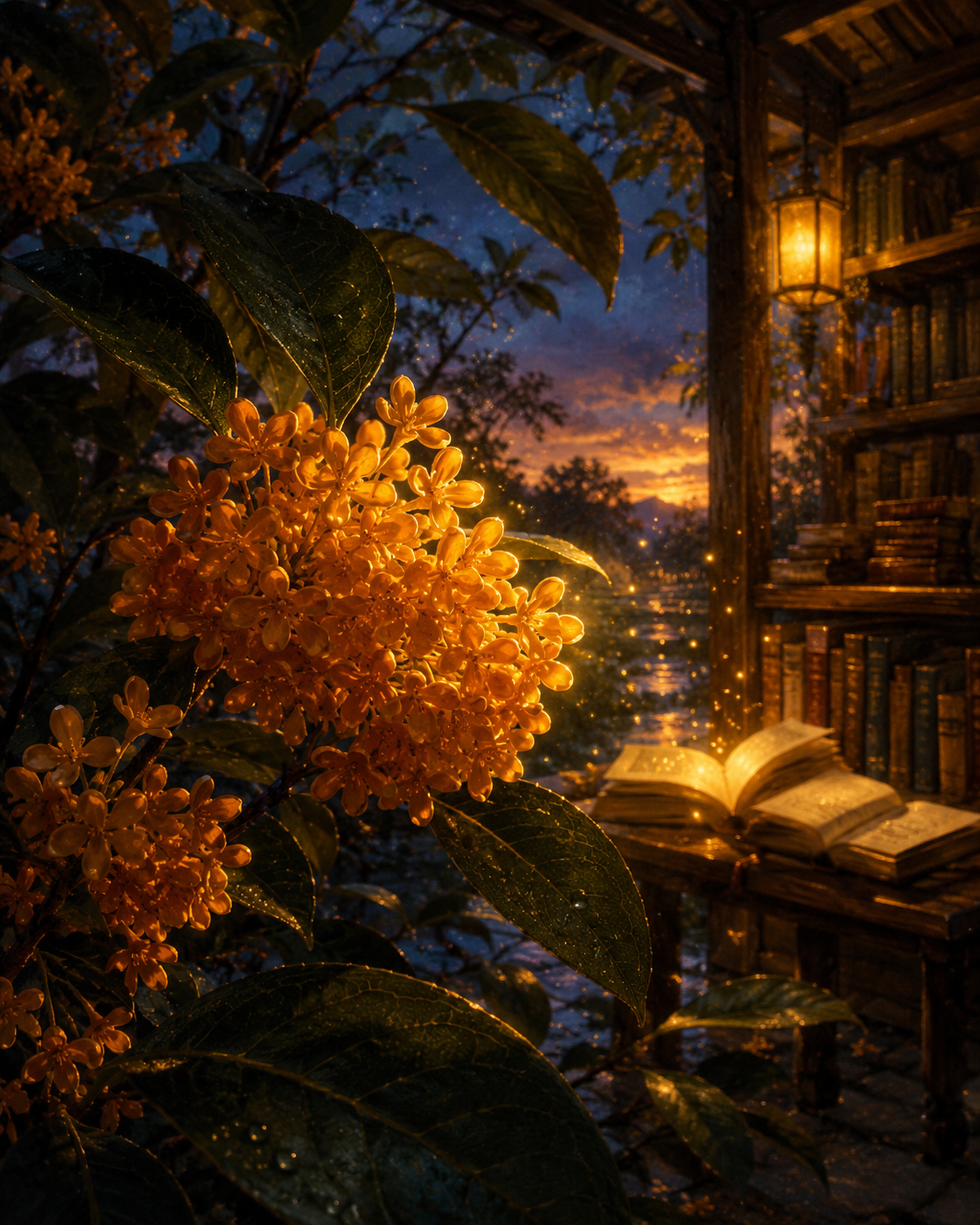
Tomes in the Osmanthus Twilight
Critique
1. Introduction This twilight scene joins orange blossoms, an open-air library, and a distant waterway under a fading blue sky. The flower cluster fills the left foreground, while shelves, a hanging lamp, and an open book occupy the right. A narrow view between them leads toward reflected sunset light, giving study and nature a shared horizon. 2. Description Dense four-petaled flowers glow among broad wet leaves marked by fine veins. Opposite them, wooden shelves hold rows and stacks of dark books beneath a square amber lantern. An open volume rests on a table, surrounded by small floating lights. Through the central gap, a river or path recedes toward orange clouds and a low mountain silhouette. 3. Analysis The flower mass and bookcase create two dark vertical wings around a luminous central distance. Warm petals answer the lamp and open pages, while cool blue sky and wet foliage deepen the surrounding shadows. Leaf diagonals direct attention toward the book, and floating points connect foreground, interior, and horizon. Varied focus preserves several distinct spatial layers. 4. Interpretation and Evaluation The image presents reading as an activity continuous with observing a living landscape. Blossoms and pages receive the same golden light, suggesting parallel forms of unfolding knowledge. The composition is carefully enclosed, the warm-cool balance is controlled, and the distinct rendering of leaf moisture, paper, wood, and atmospheric haze is technically assured. Its hybrid setting feels imaginative yet coherent. 5. Conclusion At first the radiant flowers dominate, but the open book and distant sunset gradually form an equally important route for attention. The scene becomes a meditation on knowledge gathered between cultivated nature and reflective solitude. Through layered framing and repeated light, the work creates an intimate sanctuary that remains open to the larger world.
Same Subcategory
Similar Artworks
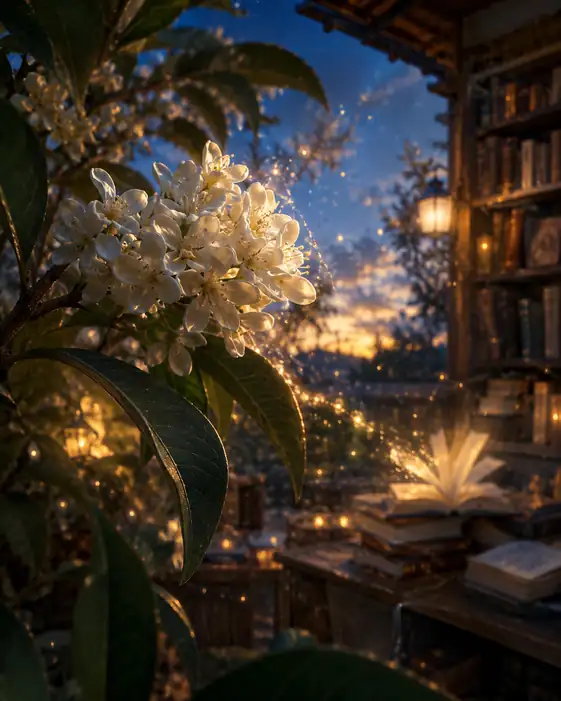 Spells of White Blossom and Open Pages
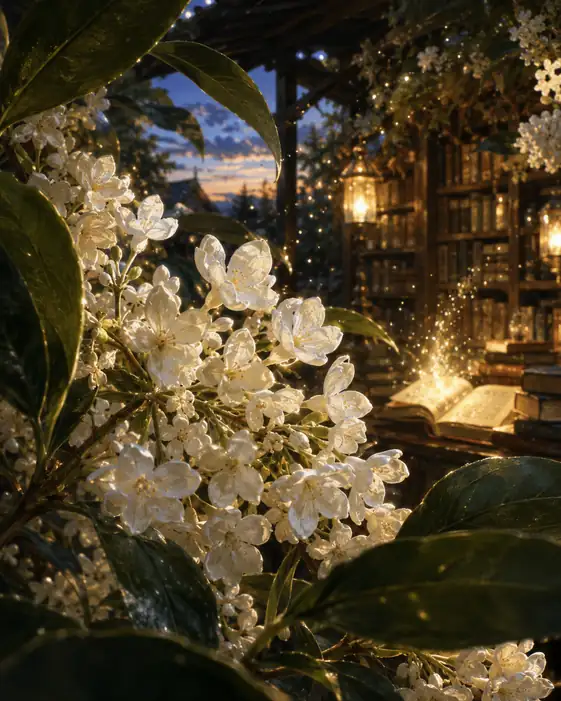 Fountain of Sparks and Silver Blossoms
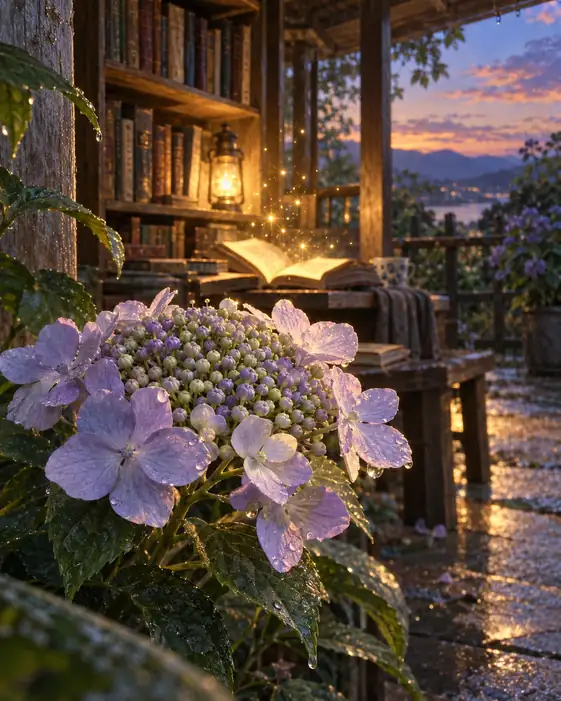 Luminous Pages, Twilight Study and Hydrangeas
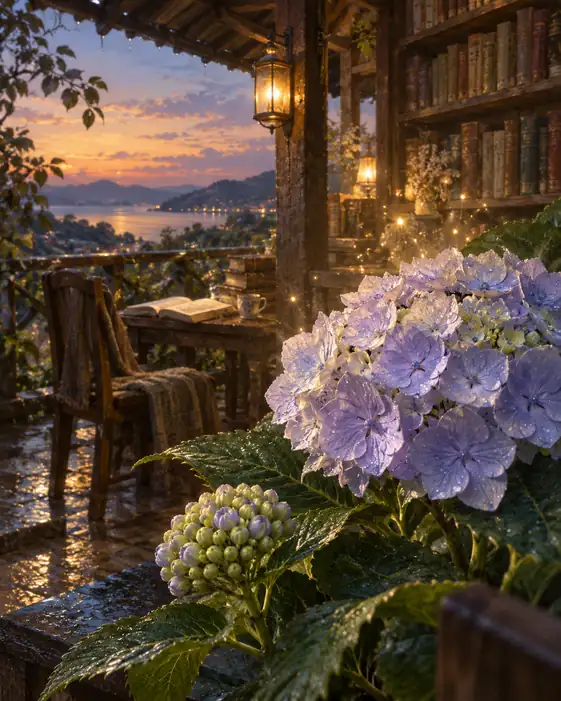 Twilight Study on the Terrace, Hydrangeas and Open Pages
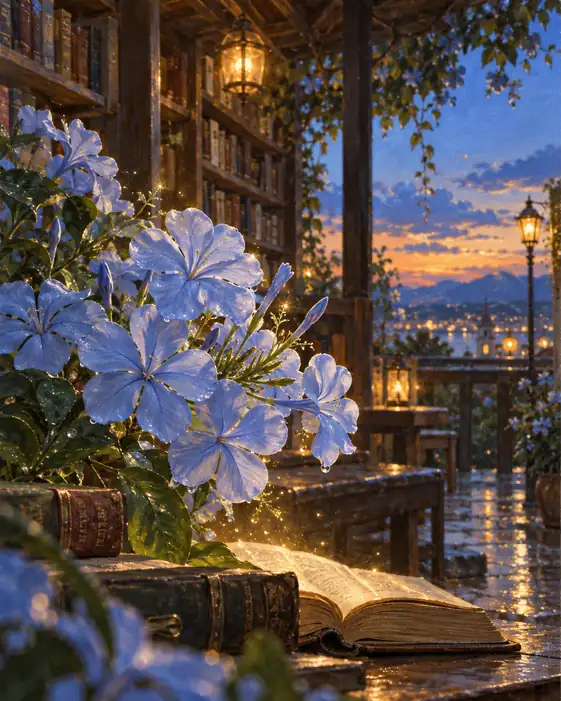 Pages of Light in the Twilight Study
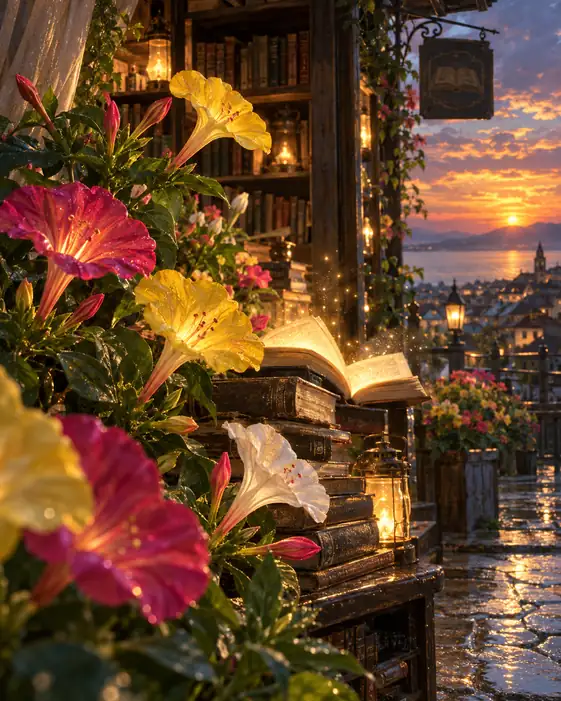 Where Written Tales Take Wing
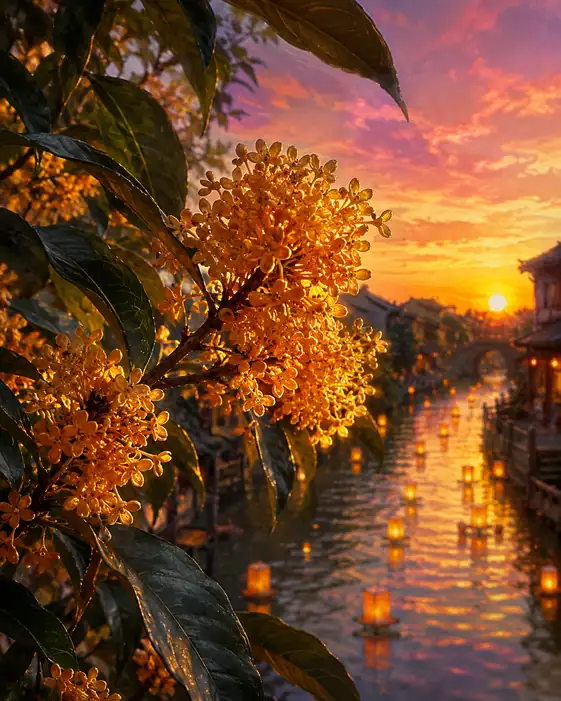 Floating Lanterns and the Amber Bower
 Beacon in the Fragrant Sunset
 Twilight Glow and Floating Lanterns
 Chimes of Dusk and the Golden Cluster