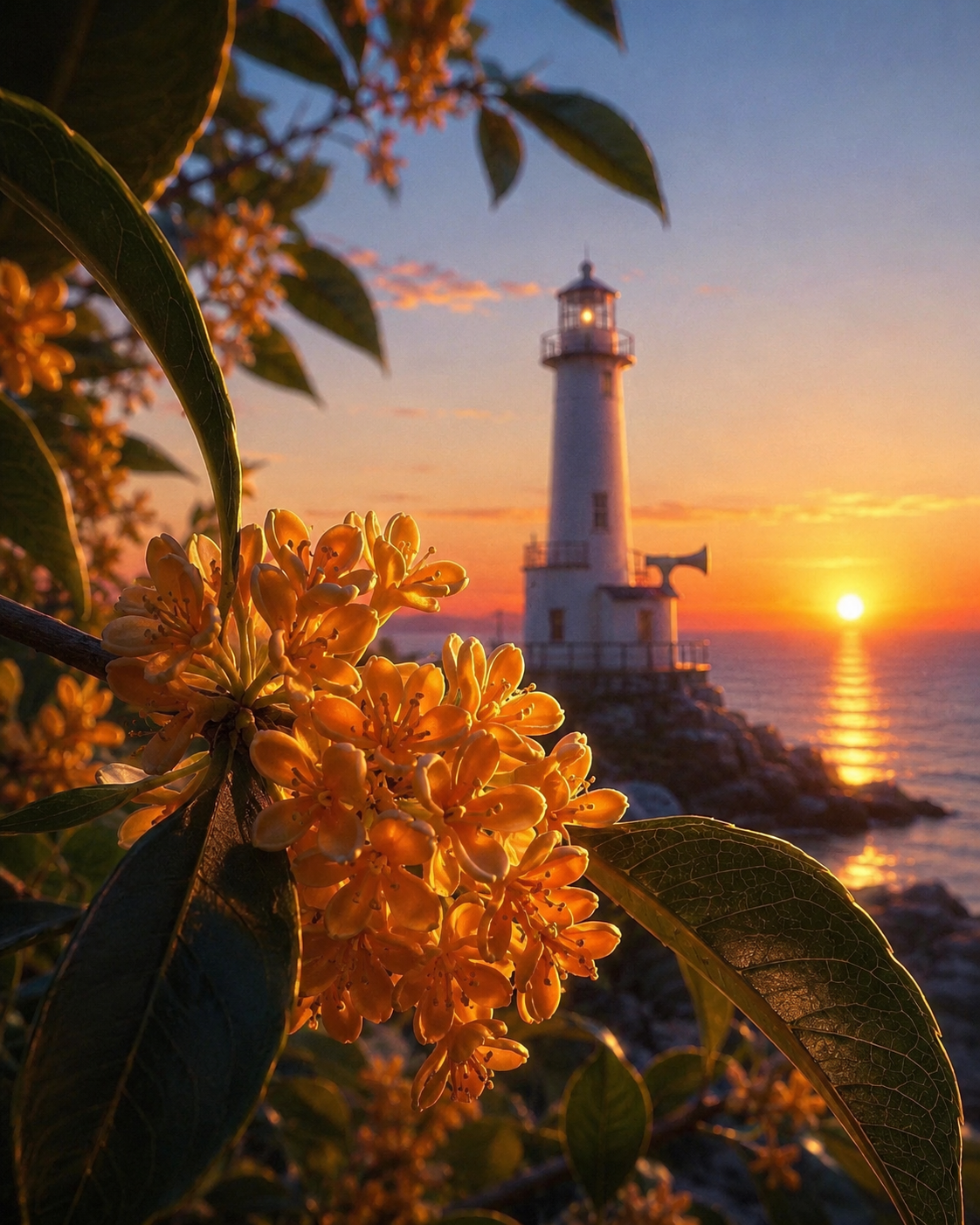
Beacon in the Fragrant Sunset
Critique
1. Introduction This sunset places orange blossoms before a white lighthouse and the descending sun. The flowers occupy the lower-left foreground, while the tower rises near the center and the sun glows at the right horizon. Three subjects are joined into a compact study of guidance, growth, and evening light. 2. Description Rounded petals and projecting stamens are illuminated from behind among broad, nearly black leaves. The lighthouse stands on a rocky projection, with its lamp lit and a horn-shaped fixture extending from one side. Beyond it, the sea forms a calm horizontal field crossed by a narrow gold reflection beneath the orange sky. 3. Analysis The vertical tower interrupts the long horizon and mediates between the close flower cluster and distant solar disk. Dark leaves curve inward as a natural frame, while their fine veins echo the linear railings around the lighthouse. Warm backlight unifies petals, lamp, sky, and water, but the cool white tower supplies a restrained tonal pause at the composition’s center. 4. Interpretation and Evaluation Blossoms and lighthouse gather the last daylight, one through translucent surfaces and the other through a beacon. Their pairing suggests continuity between natural orientation and constructed guidance. The depth is convincing, the color harmony controlled, and detailed handling of petals, leaves, stone, and architecture gives the symbolic arrangement a physical basis. 5. Conclusion At first the brilliant flowers command attention, yet the tower and its small lamp gradually become an equal focus. This shift changes the scene from decorative sunset imagery into a measured reflection on fragile life and dependable signals. The work’s disciplined composition, precise lighting, and unusual foreground framing produce a memorable balance of intimacy and distance.
Same Subcategory
Similar Artworks
 Where the Beacon Greets the Sunset
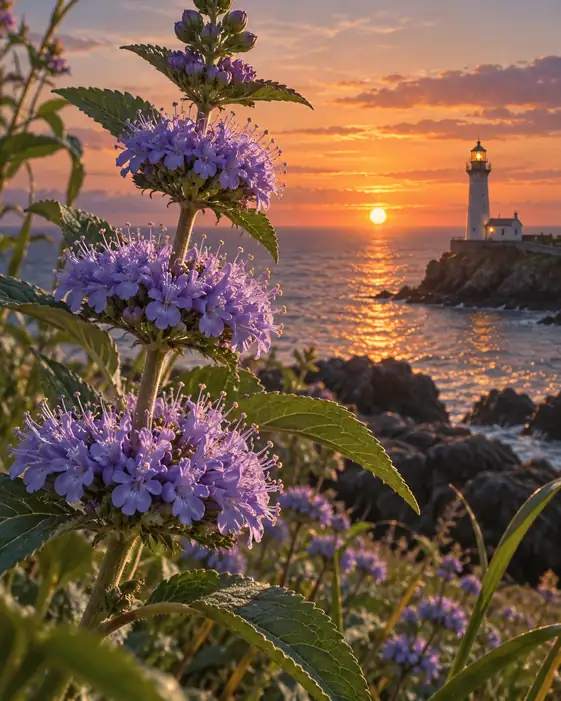 Cape Lighthouse and Sunset Caryopteris
 Twilight Cape, Lighthouse and Hydrangeas
 The Beacon and the Amaranth Meadow
 Beacon of Light, Petals of Blue
 Lighthouse Beam and Sunset Caryopteris
 Cape Lighthouse in the Sunset Glow
 Beacon Over the Sunset Shore
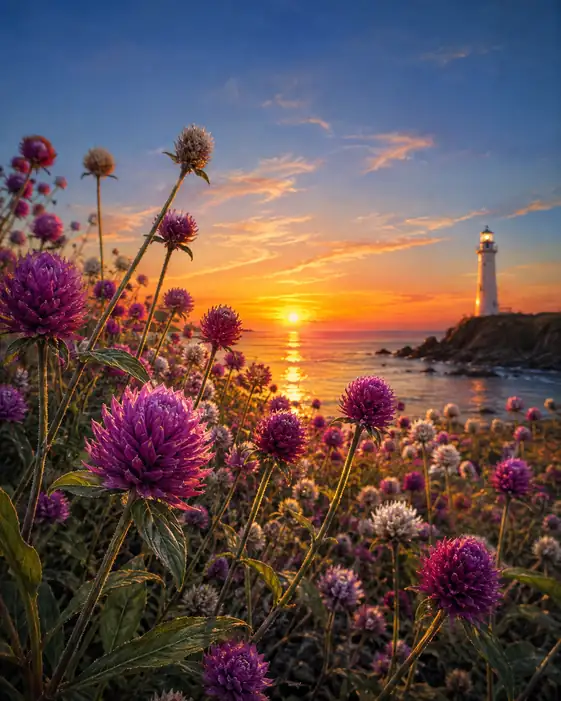 Sunset Beacon and the Amaranth Slope
 Promontory Trail at Golden Hour