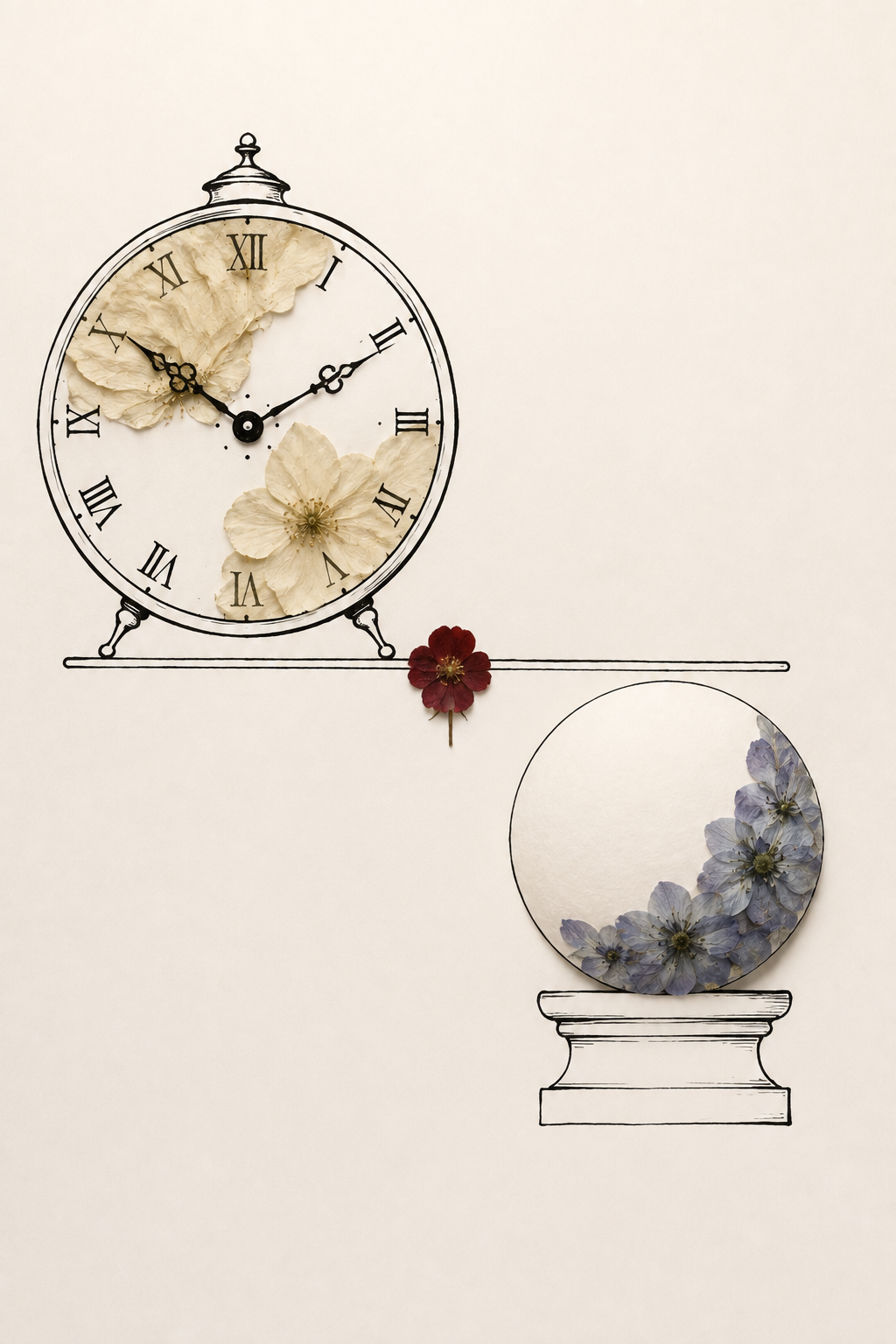
The Geometry of Fleeting Hours
Critique
Introduction This still life pairs a alarm clock in the upper left with a smaller circular glass vessel below and to the right. Pressed flowers inhabit both round forms, allowing measured time and botanical growth to meet within an austere cream field. Description Roman numerals ring the clock face, and ornate hands indicate roughly ten minutes to two. ivory blossoms overlap the numerals across the upper-left quadrant and lower center. A thin shelf line extends beneath the clock, interrupted by a small dark red flower. Below it, blue-violet flowers curve around the lower and right edges of a transparent sphere set on a stepped base. Analysis The two circles establish a descending diagonal and a contrast of scale. The long shelf line stabilizes the clock but also separates its crowded face from the quieter sphere. Black numerals and hands form a rigid system around irregular petals. Ivory flowers nearly merge with the ground, whereas blue blossoms define the lower circle more ; the red flower acts as a compact hinge between both zones. Interpretation and Evaluation The clock converts petals into temporary occupants of a device meant to measure continuity. The lower sphere, resembling a contained garden or moon, offers cyclical growth as a counterpart to numbered time. The drawing is crisp, and the compositional balance across a wide void is assured. Restrained color and varied floral placement prevent repetition, while the small red bloom gives the symbolic comparison a precise visual fulcrum. Conclusion Initially the image reads as two decorative objects, but closer attention reveals a thoughtful comparison between mechanical duration and organic recurrence. Clear geometry, tactile flowers, and purposeful emptiness make time visible as both structure and change.
Same Subcategory
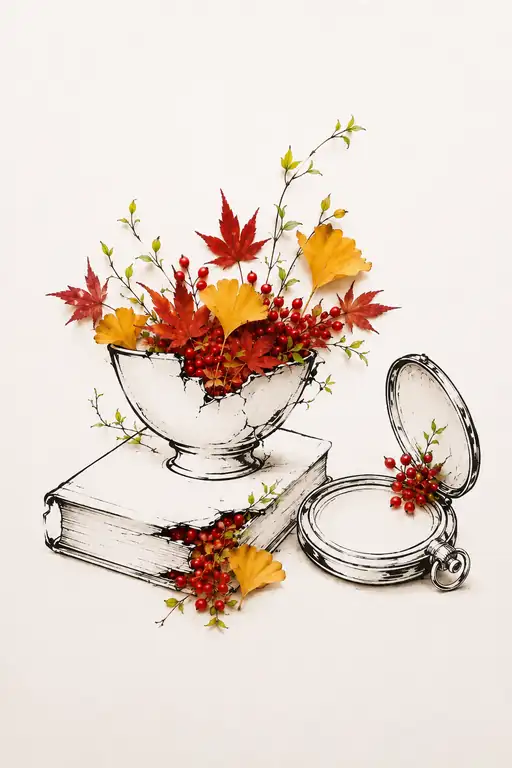 Timeless Autumn Chronicle
Similar Artworks
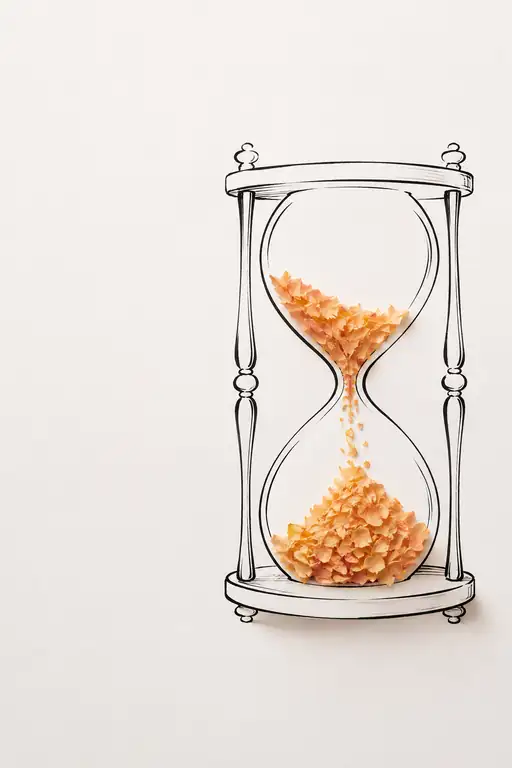 Golden Sands of Fleeting Hours
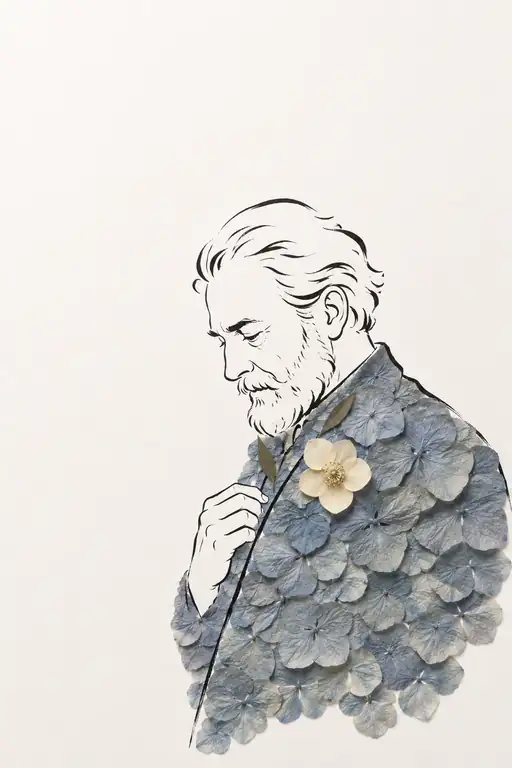 Quiet Contemplation of the Passing Years
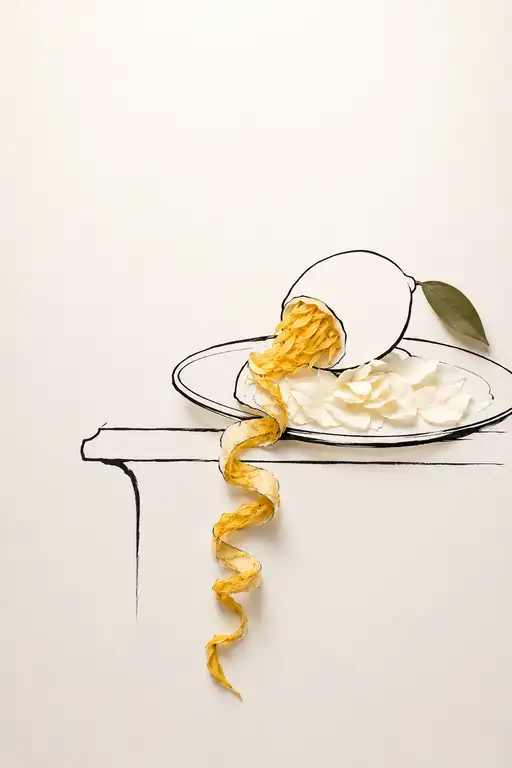 Descent of the Unfolding Spiral
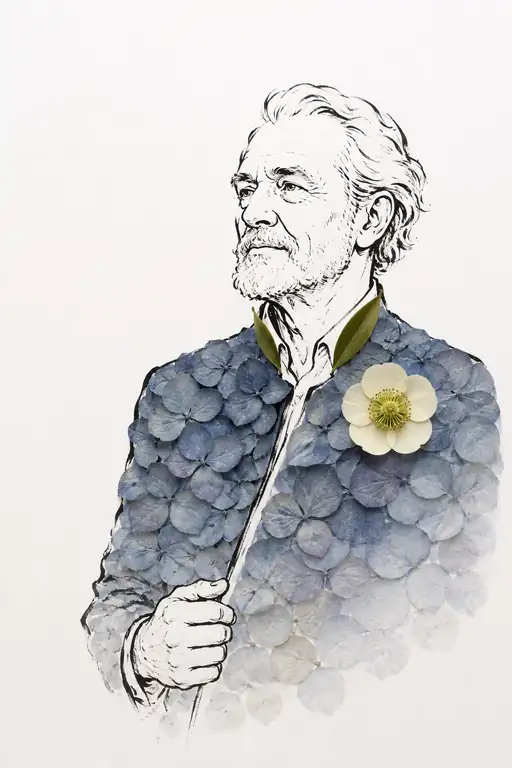 Dignity and the Blue Light of Memory
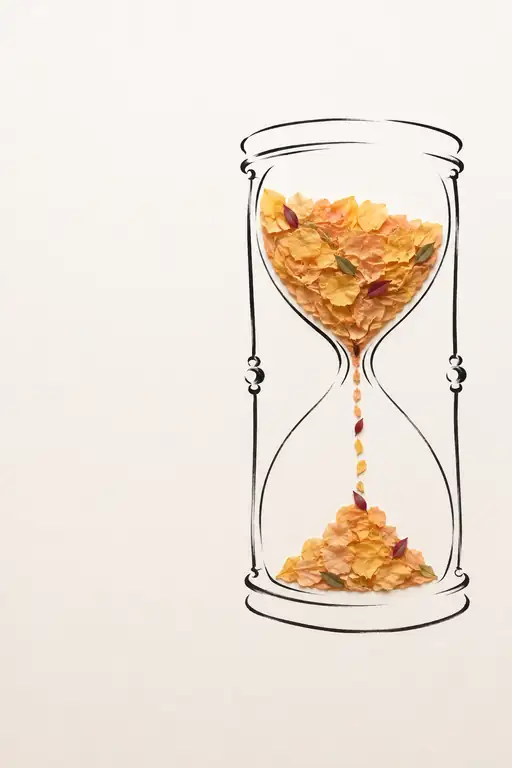 Golden Grains of Solitude
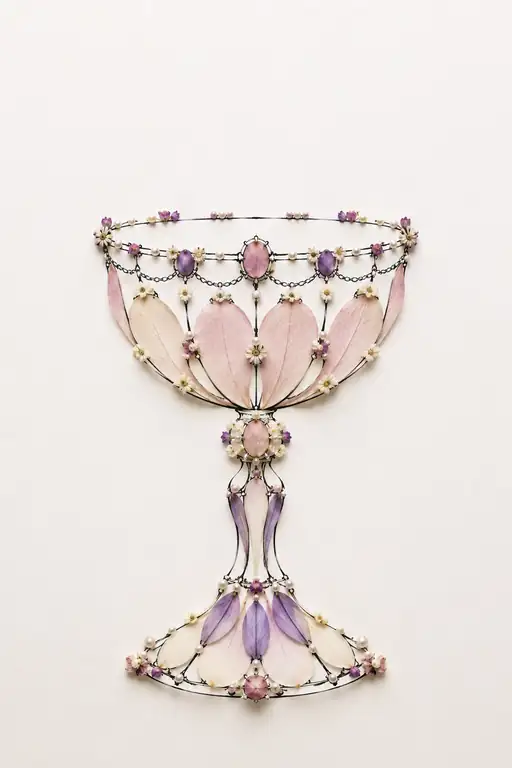 Vessel of Translucent Hours
 Harmony of Flight and Ground
 Reaching for the Drifting Bloom
 Circle of Zen and the Arched Bridge
 The Waterwheel Clock and the Path of Hydrangeas