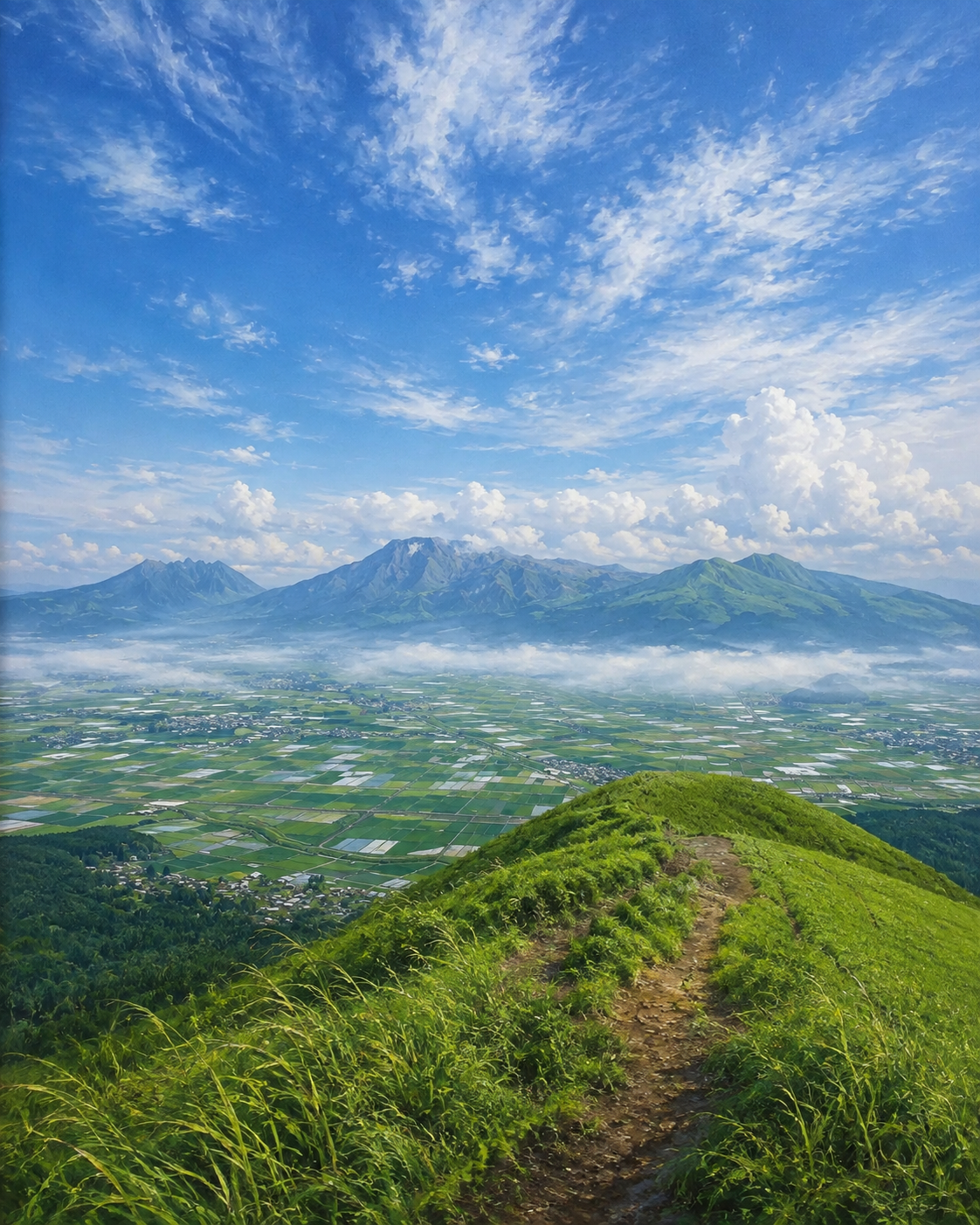
Ridge Above the Caldera Plains
Critique
Introduction This mountain landscape looks from a grassy ridge across an agricultural basin toward a volcanic range. A narrow footpath enters at lower center, while summer clouds occupy most of the sky. Panoramic distance meets the bodily invitation of a walk underway. Description Wind-bent grasses crowd the foreground around a rocky brown path that crests a rounded green ridge. Below, rectangular fields, pale greenhouse roofs, roads, and clustered settlements spread across the valley. A thin bank of mist separates the plain from blue-green mountains. Above them, small horizon clouds develop into feathered white currents across a luminous cyan sky. Analysis The path forms a central wedge that narrows toward the ridge, then releases the eye into the broad gridded basin. Successive bands—grass, forest, fields, mist, mountains, and sky—organize immense depth. Saturated yellow-green foregrounds shift toward cooler blue at distance. Fine agricultural marks contrast with broad mountain planes. High, radiating cloud strokes echo the path's outward motion and enlarge the atmosphere. Interpretation and Evaluation The viewpoint balances human scale and geological scale. A walker's worn trail leads toward fields shaped by collective labor, beyond which mountains register far longer time. Mist softens the boundary without hiding either world. The abundant sky prevents the panorama from becoming a map, making weather an active force. Perspective, atmospheric color, and varied mark size are controlled with clarity. Conclusion At first the valley's mosaic attracts attention, but sustained viewing returns to the humble path as the image's ethical center. It offers access without claiming mastery over the vista. Foreground grasses lean and sparkle, suggesting wind that also shapes the clouds. The painting succeeds in making a vast cultivated landscape feel both comprehensible and inexhaustible, joining movement, livelihood, and open weather.
Same Subcategory
 Lavender Snowfields on the High Peaks
Similar Artworks
 Towering Cloud Above the Green Trail
 Impasto Horizon of the Caldera
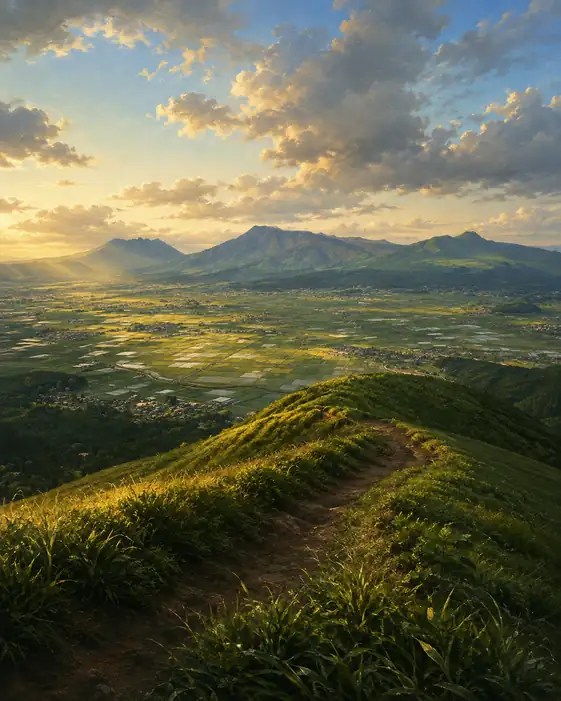 Golden Hour Over the Caldera
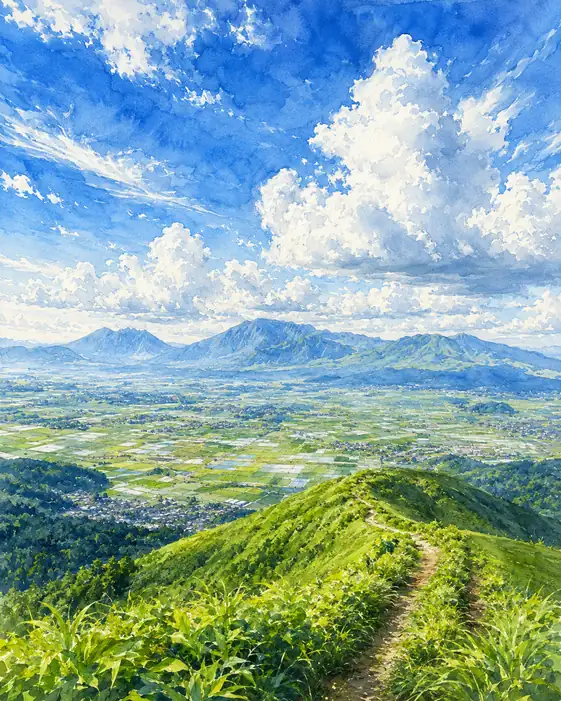 Cloud Tower Over the Sasa Ridge
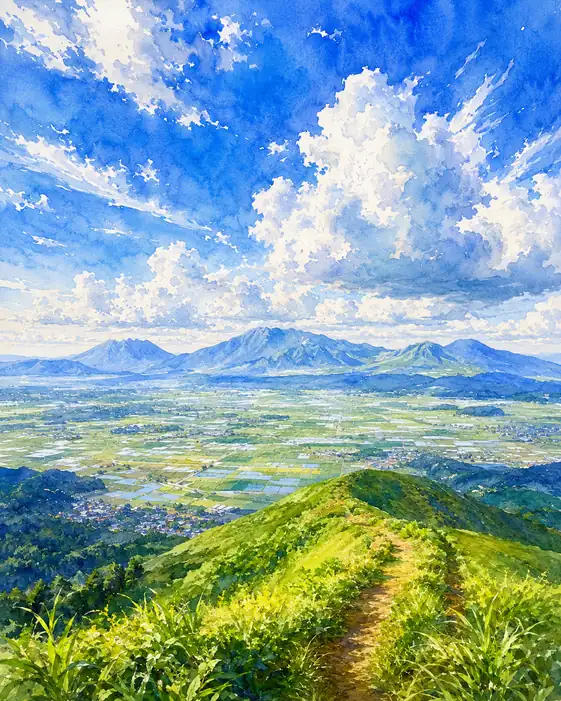 Watercolor Wind Over the Caldera
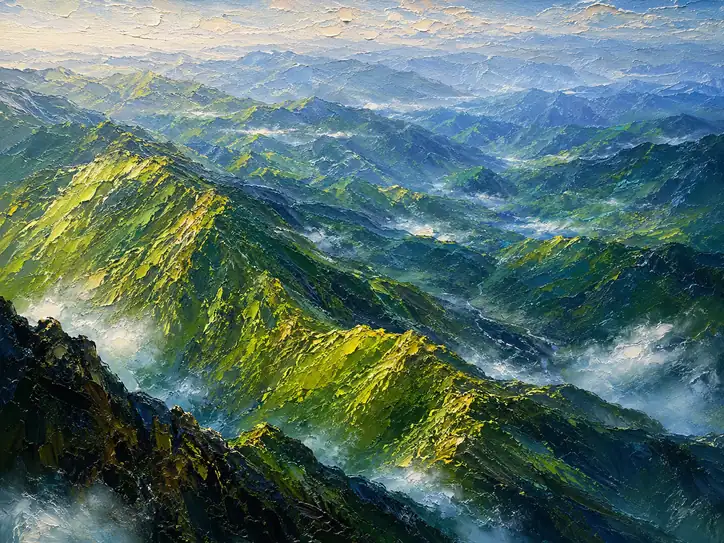 The Titan's Golden Crest
 A Rainbow Journey to the Horizon
 Dew-Beaded Petals and the Distant Summit
 Dawn of the Serene Peaks
 Majesty of the Mountain Peak