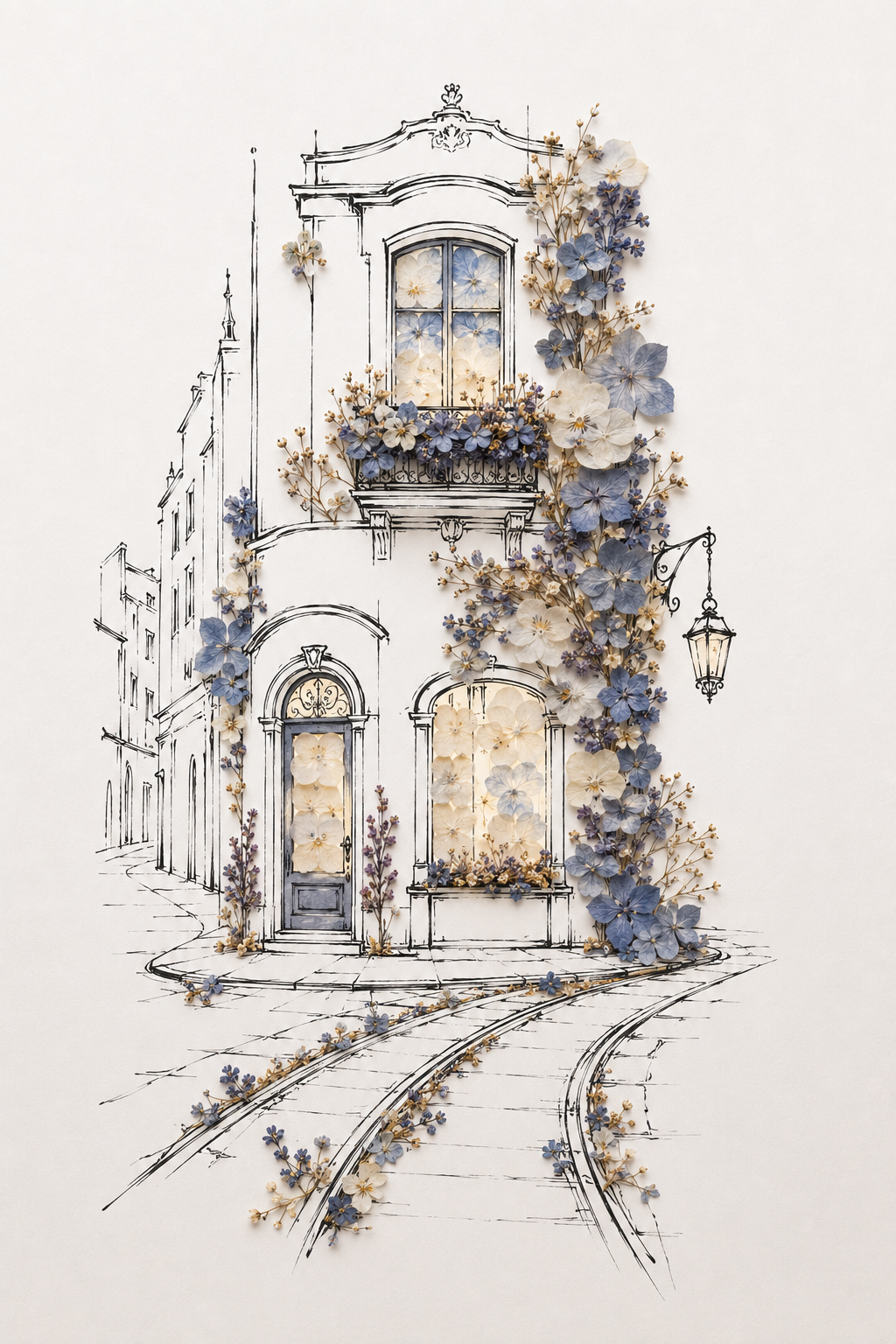
Azure Hydrangea at the Street Corner
Critique
Introduction A corner house stands at a tramway bend, building its facade from drawing and flowers. It appears inhabitable and herbarium-like. The street concentrates on a threshold where dwelling, ornament, and growth converge. Description The three-story facade rises near center beneath a curved ornamental parapet. An upper arched window stands above a projecting iron balcony; below are a dark door and broad shop window. Pressed cream and dusty-blue blossoms fill the panes, balcony box, and a dense vine descending the right corner. Curved rails enter from below, carrying scattered flower fragments toward the building. A hanging lantern floats at right. Analysis The facade's vertical axis is offset by rails that bend strongly from lower right to center. Repeated arches unify parapet, windows, and doorway, while the balcony inserts a firm horizontal pause. Blue flowers accumulate along the right edge and balance the faint receding buildings at left. Fine ink supplies depth with minimal shading; translucent petals, wiry seed stems, and their cast shadows provide color and volume. Interpretation and Evaluation The house reads as a container for memory rather than a literal botanical building. Flowers replace reflections and interiors, making each window a preserved season. Growth is most abundant at the corner, precisely where two streets and two wall planes meet. This intelligent placement turns ornament into a spatial hinge. The limited palette, clear value structure, and economical perspective show restraint, while the physical petals lend emotional specificity. Conclusion At first the flowers seem decorative, yet the rails introduce approach and departure. Blossoms fallen between them extend the facade into public space. The isolated lantern and empty pavement heighten expectancy. Through disciplined omission, one corner becomes a neighborhood landmark suspended between use, recollection, and renewal.
Same Subcategory
 Where Two Worlds Meet at Twilight
Similar Artworks
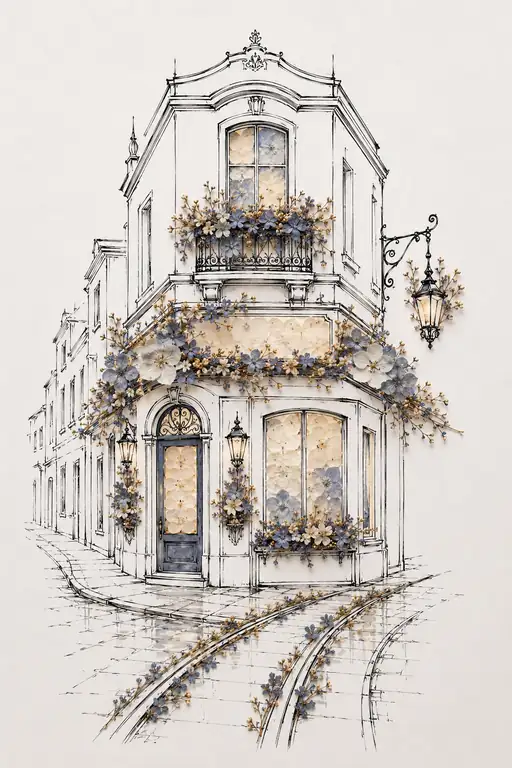 Festoon of the Corner Salon
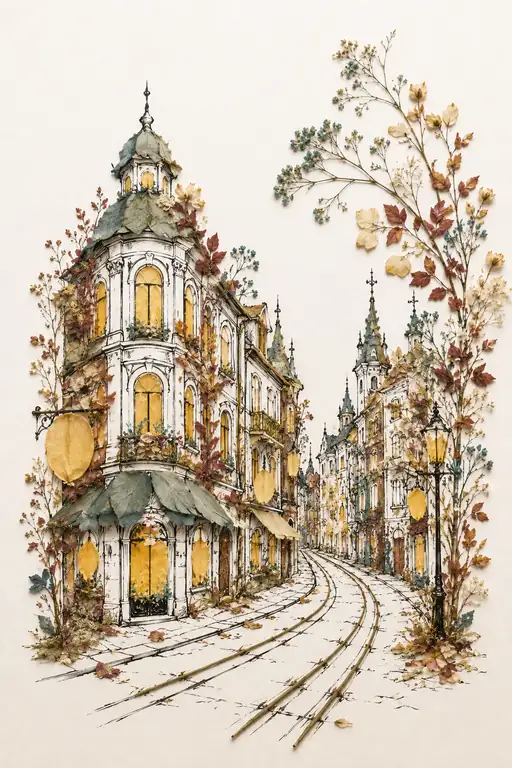 Autumn Nocturne Along the Tramline
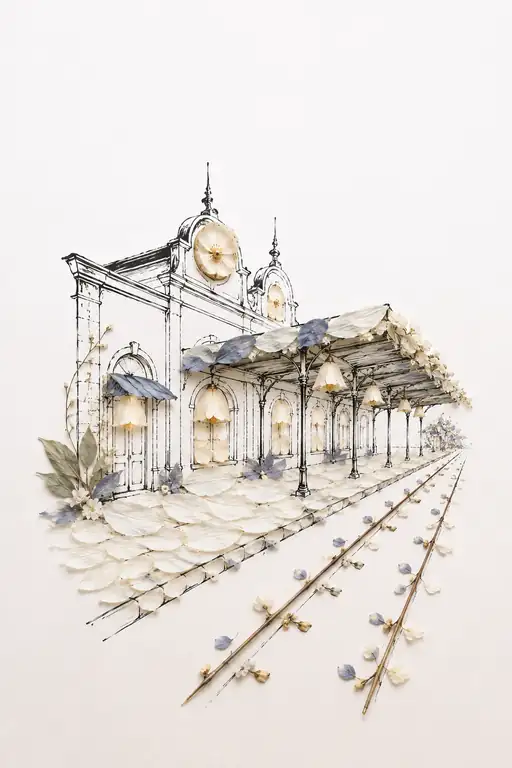 Station of the Silent Departure
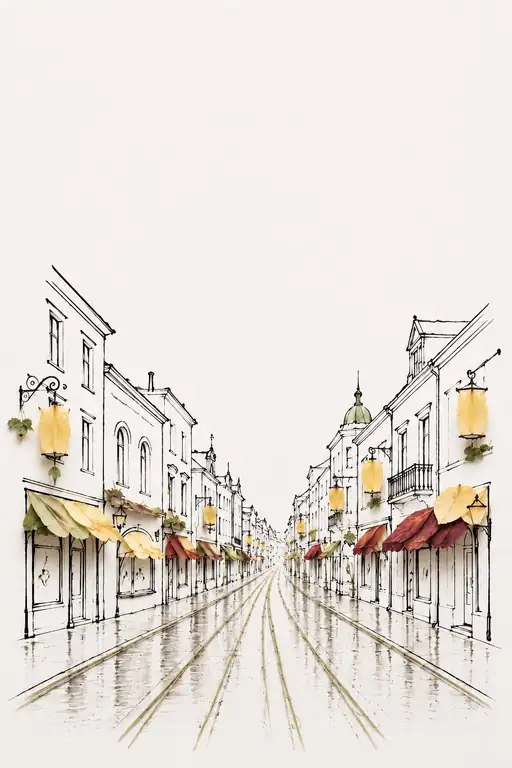 Quiet Convergence After the Rain
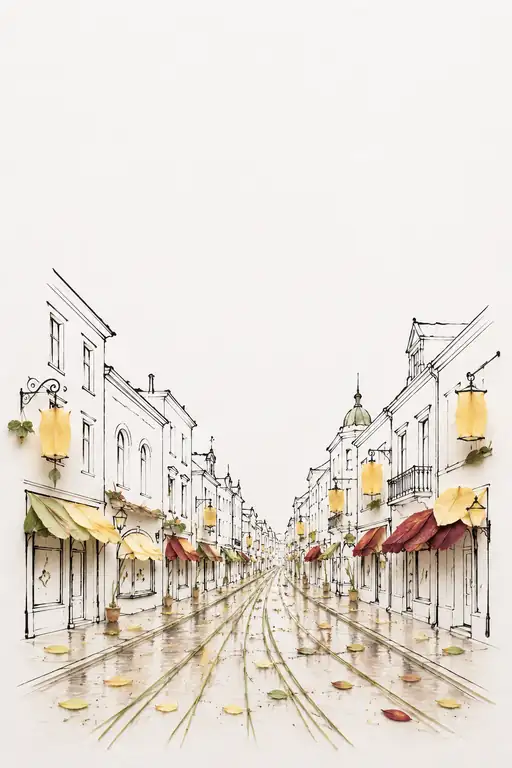 Autumn Rain on the Avenue
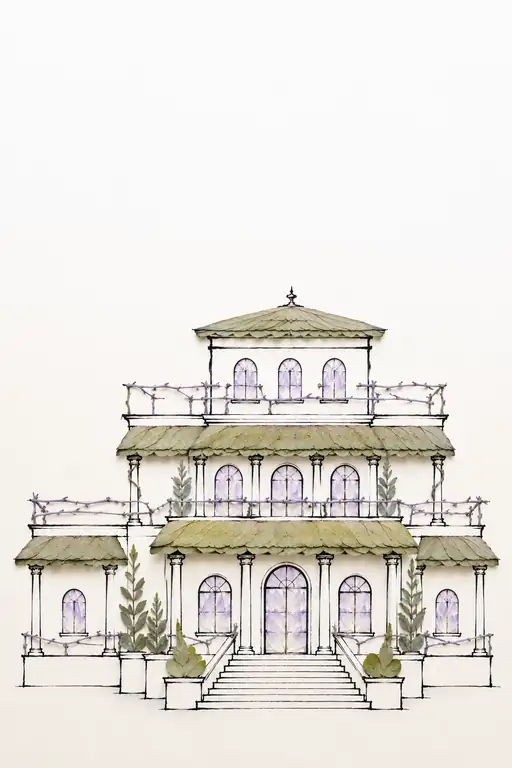 Pavilion of Petal and Tier
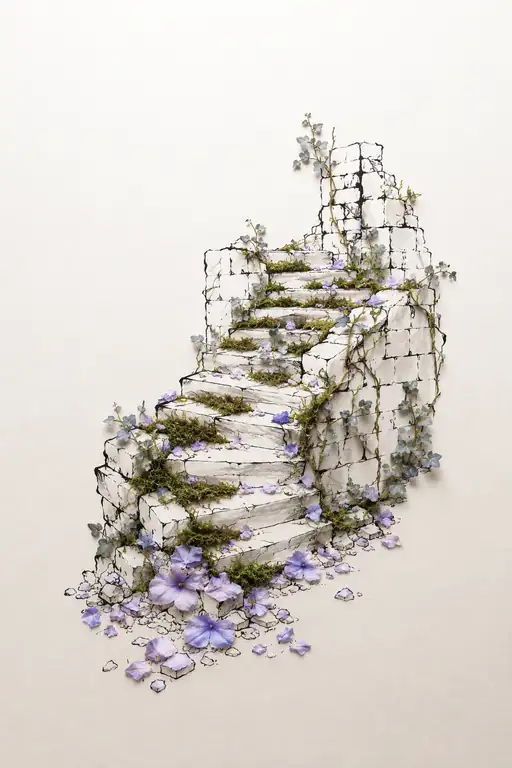 Ruined Stairway and the Mossy Steps
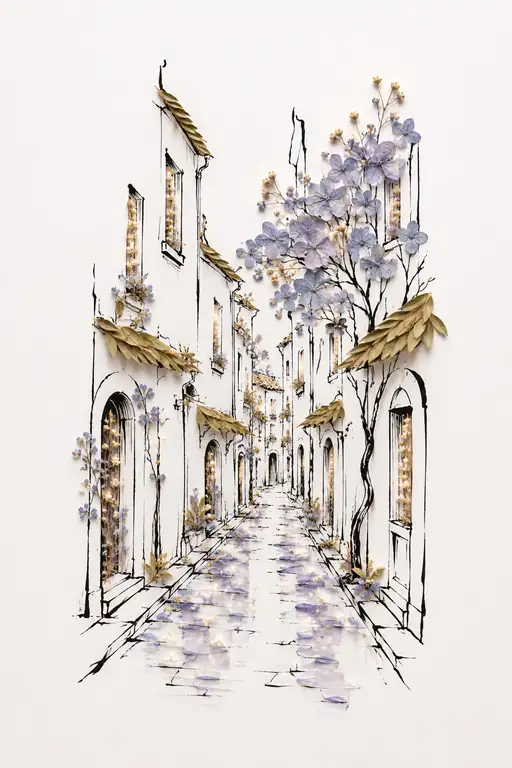 Deep into the Wisteria Lane
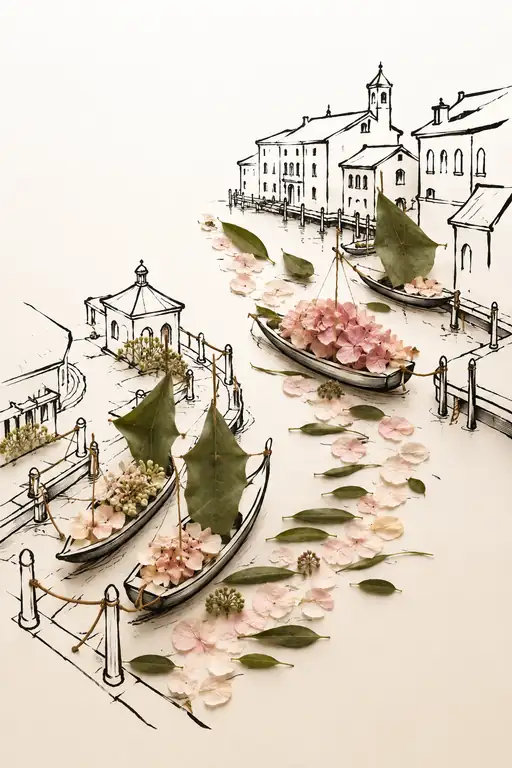 Waterway of Drifting Petals
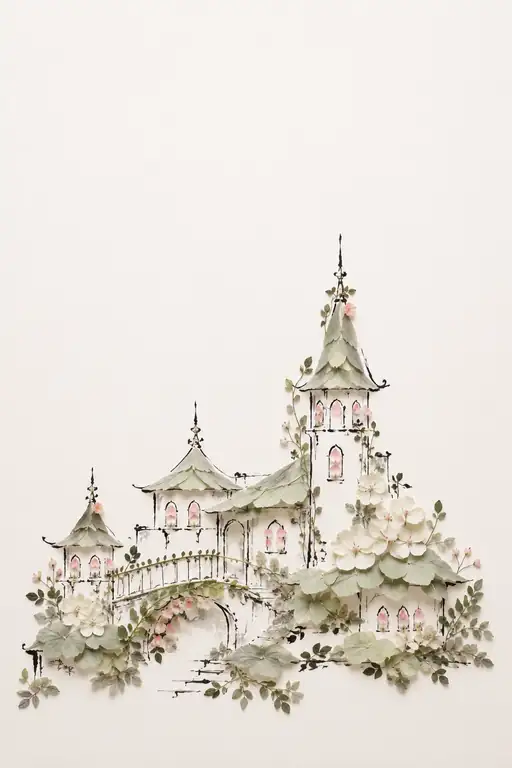 Sage Spire Castle and the Blossoming Bridge