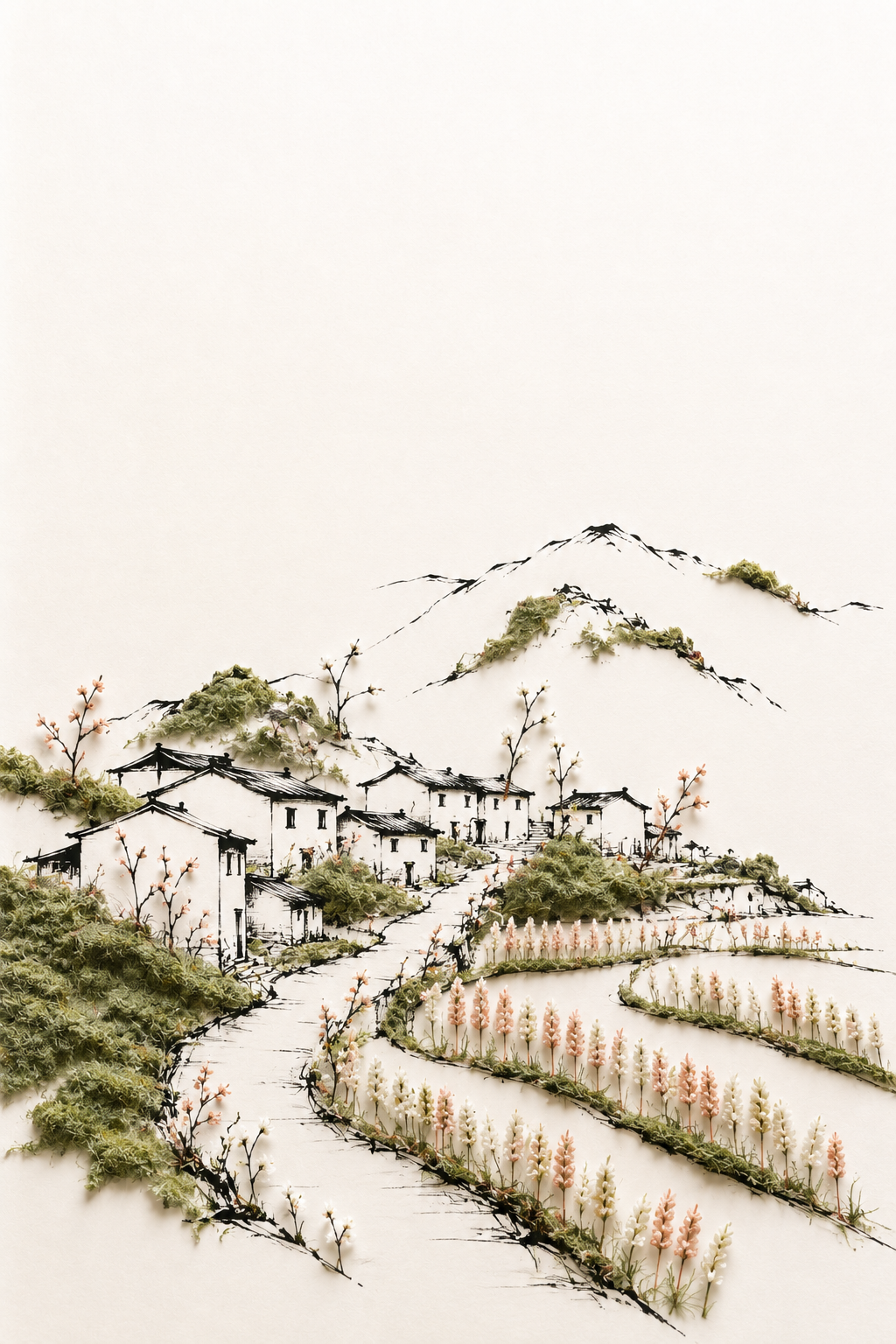
Terraced Haven Beneath the High Peak
Critique
Introduction This work presents a mountain village where white houses, moss-covered slopes, and terraced rows of pale flowers gather beneath an immense unpainted sky. Fine black drawing supplies architecture and distant peaks, while raised botanical materials give the foreground physical presence. Description A broad road enters at lower center, bends left through a cluster of tiled houses, and rises toward buildings on a middle ridge. On the right, three curved terraces carry alternating peach and ivory flower spikes. Moss defines their banks and spreads densely across the left hillside. Sparse flowering trees punctuate the road, while successive mountain ridges ascend behind the village. Analysis The road and terrace edges create curves that funnel attention into the settlement. Buildings diminish toward the center, and the black mountain contours become thinner as they recede. This measured reduction establishes depth despite the white ground. Peach accents migrate from large foreground spikes to tiny orchard blossoms. Rough moss, projecting flowers, and dry brush lines establish a clear hierarchy of textures. Interpretation and Evaluation The village appears as a patient accommodation between habitation and steep terrain. Terraces do not conquer the slope; their arcs echo its contours, turning cultivation into a form of listening. The enormous blank upper field intensifies the settlement's small scale and gives the distant summit contemplative authority. Spatial compression, disciplined color, and convincing changes of scale demonstrate strong control across the mixed media. Conclusion At first the terraced flowers attract, yet sustained viewing reveals the road as the work's connective tissue. It joins fields, homes, trees, and mountains without breaking their rhythms. The restrained palette prevents the tactile elements from becoming merely decorative. This is an image of communal life shaped by elevation, seasonal labor, and open space.
Same Subcategory
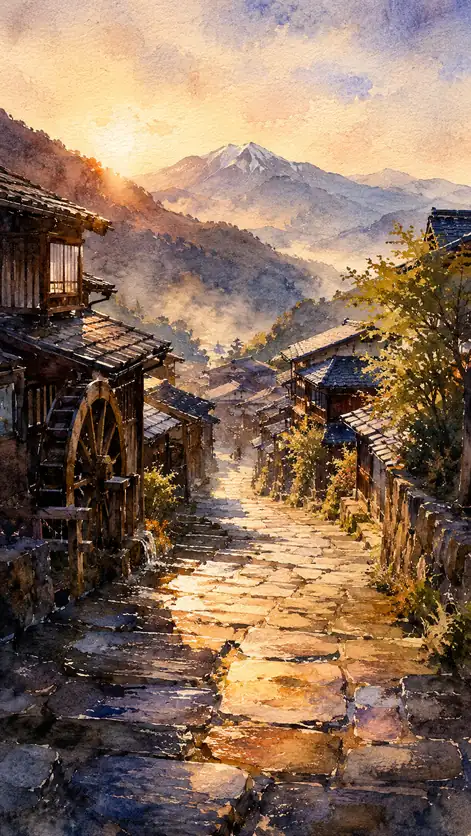 The Road Keeps the Evening
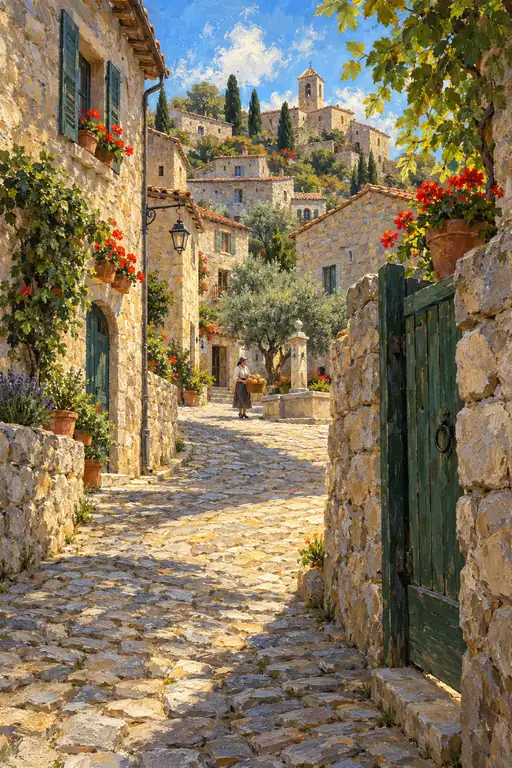 Path to the Hilltop Belfry
Similar Artworks
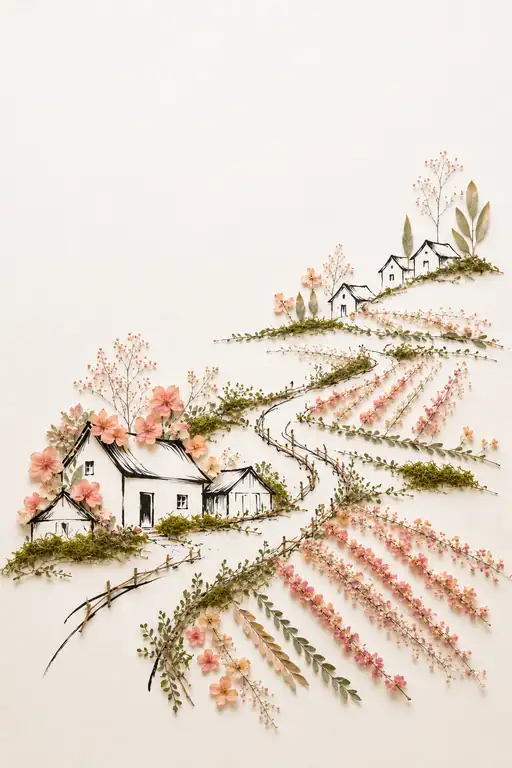 Spring Ascent to the Hilltop Cottages
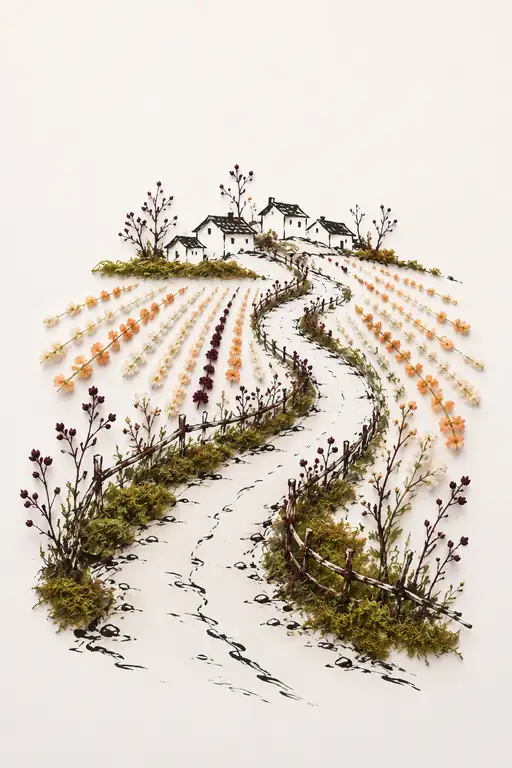 Winding Trail Through the Flowered Hills
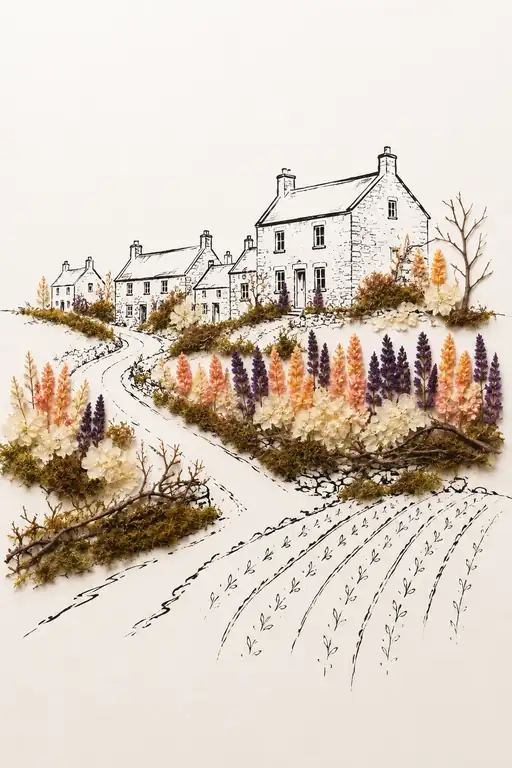 Village Road in Lupine and Stone
 Passage Beneath the Arch
 Flow of Blossoms by the Stone Bridge
 Ripple and Reflection at the Canal House
 Pathway of the Lantern and Bridge
 Fountain of the Coral Grove
 Wheel Turning by the Violet Stream
 Violet Cascade in Misty Crags