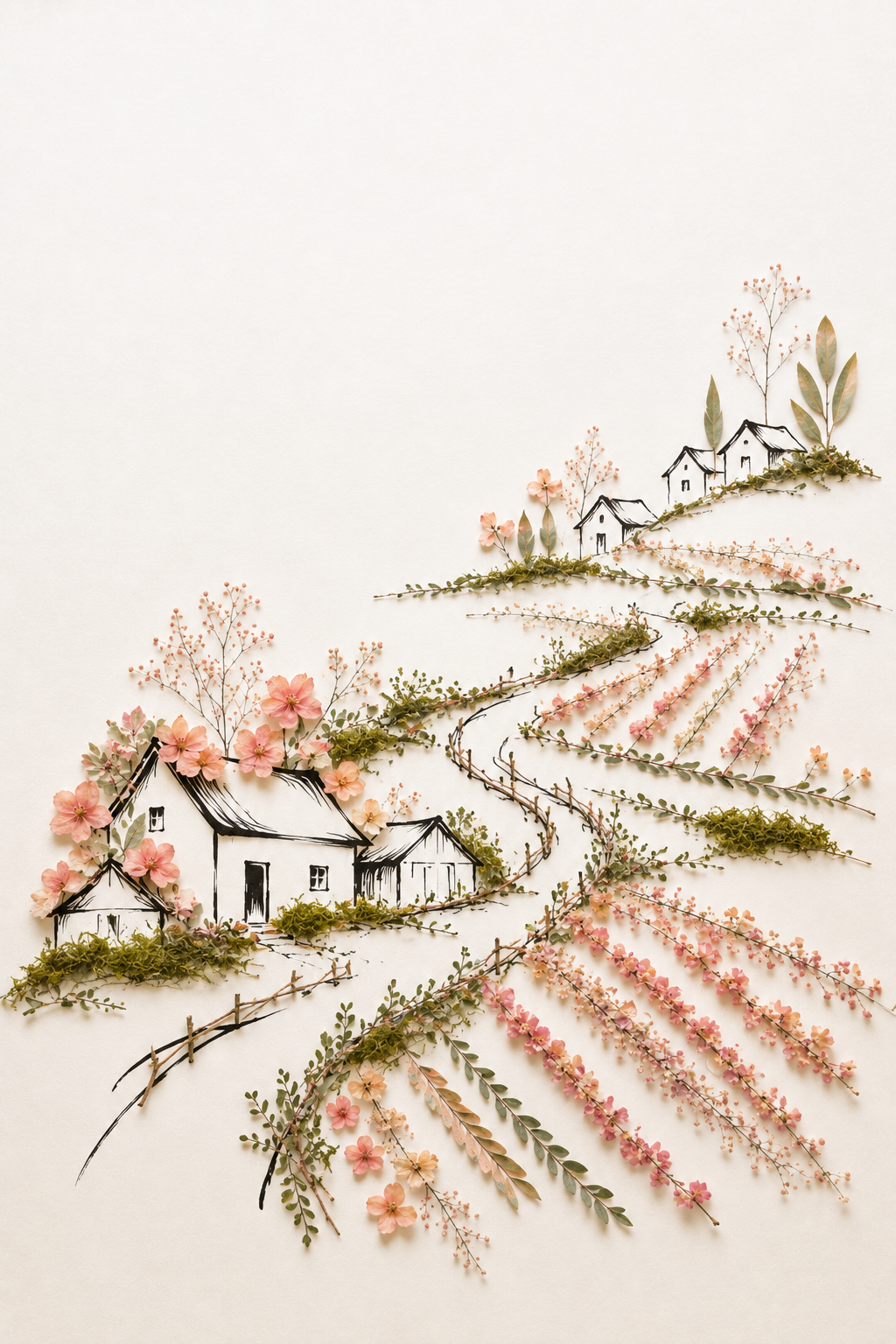
Spring Ascent to the Hilltop Cottages
Critique
Introduction This work depicts a hillside settlement threaded by a winding fenced road and rows of coral flowers. Small white houses occupy several elevations, while moss, seed sprays, green leaflets, and black line drawing transform the pale slope into an airy cultivated landscape. Description The largest house cluster sits in the lower left, surrounded by peach blossoms and moss. A road curves from the lower edge, passes the houses, and climbs through the center toward three smaller homes at upper right. Rustic fences follow its bends. Parallel flowering branches form fields across the lower right and middle slope, accompanied by tall sparse sprays and large pointed leaves near the top. Analysis The road's repeated S-curves provide the main spatial route and connect three distinct levels. Flower rows descend diagonally across the slope, making cultivation visible without filling the white ground. Coral pink is concentrated in the lower right, balanced by smaller peach clusters near the houses. Olive moss and leaflet stems stabilize the palette. Thin shadows separate the botanical relief from the drawn terrain. Interpretation and Evaluation The image presents rural order as a light framework rather than a dense occupation of land. Fences and rows guide movement, but large intervals remain open, allowing each house and plant to retain autonomy. The tiered composition, restrained warm palette, and clear directional hierarchy demonstrate control. Precise small architecture and inventive use of flowering branches as fields give the hybrid technique freshness and coherence. Conclusion At first the foreground blossoms attract attention, but sustained viewing reveals the road as the element that turns scattered houses into a community. Its curves negotiate elevation and distance. Cultivation, habitation, and open ground remain balanced, producing a landscape that feels organized without becoming closed.
Same Subcategory
 1787953013822
Similar Artworks
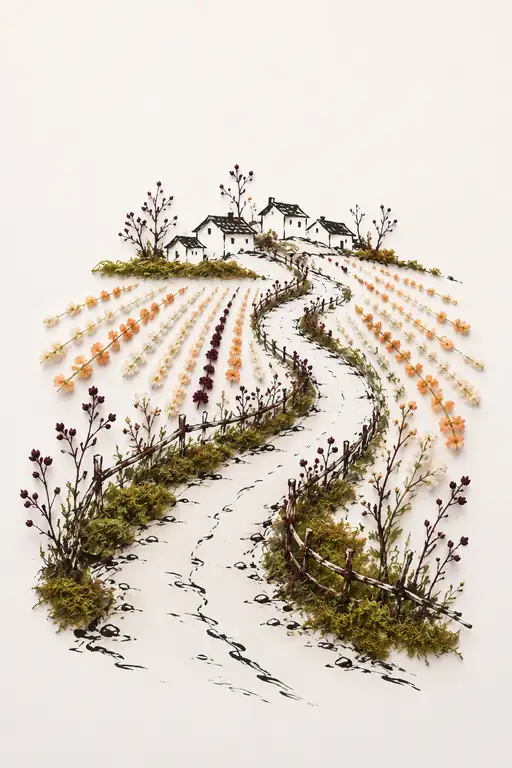 Winding Trail Through the Flowered Hills
 Village Road in Lupine and Stone
 Terraced Haven Beneath the High Peak
 Flow of Blossoms by the Stone Bridge
 Passage Beneath the Arch
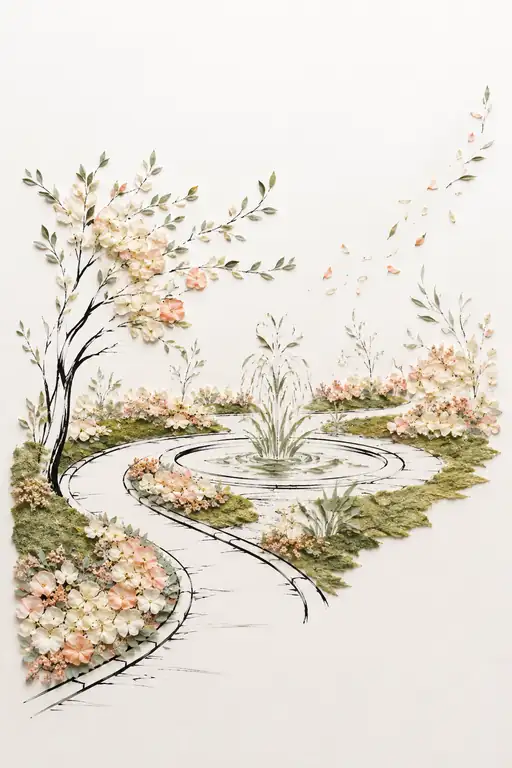 Garden Fountain and Whispering Petals in the Wind
 Pathway of the Lantern and Bridge
 Fountain of the Coral Grove
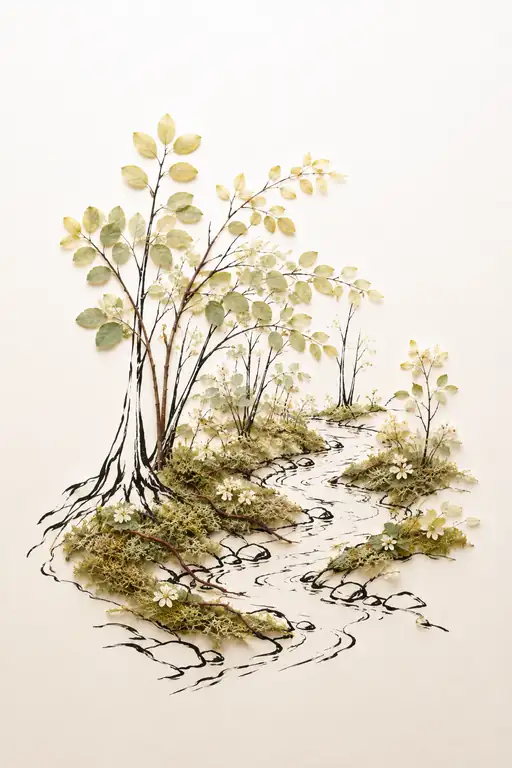 Serenade of the Winding Stream
 Where the Whispering Water Leads