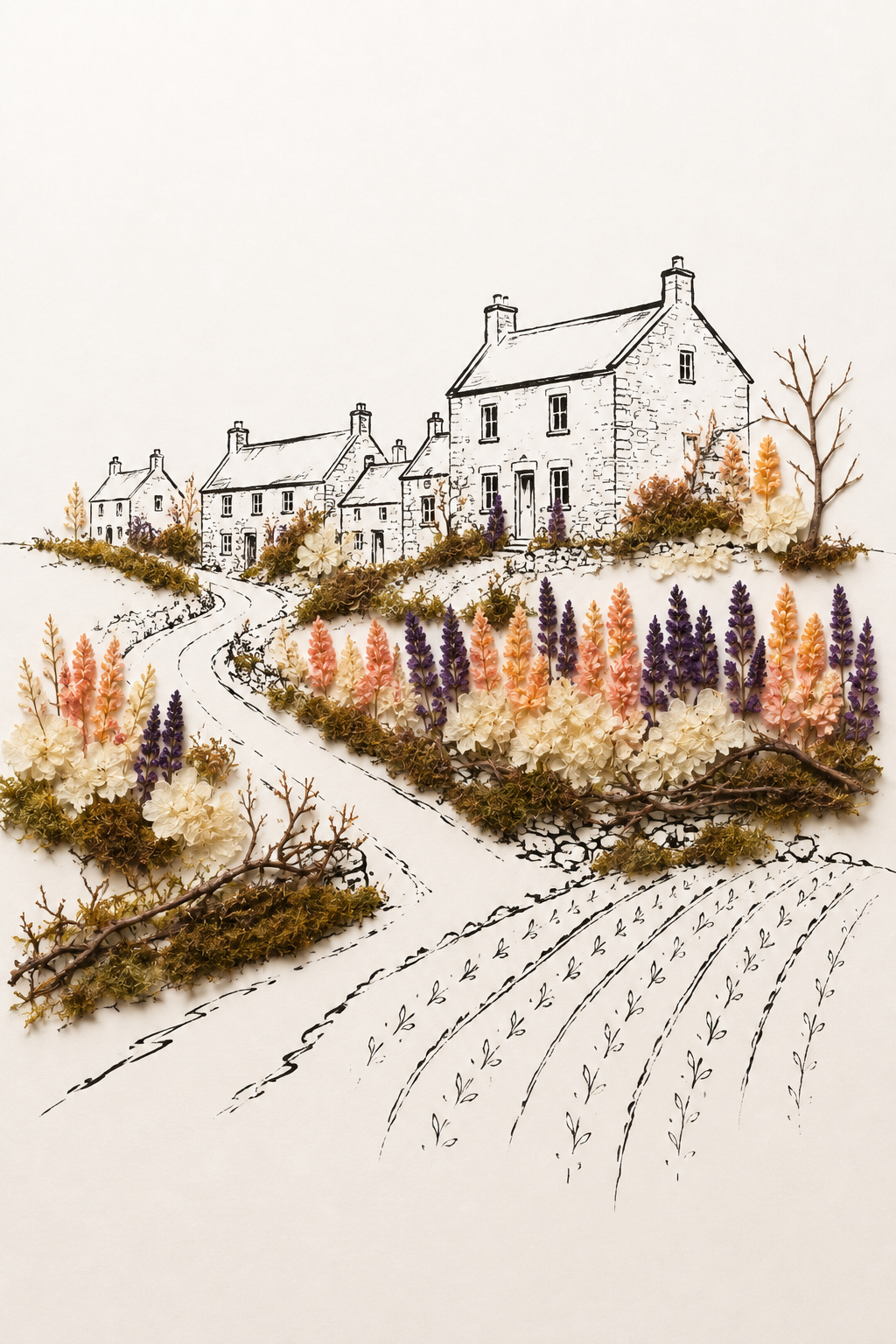
Village Road in Lupine and Stone
Critique
Introduction This work presents a cluster of pale stone houses above curved fields and a flower-lined road. Coral, cream, and violet spikes rise from mossy beds, while architecture, bare trees, field furrows, and road remain disciplined black drawing. The largest house anchors the upper right. Description Four groups of pitched-roof houses recede from right foreground to left distance, each marked by chimneys, windows, doors, and stone courses. The road enters at lower left and curves uphill between mossy walls. Dense rows of upright peach and purple flowers fill the middle beds above masses of cream blossoms. The lower right field is indicated by parallel curved furrows and tiny repeated shoots. Analysis The curving road creates one route into depth, while the field furrows generate a broad counter-sweep across the lower right. Changing house scale strengthens recession. Upright flower spikes form a colorful horizontal band between near fields and buildings. Coral and purple alternate rhythmically above cream bases; dark branches and moss provide weight. Fine masonry lines contrast with tactile petals and rough vegetation. Interpretation and Evaluation The scene treats the village as a layered product of habitation and cultivation. Houses, paths, walls, planted beds, and newly marked rows record different kinds of repeated labor. The asymmetrical arrangement, converging scales, and balanced color bands demonstrate compositional confidence. Detailed stone architecture and the clear conversion of plant materials into crops show descriptive skill and technical originality. Conclusion At first the large right-hand house appears dominant, but sustained viewing reveals a network extending through road, fields, and smaller homes. The empty furrowed plot introduces future growth beside existing bloom. The work holds continuity and renewal within a calm, legible rural structure.
Same Subcategory
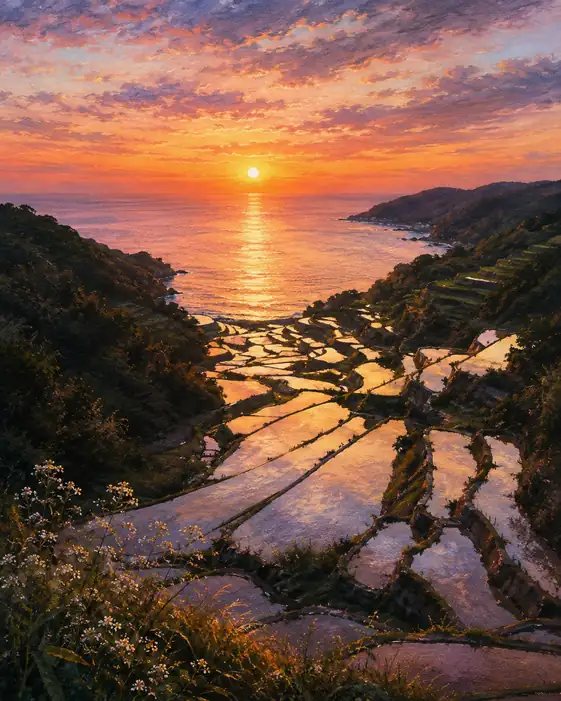 Twilight Mosaic Over the Coast
Similar Artworks
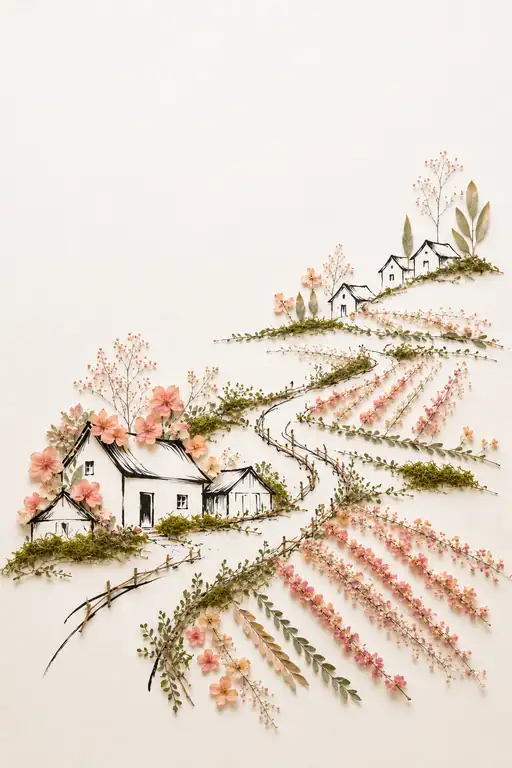 Spring Ascent to the Hilltop Cottages
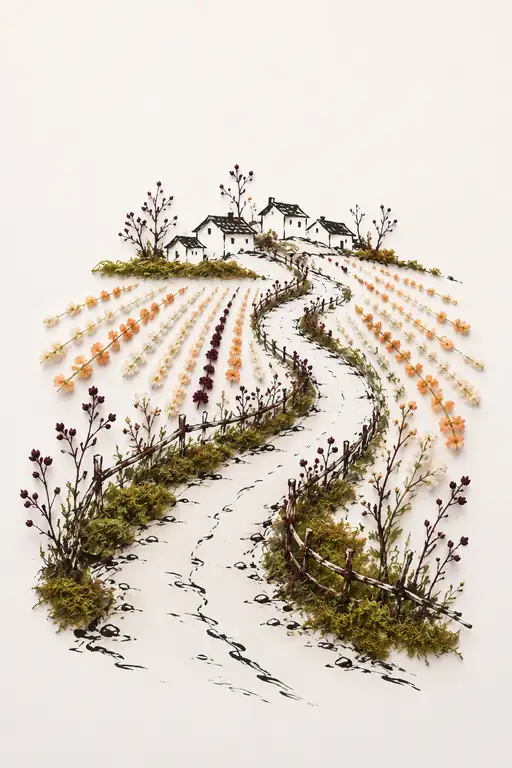 Winding Trail Through the Flowered Hills
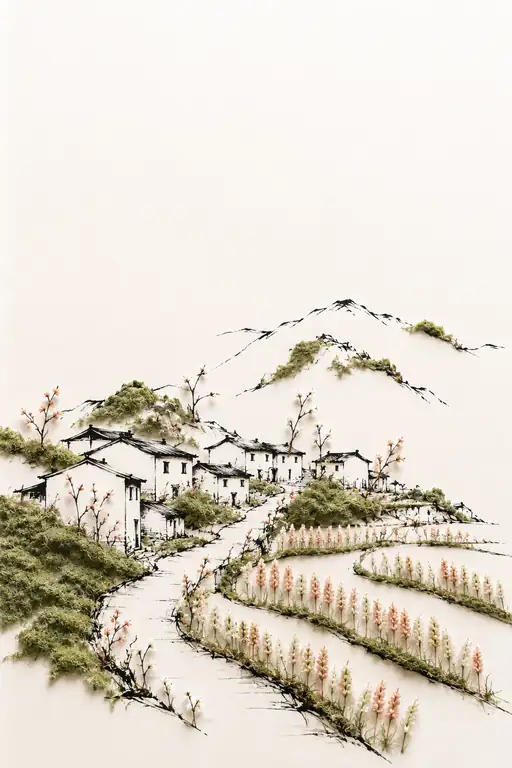 Terraced Haven Beneath the High Peak
 Flow of Blossoms by the Stone Bridge
 Passage Beneath the Arch
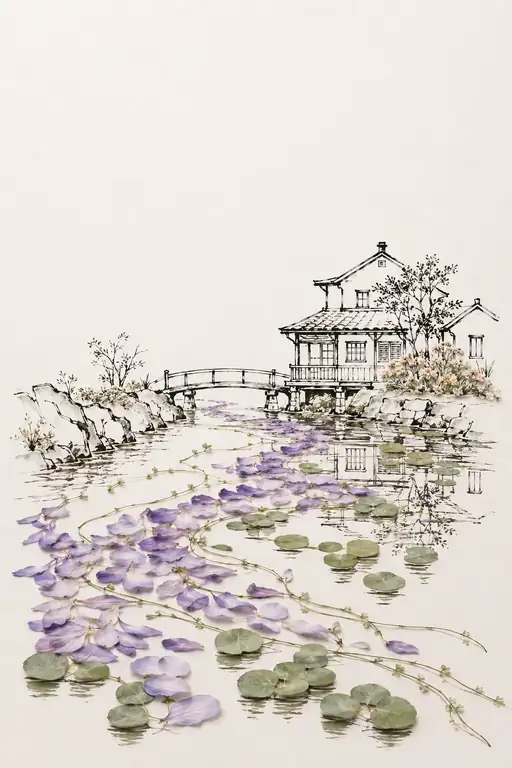 Ripple and Reflection at the Canal House
 Pathway of the Lantern and Bridge
 Fountain of the Coral Grove
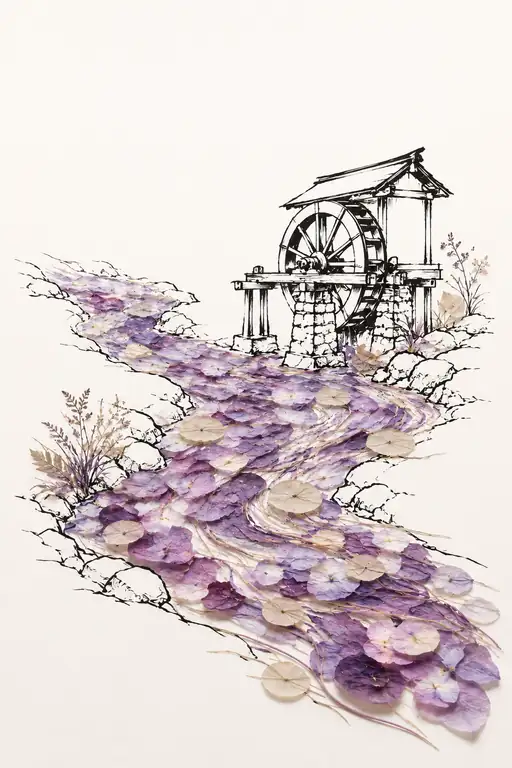 Wheel Turning by the Violet Stream
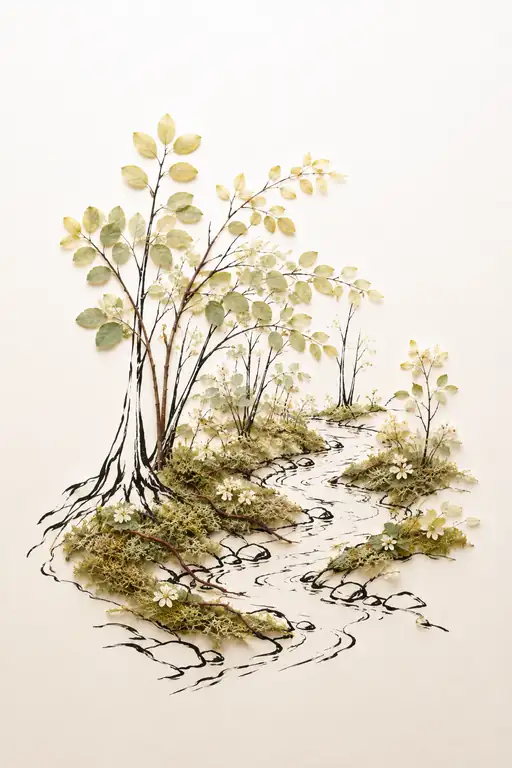 Serenade of the Winding Stream