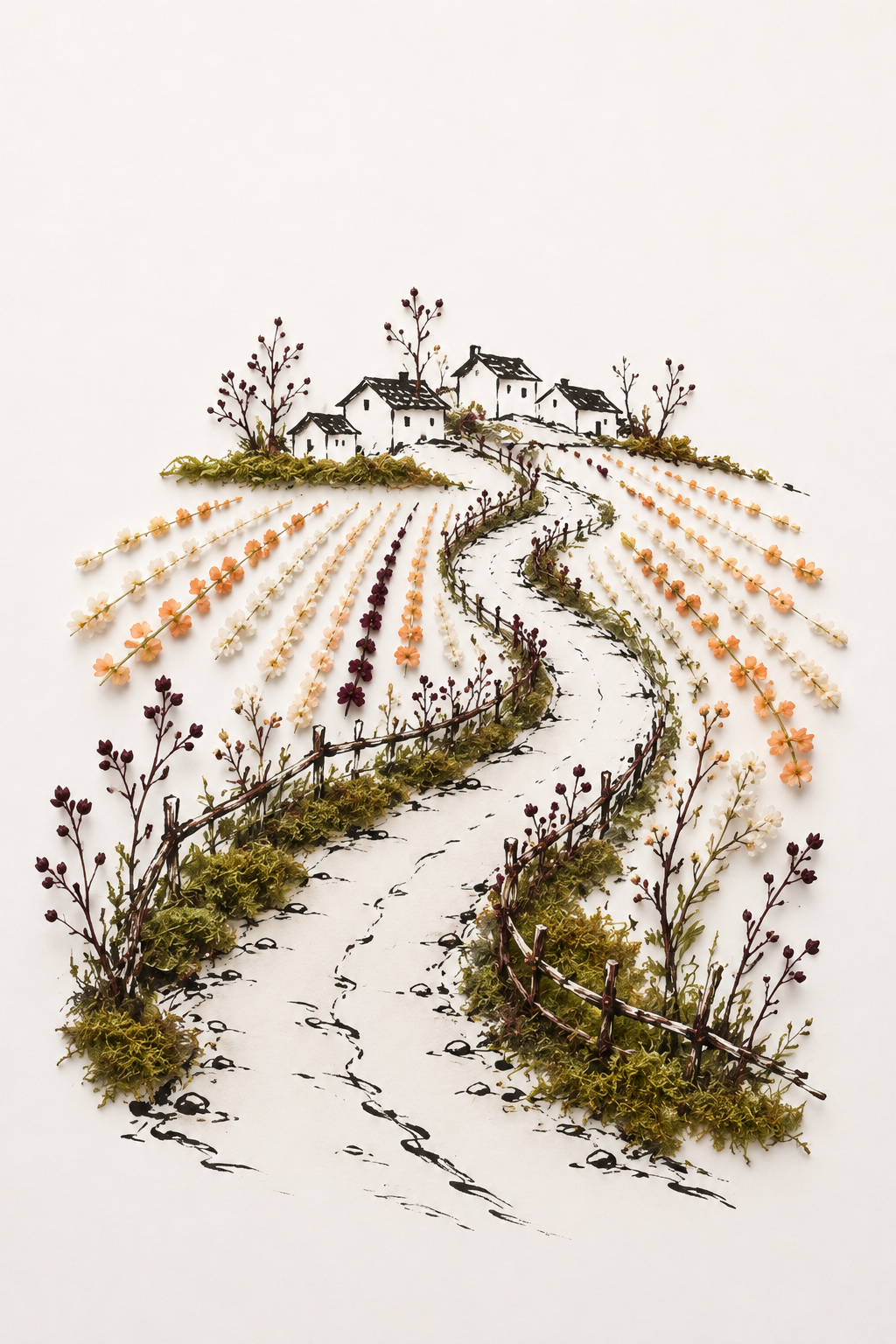
Winding Trail Through the Flowered Hills
Critique
Introduction This work depicts a winding fenced road climbing between cultivated flower rows toward a compact hilltop village. Moss, coral, cream, and burgundy plants form the fields and verges, while the road, fences, and white houses remain brisk black drawing against an open ground. Description The road begins broad at the lower center, curves right, then bends left toward several tiled-roof houses. Rustic fences follow both margins. Dense moss and dark budding branches fill the nearest verges. Across the upper slopes, parallel rows of peach, cream, and deep wine flowers radiate outward from the village, becoming larger and more widely spaced toward the foreground. Analysis The S-shaped road is the principal spatial device, reinforced by converging fences and decreasing house scale. Flower rows provide a second system of diagonals, fanning across both slopes and contrasting with the road's curves. Peach and cream establish light rhythm, while burgundy stems create dark accents. Rough moss, rounded buds, flat petals, and rapid ink marks produce varied textures. Interpretation and Evaluation The landscape presents cultivation as an ordering practice that does not eliminate irregular growth. Straight planting rows coexist with a bending road and uneven verges, suggesting labor adapted to terrain. The composition controls multiple recession lines without confusion, and the limited warm palette remains coherent. Clear architectural silhouettes and carefully placed botanical material demonstrate technical precision and an inventive hybrid method. Conclusion At first the village appears to be the destination, but closer viewing makes the journey through patterned fields equally important. Fences measure progress, flower rows reveal the slope, and the road preserves openness amid density. The work balances collective order with the particularity of each plant.
Same Subcategory
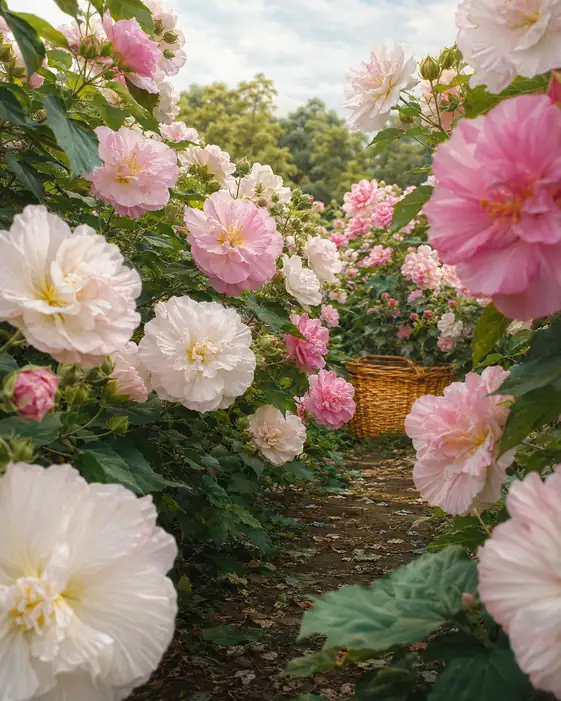 Garden Lane with Woven Basket
Similar Artworks
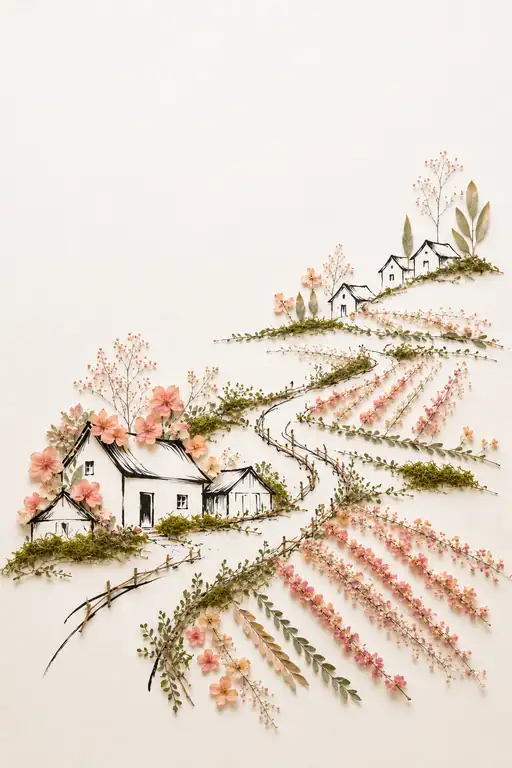 Spring Ascent to the Hilltop Cottages
 Terraced Haven Beneath the High Peak
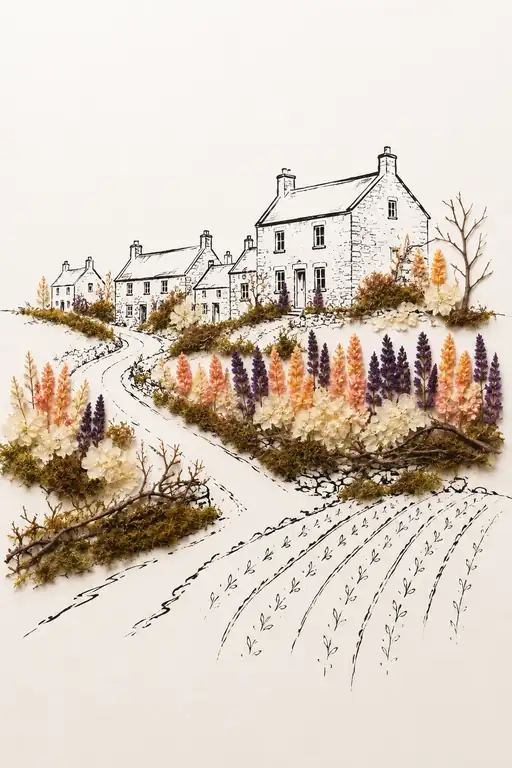 Village Road in Lupine and Stone
 Passage Beneath the Arch
 Flow of Blossoms by the Stone Bridge
 Pathway of the Lantern and Bridge
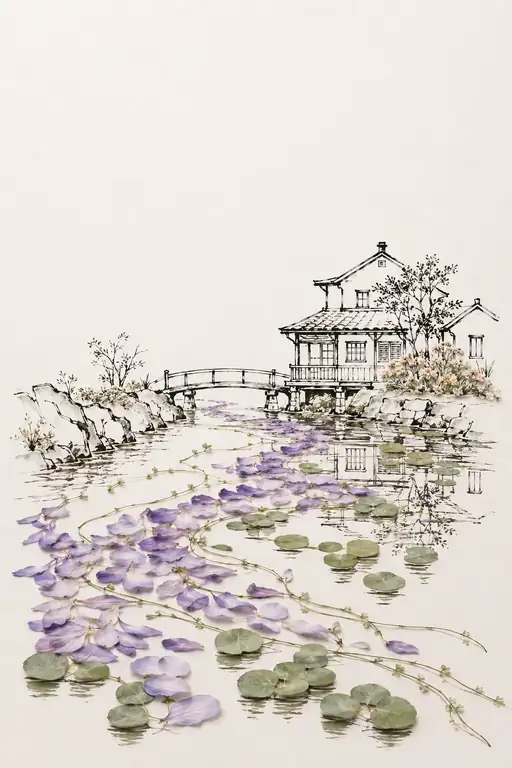 Ripple and Reflection at the Canal House
 Fountain of the Coral Grove
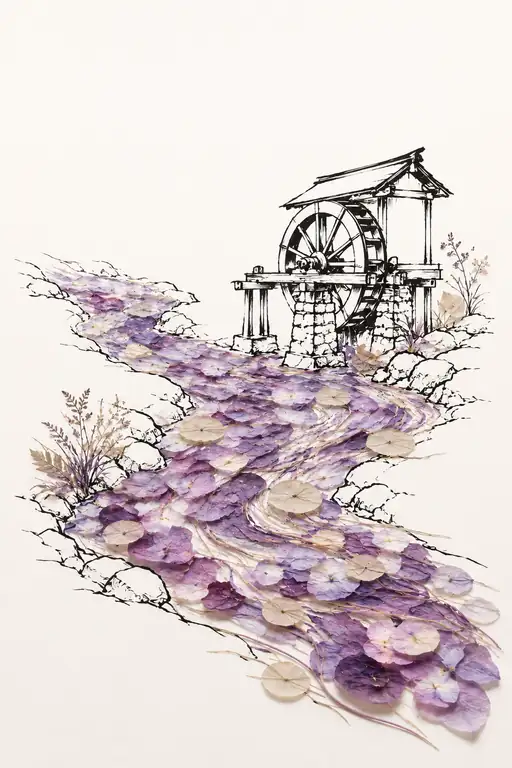 Wheel Turning by the Violet Stream
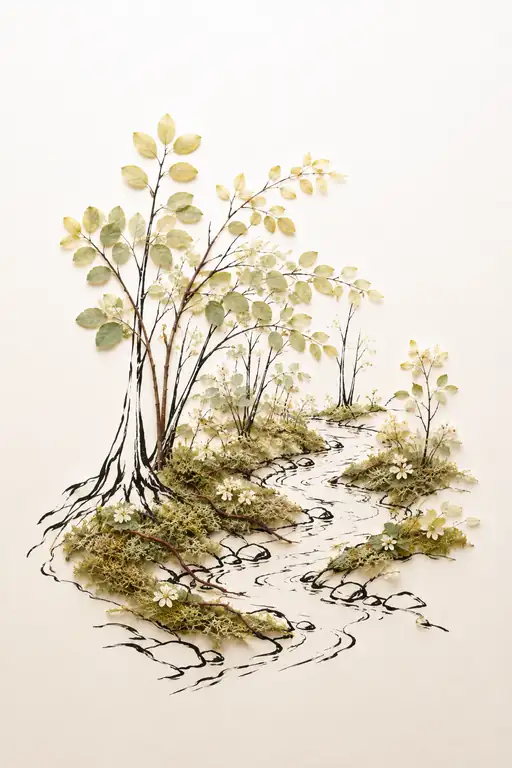 Serenade of the Winding Stream