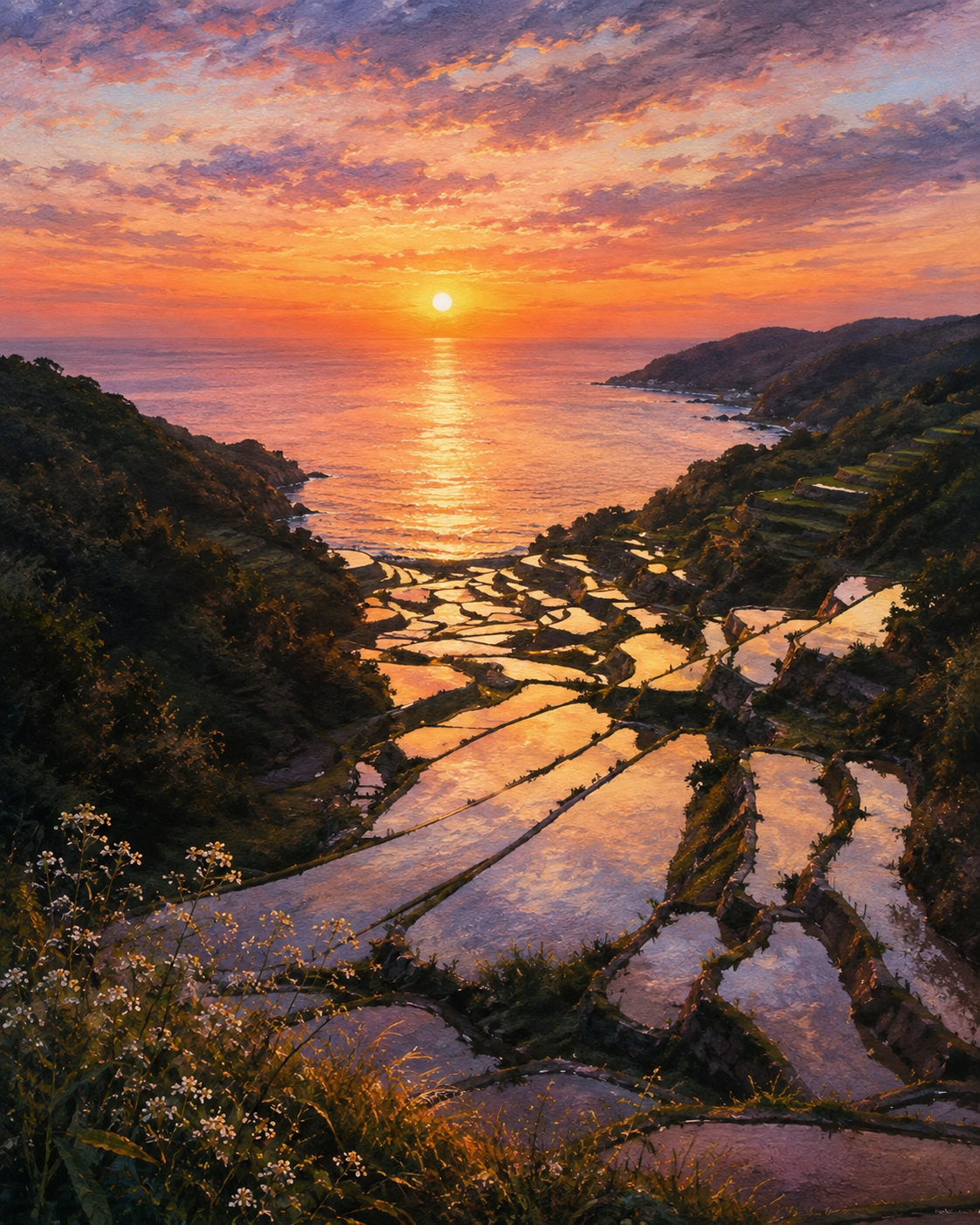
Twilight Mosaic Over the Coast
Critique
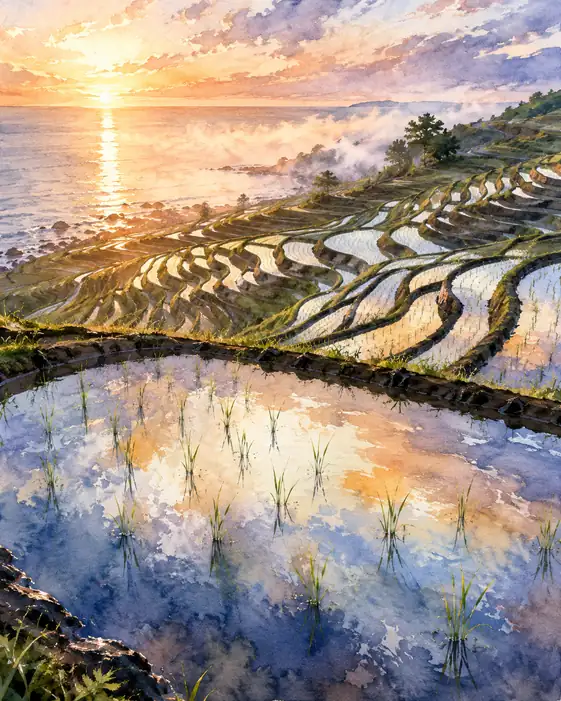
Introduction This work surveys a broad coastal basin at sunset, where flooded terraces spread across the lower slopes before meeting an expansive sea. The sun stands left of center beneath a layered cloud ceiling, and its reflection crosses both open water and many separated fields. Description Large foreground terraces extend from the lower center toward the right edge, divided by dark branching embankments. Smaller, more irregular plots cluster near the shore and climb the far-right hillside. White wildflowers and illuminated grasses occupy the lower left. Two rugged headlands frame the bay, while lavender, coral, and gold clouds fill almost half the image. Analysis The horizon divides the scene near mid-height, but the descending terrace diagonals lead forcefully from the foreground to the bay. The sun's reflection forms a secondary vertical route left of center. Golden water is surrounded by violet shadows and deep green vegetation; coral cloud edges repeat in the fields. Broad textured strokes describe sky and water, while sharper dark marks articulate walls, rocks, and vegetation. Interpretation and Evaluation The landscape presents cultivated ground as a network that gathers and distributes atmospheric change. Unlike one continuous sea reflection, every field preserves a slightly different portion of the sky. The wide coastal framing, layered depth, and asymmetrical balance demonstrate compositional assurance. Nuanced color transitions and varied brush handling show technical skill, while foreground flowers prevent the panoramic view from losing intimate scale. Conclusion At first the sunset's brilliant sky commands attention, but sustained viewing reveals the terraces as an equally active mosaic of reflected time. The bay opens the scene outward, while the field walls bring light back toward the viewer. Monumental atmosphere and specific lived terrain are held in a persuasive balance.
Same Subcategory
 Village Road in Lupine and Stone
Similar Artworks
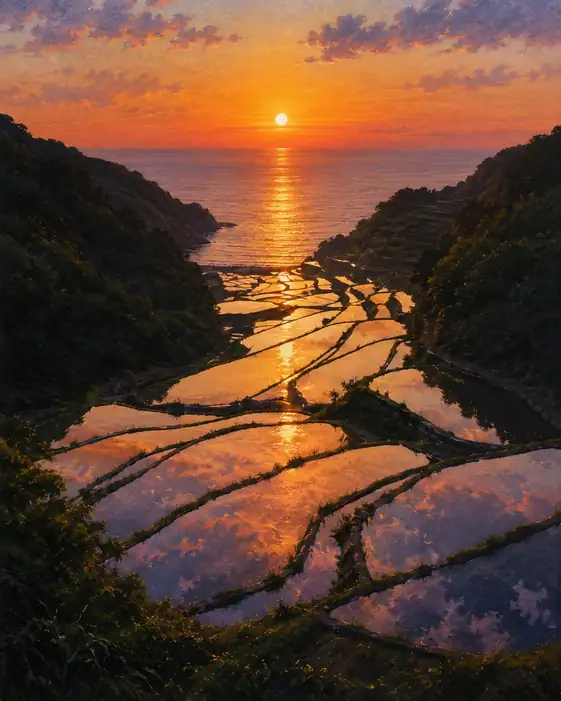 Golden Mirror to the Horizon
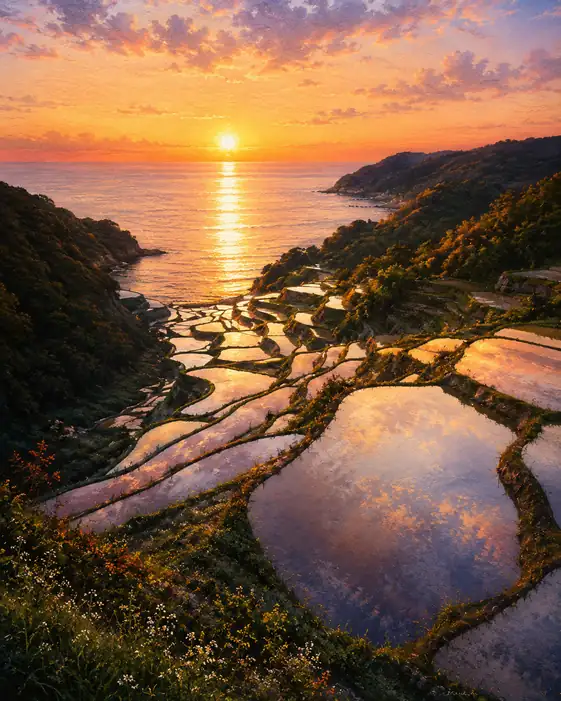 Two Hundred Eighty-Three Skies Asleep in the Cove
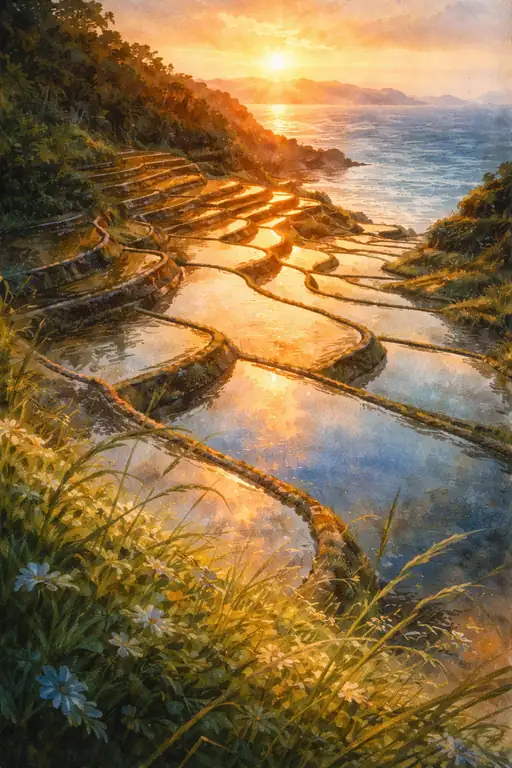 The Golden Mirror of the Hills
 Mirror of the Golden Terraces
 The Golden Mirrors of the Silent Hill
 A Thousand Hands Gather the Sun
 Golden Terraces: The Sunset's Embrace
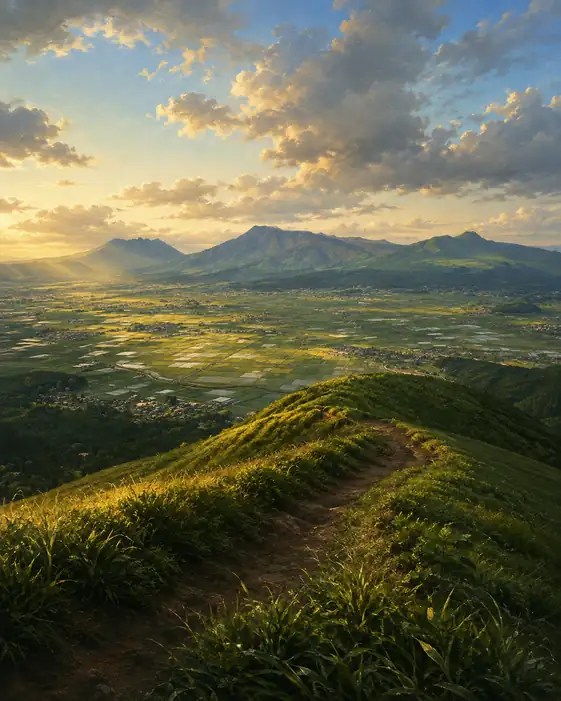 Golden Hour Over the Caldera
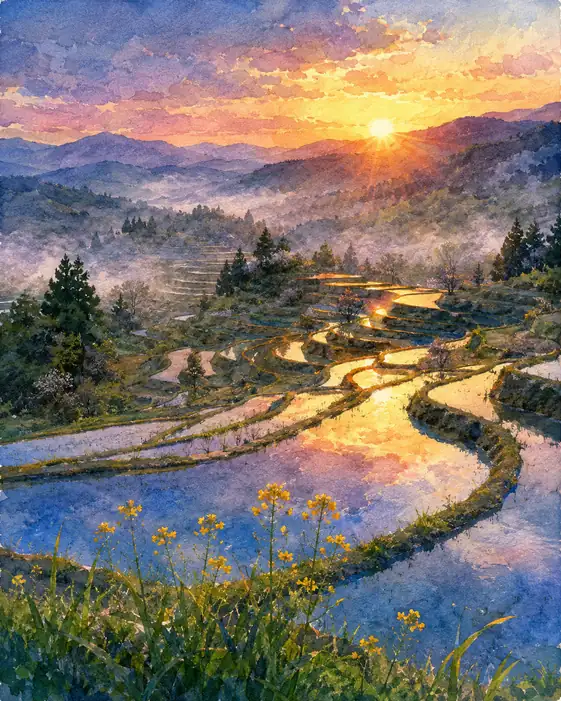 Sunset Flows through the Rice Terraces
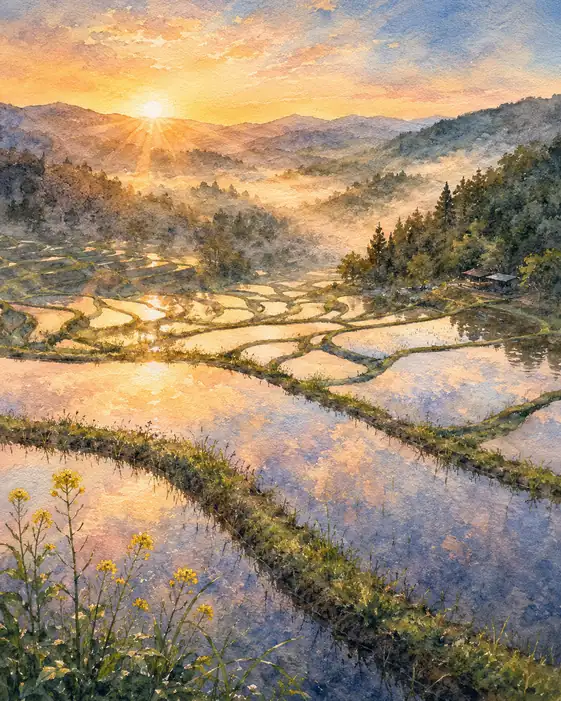 Dawn Sleeps in a Thousand Fields