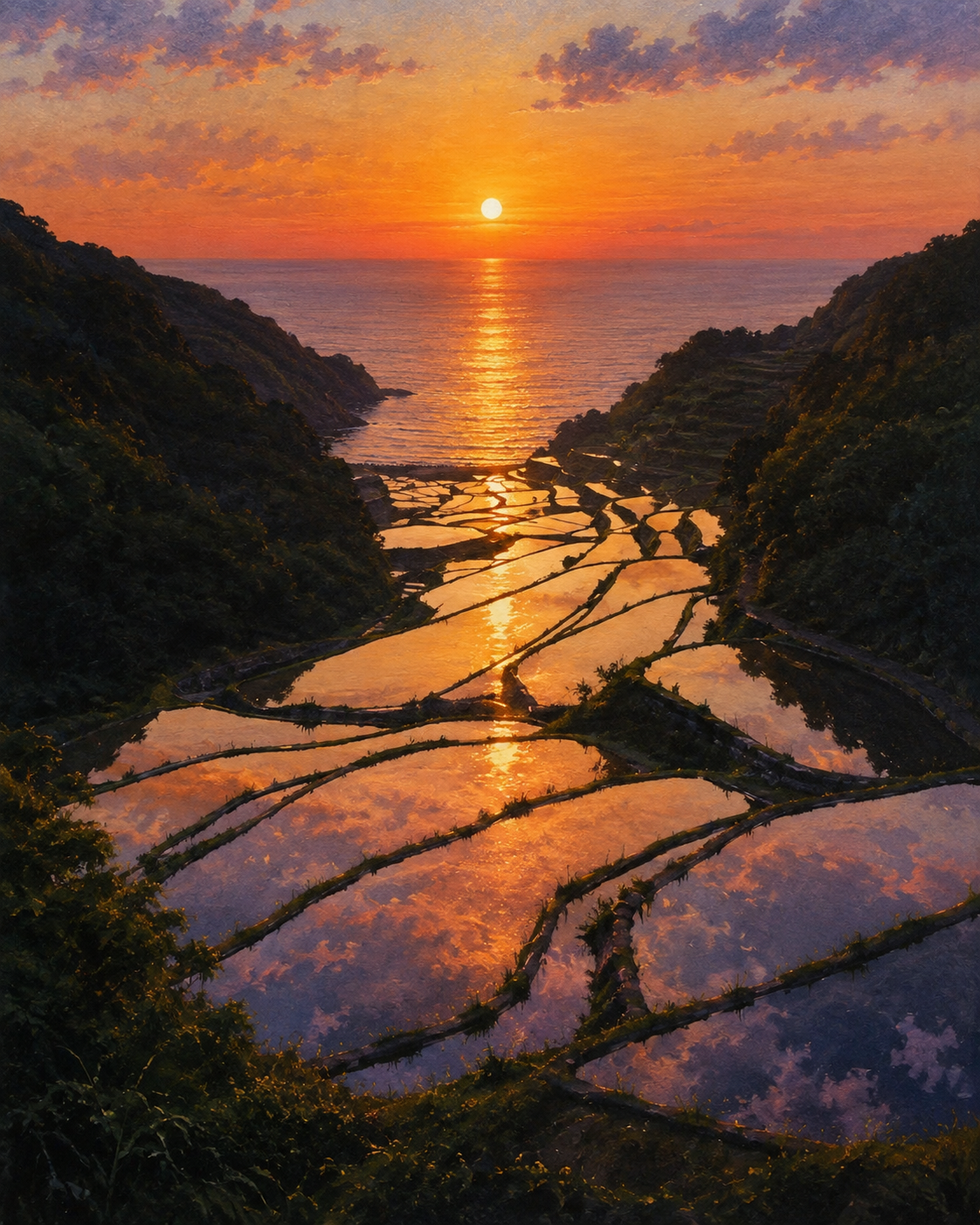
Golden Mirror to the Horizon
Critique
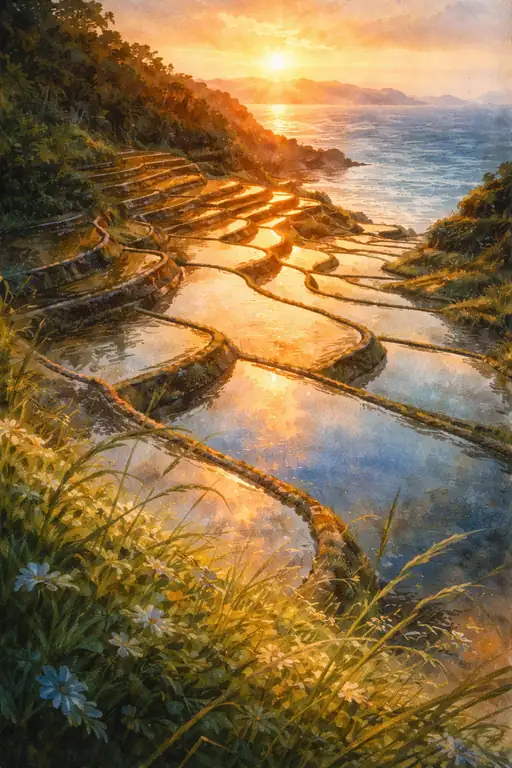
Introduction This work looks down flooded terraces toward the sea and setting sun. Dark hills form a deep V, and orange reflection passes from the horizon through stepped water to the foreground. Description Broad terraces fill the lower two thirds, their irregular pools divided by black-green embankments. The nearest water is violet-blue with orange cloud reflections, while middle plots burn more intensely gold. Steep wooded slopes rise on both sides and converge near the shore. Above a straight horizon, a small round sun hangs beneath scattered mauve clouds in a dense orange sky. Analysis The composition is strongly axial: sun, sea reflection, valley opening, and brightest fields align near the center. Curving terrace walls complicate this symmetry and widen toward the viewer, producing forceful depth. Orange and gold occupy the central corridor, enclosed by nearly black green slopes; violet shadows cool the foreground. Short broken strokes distinguish rippling sea, mirrored sky, vegetation, and rough embankments. Interpretation and Evaluation The view treats the terraces as a human extension of the solar path. Their many boundaries fragment light, yet the aligned highlights preserve continuity from sea to cultivated land. The V-shaped framing, disciplined central focus, and progressive scale demonstrate strong compositional control. Rich warm-cool modulation and differentiated textures show technical skill, while the unusually direct chain of reflections gives the scene concentrated symbolic force. Conclusion At first the centered sunset appears to be the sole subject, but closer viewing reveals that the fields actively construct its approach toward the viewer. Darkness on both hills intensifies the luminous corridor without erasing land detail. The work turns agricultural geometry into a measured passage between distant horizon and immediate ground.
Same Subcategory
Similar Artworks
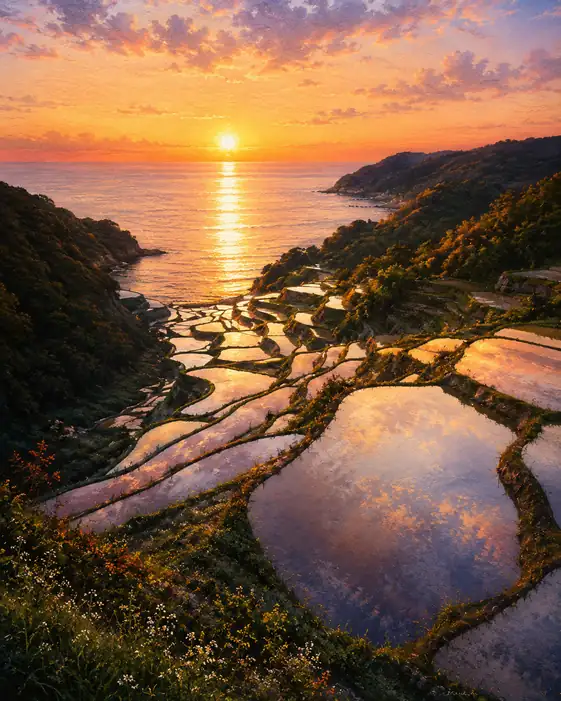 Two Hundred Eighty-Three Skies Asleep in the Cove
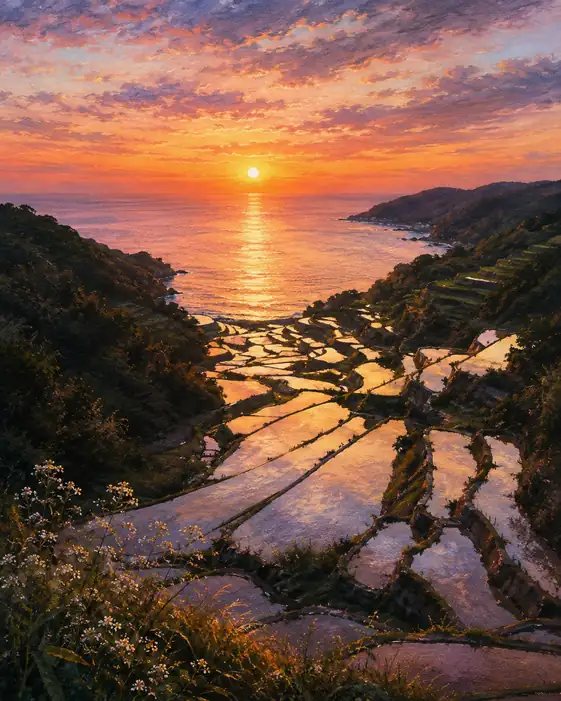 Twilight Mosaic Over the Coast
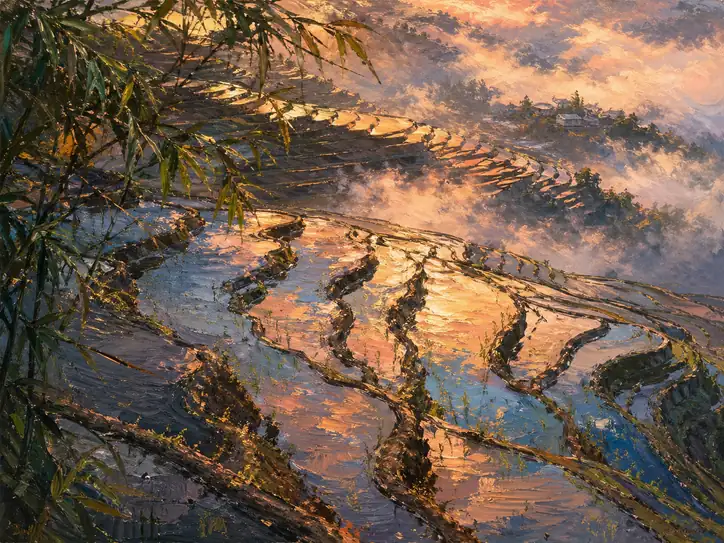 Mirror of the Golden Terraces
 The Golden Mirror of the Hills
 Golden Terraces: The Sunset's Embrace
 Golden Hour Over the Caldera
 A Thousand Hands Gather the Sun
 The Quiet Mirror of the Earth
 Golden Dawn's Reflection
 The Golden Mirrors of the Silent Hill