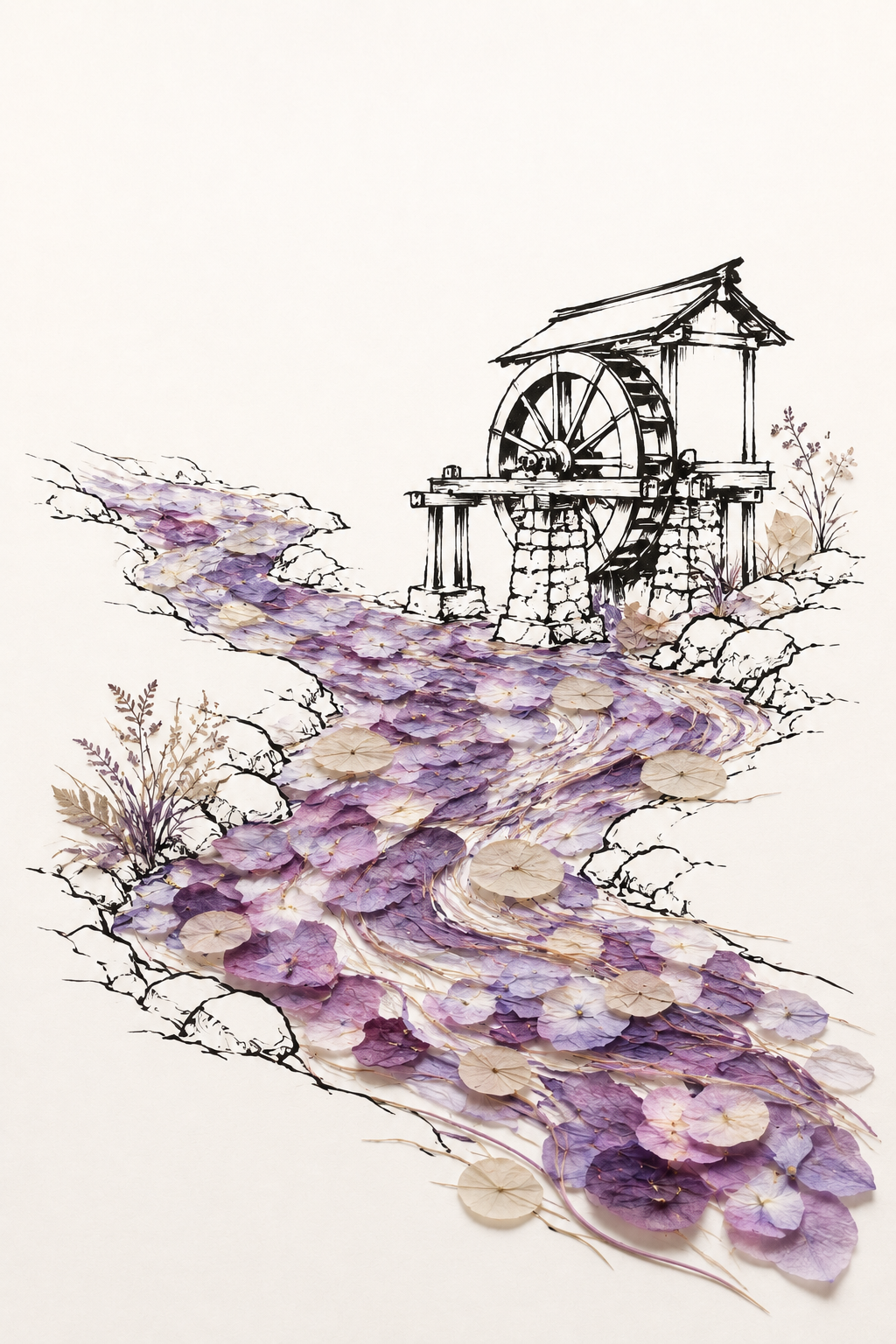
Wheel Turning by the Violet Stream
Critique
Introduction This work depicts a traditional watermill beside a winding stream composed of layered violet, cream, and pale pink petals. The building and rocky banks are drawn in vigorous black line, while the dense botanical current sweeps from the distant left toward the lower foreground. Description The mill occupies the upper right, with a pitched roof, timber platform, stone base, and large wheel. Its dark spokes and paddles stand partly above the stream. The water bends in a broad S-shape, filled with overlapping petals, round translucent seed forms, and long pale fibers. Sparse dry plants rise among outlined rocks on both banks. Analysis The stream is the dominant spatial route: narrow at the distant left, it curves past the wheel and expands dramatically toward the viewer. The mill's rigid verticals and circle counter the current's fluid diagonals. Violet supplies depth, while cream disks and pale strands mark eddies and surface highlights. Layered petals give the water physical thickness; rapid ink contours keep stones and architecture comparatively light. Interpretation and Evaluation The image links natural flow to human mechanism without showing labor. The wheel receives the petal current, suggesting energy translated into structure, yet its stillness preserves an ambiguous pause. Strong recession, clear focal contrast, and disciplined cool color demonstrate compositional control. The precise architectural drawing and inventive conversion of fragile blossoms into forceful water give the technique technical and conceptual originality. Conclusion At first the scene appears to be a picturesque mill landscape, but sustained attention reveals a tension between motion and suspension. The current seems abundant enough to turn the wheel, although the drawn machinery remains silent. Material flowers and implied water therefore create a reflective image of stored energy and passing time.
Same Subcategory
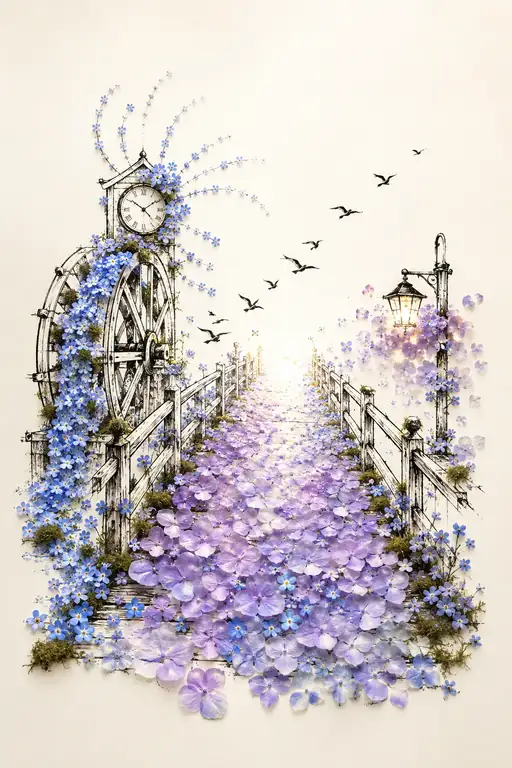 The Waterwheel Clock and the Path of Hydrangeas
Similar Artworks
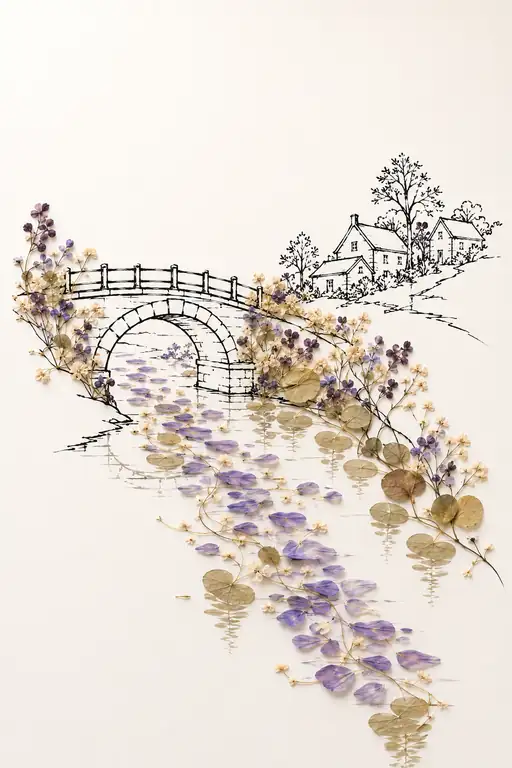 Passage Beneath the Arch
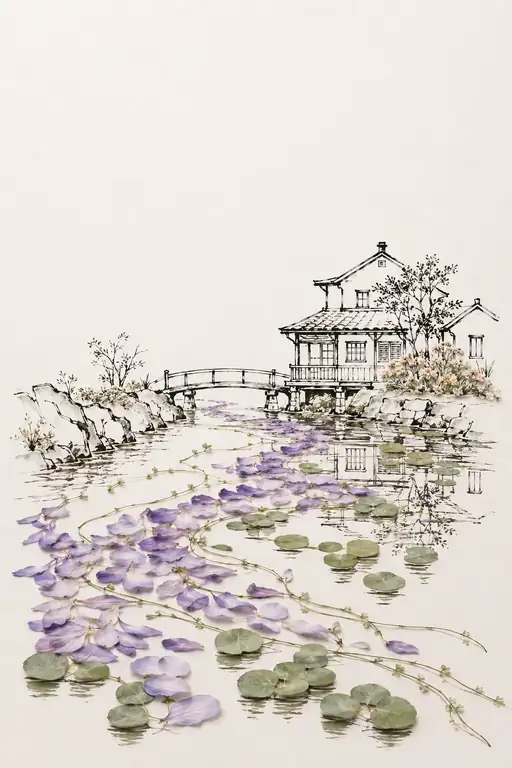 Ripple and Reflection at the Canal House
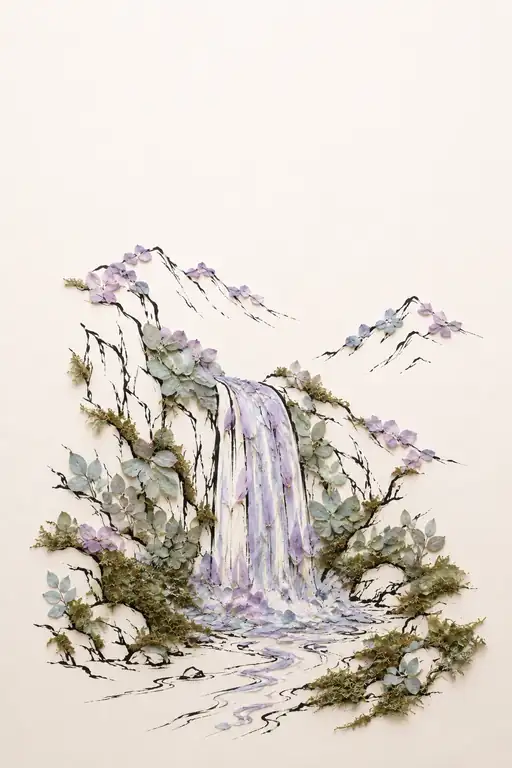 Violet Cascade in Misty Crags
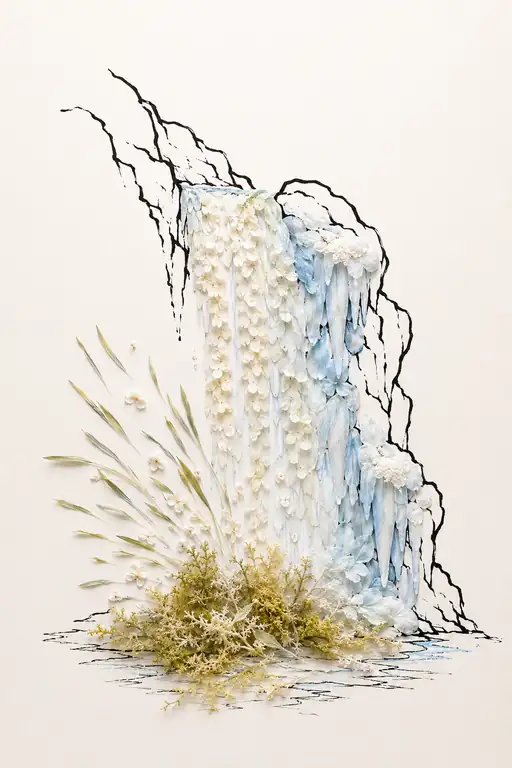 Petal Cascade on the Inky Crags
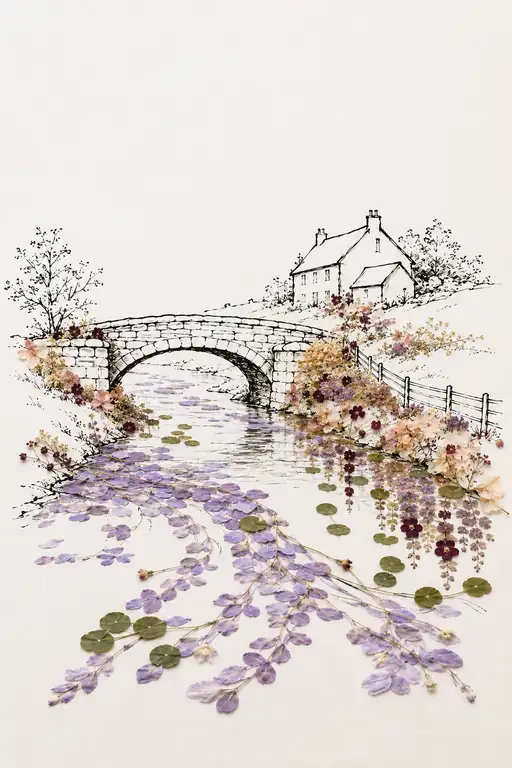 Flow of Blossoms by the Stone Bridge
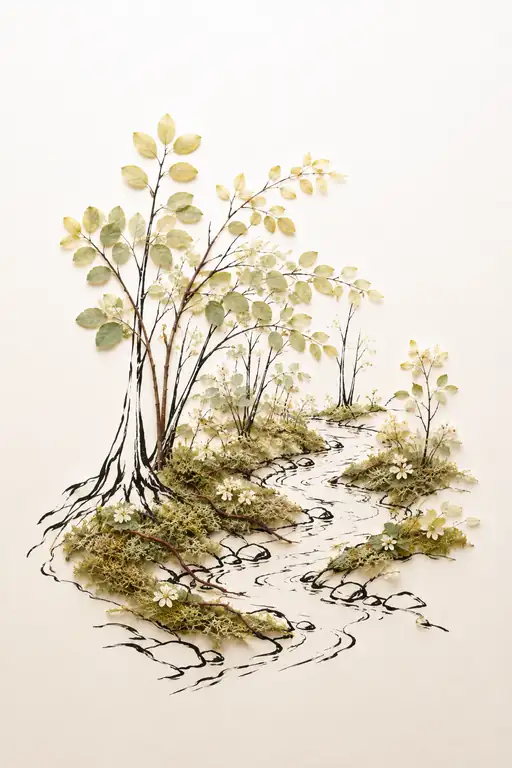 Serenade of the Winding Stream
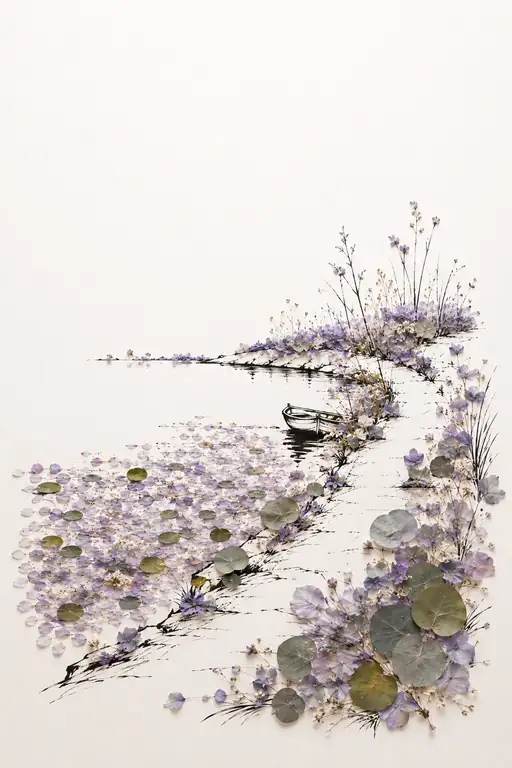 Lavender Inlet and the Moored Boat
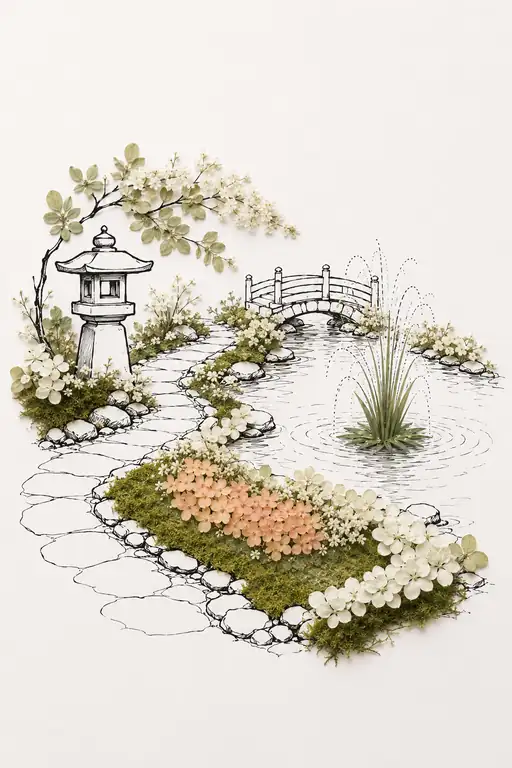 Pathway of the Lantern and Bridge
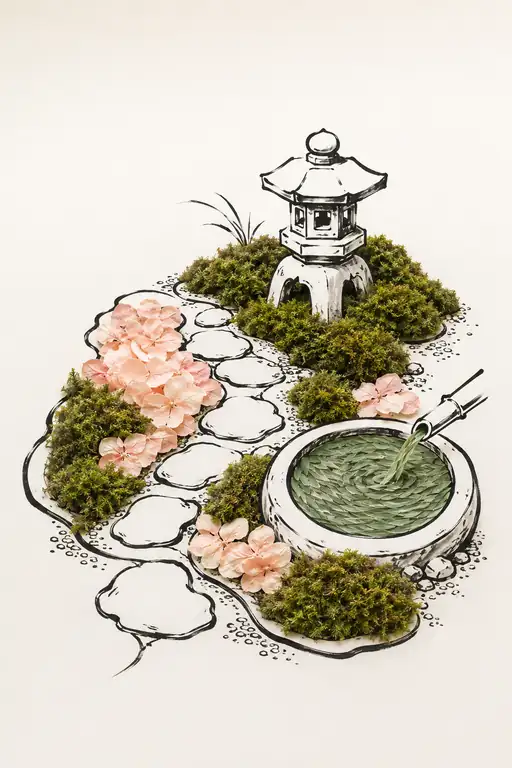 Stone Lantern and Flowing Water in the Moss Garden
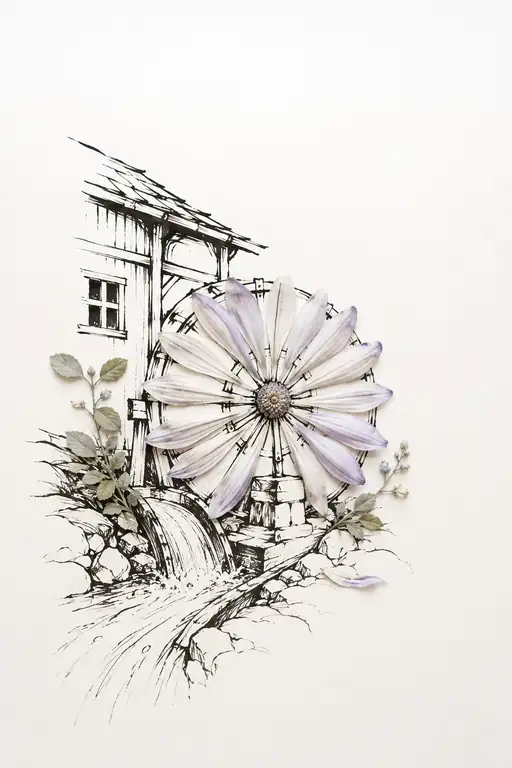 Wheel of Whispering Waters