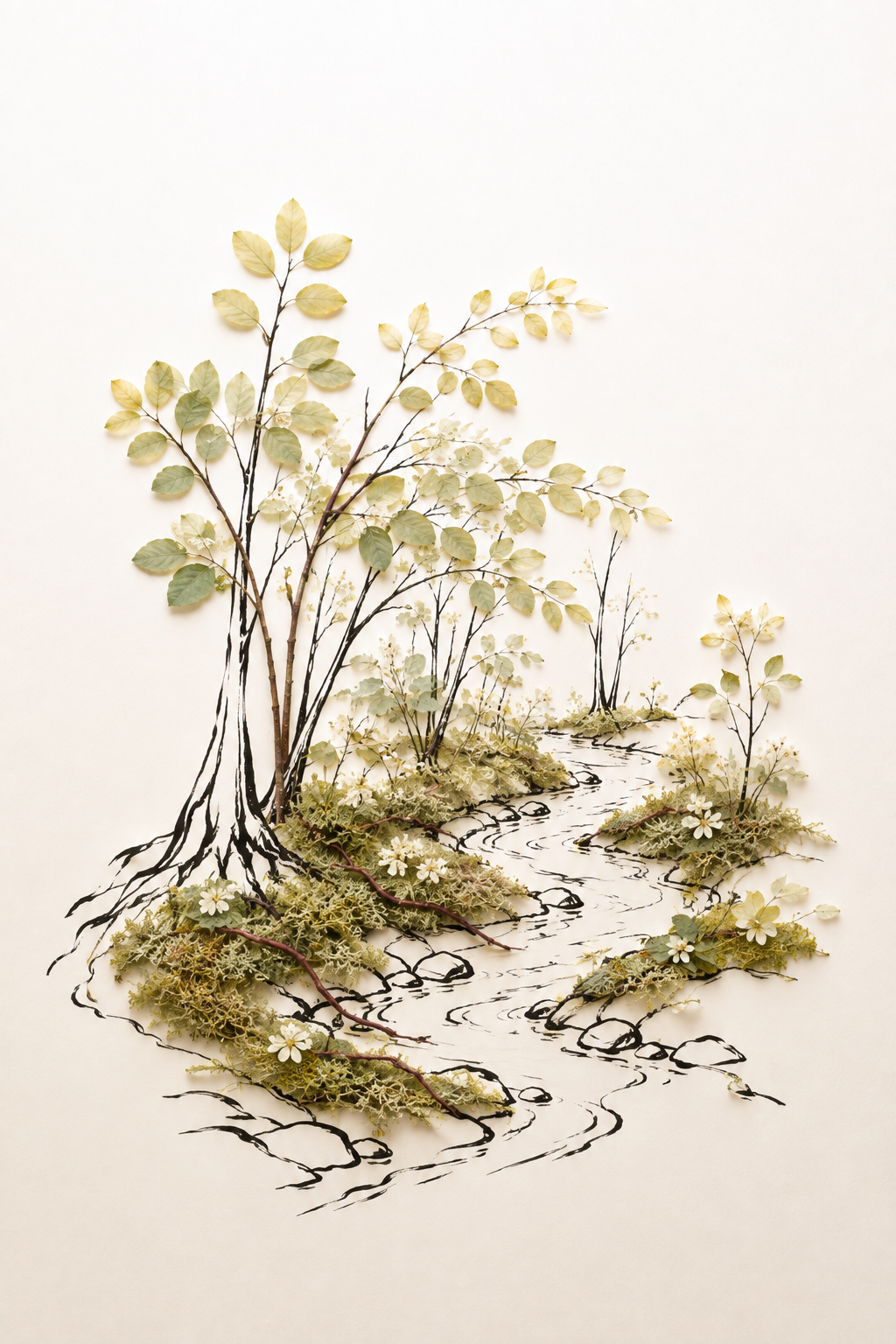
Serenade of the Winding Stream
Critique
Introduction This work depicts a pale woodland stream winding between mossy banks beneath a tall cluster of slender trees. Preserved leaves, lichen, small white blossoms, and black linear drawing share the surface, creating a quiet landscape in which material density gradually gives way to open water and sky. Description At left, several trunks rise from exposed drawn roots and carry translucent yellow-green leaves. Smaller trees recede along both banks. The stream begins near the distant center, bends repeatedly, and widens toward the foreground. Moss and branching lichen cover the islands, punctuated by tiny white flowers, reddish twigs, and scattered stones outlined in ink. Analysis The serpentine watercourse provides the central spatial route, while the tallest tree supplies a strong vertical anchor. Leaf clusters become smaller and lighter toward the distance, strengthening recession. Pale yellow-green dominates, supported by gray lichen and dark brown-red branches. Rough moss, crisp leaf veins, delicate petals, and fluid water lines create distinct textures without disturbing the restrained harmony. Interpretation and Evaluation The scene values gradual attention rather than dramatic incident. Water leads the viewer through modest changes of bank, root, stone, and undergrowth, suggesting continuity within a fragile habitat. Convincing perspective, asymmetrical balance, and subtle tonal control demonstrate compositional skill. The precise botanical surfaces and economical extension of missing land and water through drawing reveal an original, technically coherent method. Conclusion At first the image appears to be a simple woodland passage, but sustained viewing reveals how carefully every bend regulates pace. The large tree establishes rooted permanence, while the stream and pale leaves imply continual change. Material fragments and unfinished lines cooperate to make quiet observation the work's central experience.
Same Subcategory
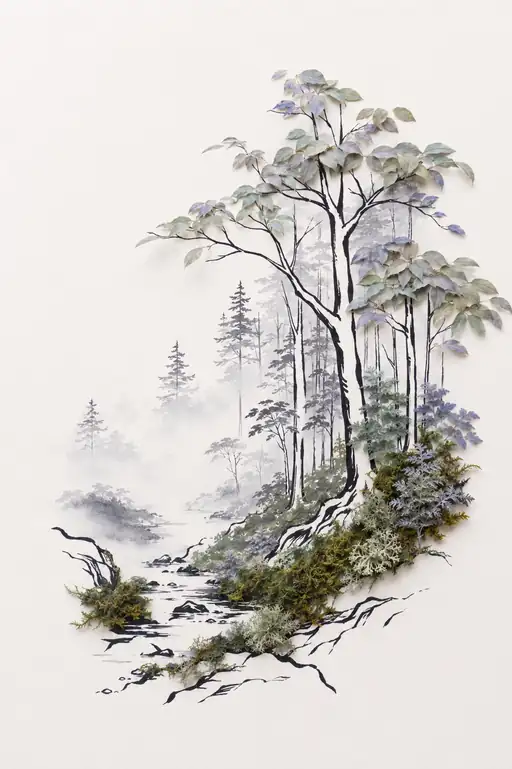 Whispering Mist Along the Forest Stream
Similar Artworks
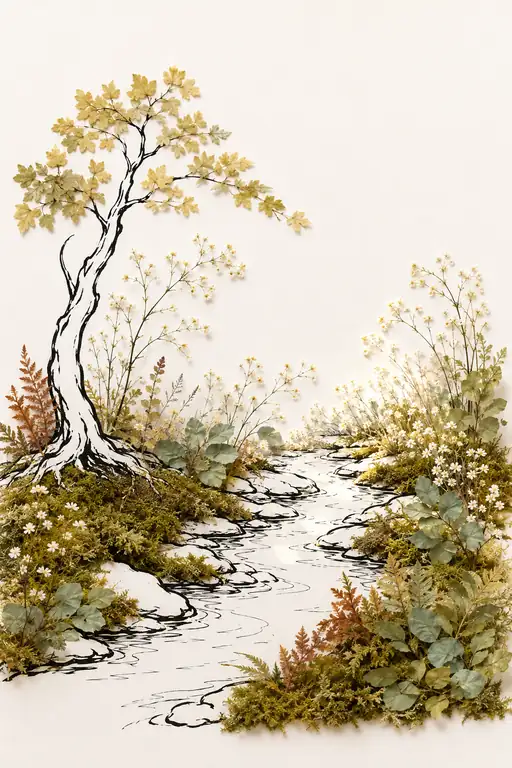 Whisper of the Autumn Stream
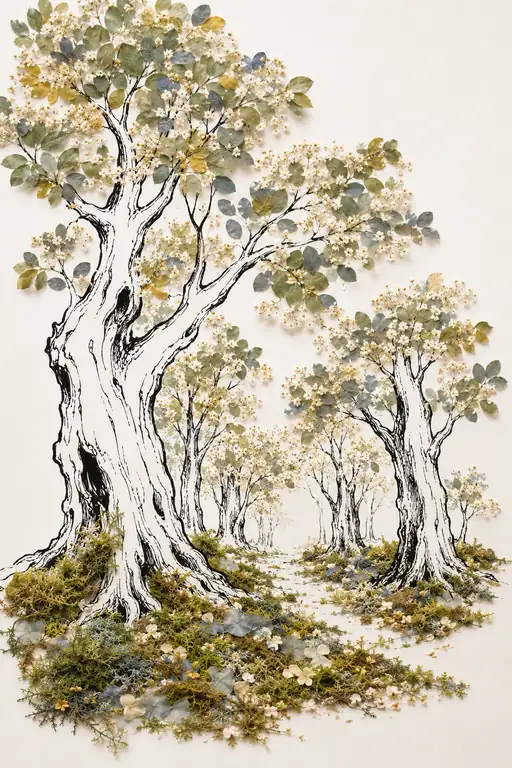 Gateway to the Ancient Grove
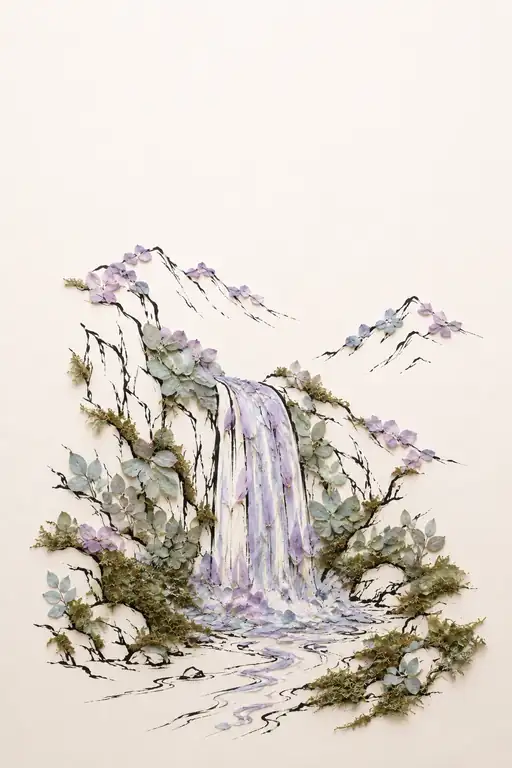 Violet Cascade in Misty Crags
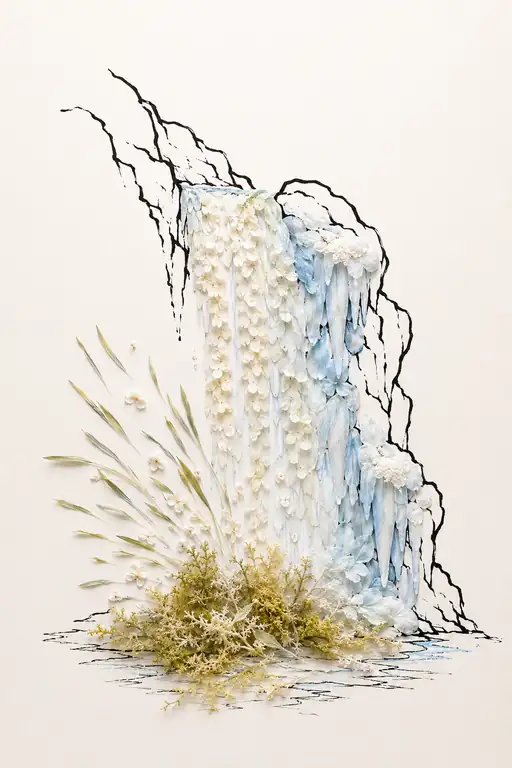 Petal Cascade on the Inky Crags
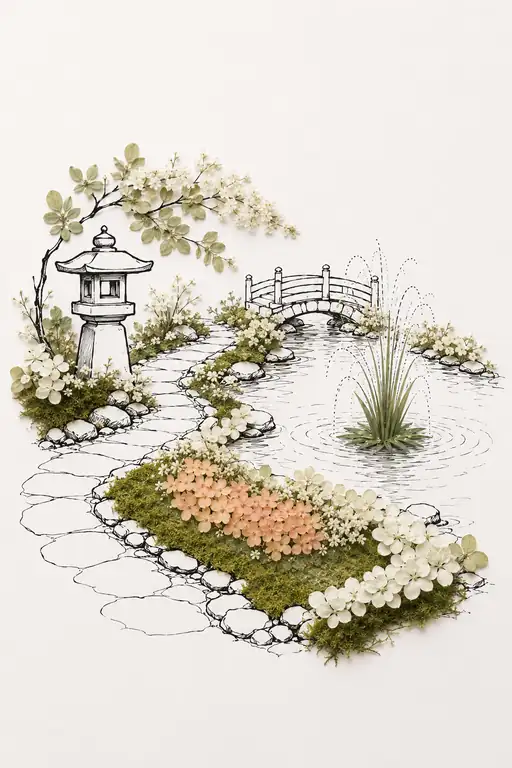 Pathway of the Lantern and Bridge
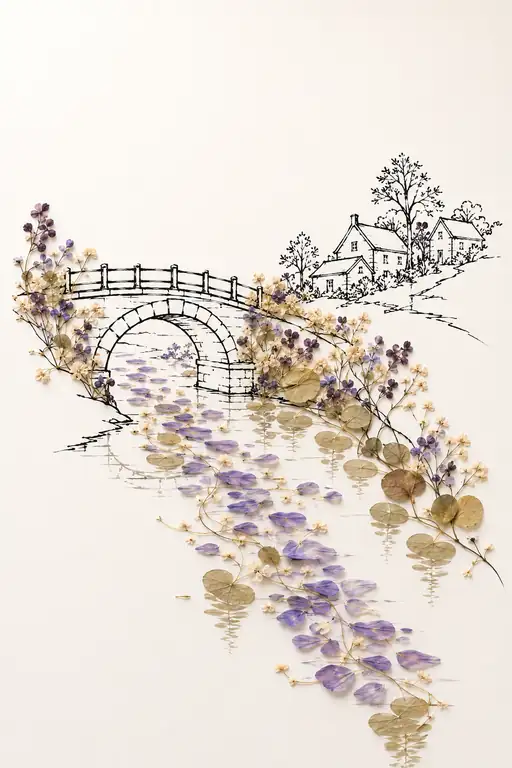 Passage Beneath the Arch
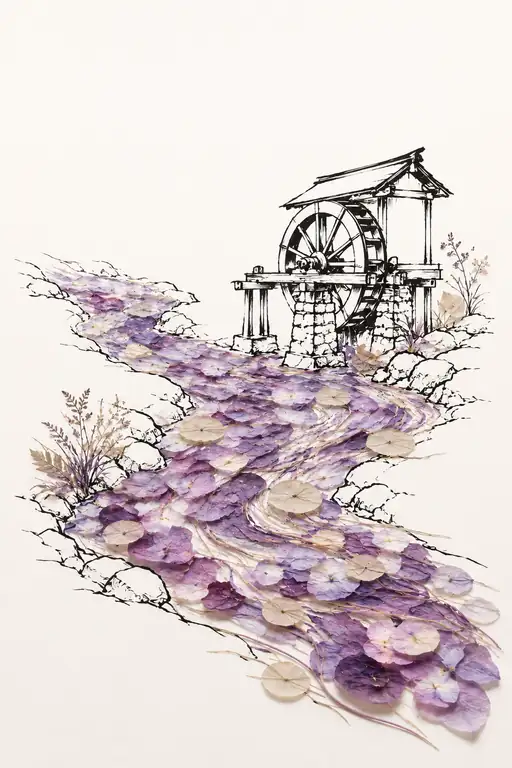 Wheel Turning by the Violet Stream
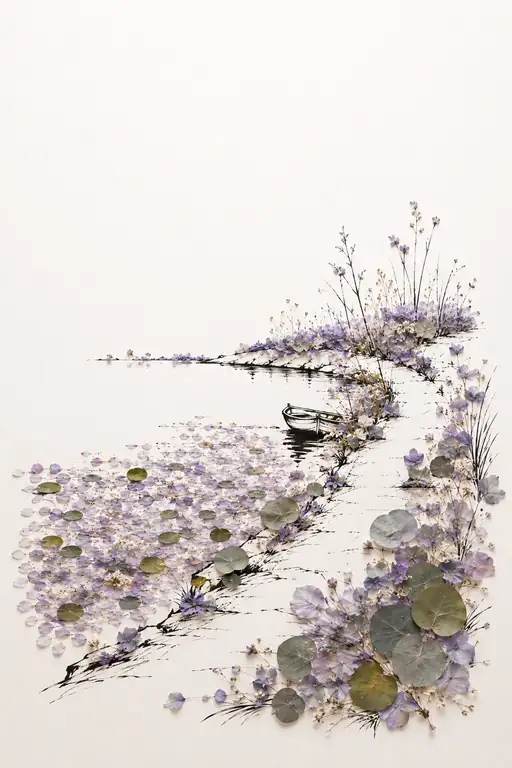 Lavender Inlet and the Moored Boat
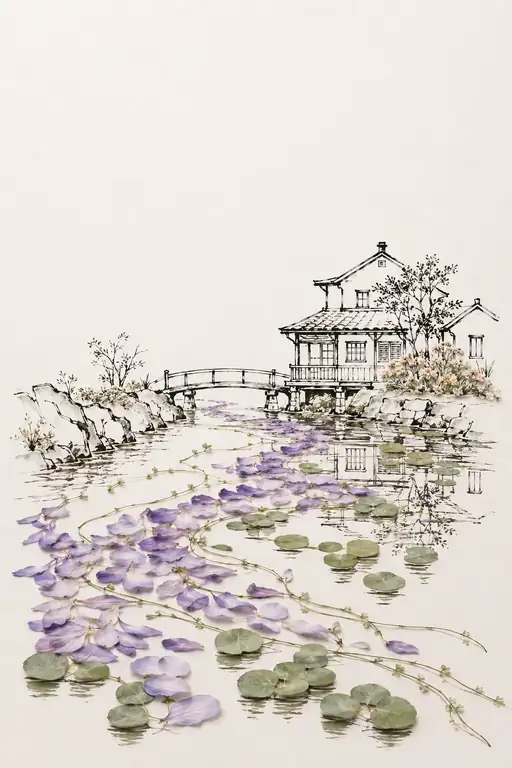 Ripple and Reflection at the Canal House
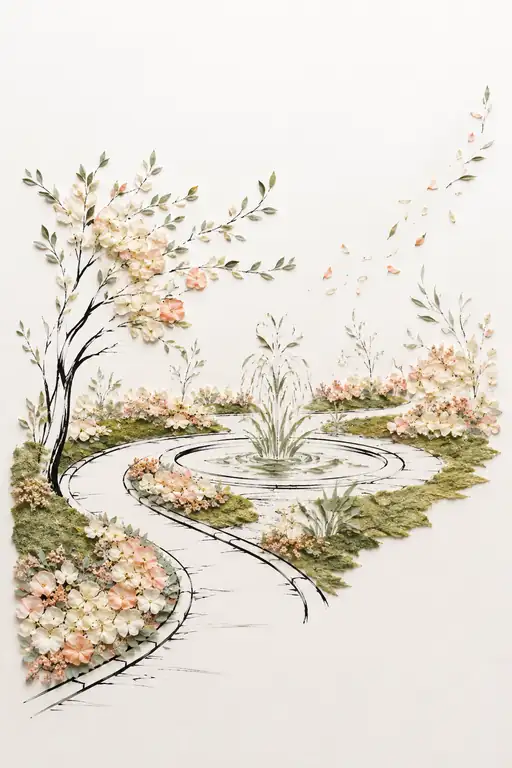 Garden Fountain and Whispering Petals in the Wind