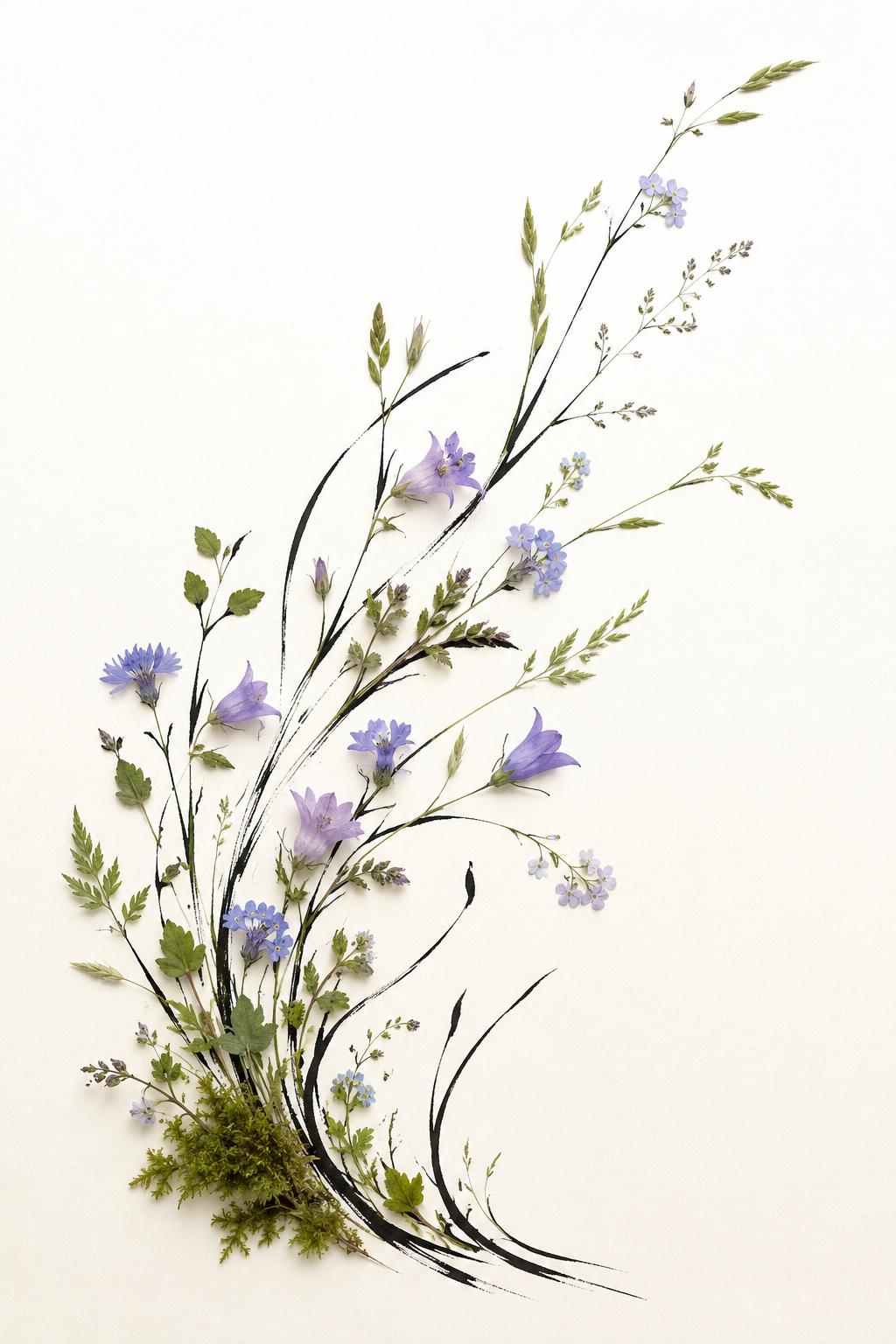
Bellflowers and Calligraphic Vines in Spring
Critique
Introduction This work constructs an ascending spray of purple and blue wildflowers from a low patch of moss, interweaving actual botanical forms with bold black brush lines. With no vase or architectural enclosure, the arrangement reads less as a domestic bouquet than as growth unfolding across open space. Description The densest cluster sits near the lower left, where moss, fernlike foliage, serrated leaves, buds, and tiny blue flowers gather. From it, slender stems rise diagonally toward the upper right, bearing lavender bells, small blue clusters, grasses, and seed panicles. Curved ink strokes emerge alongside the plants and sweep down across the lower field. Analysis Movement is generated by repeated diagonals that fan outward from the compact base. Larger violet blossoms mark the middle register, while increasingly sparse buds and grass heads extend the rhythm upward. Cool petals stand against fresh and olive greens; black strokes supply weight and continuity. Slight shadows reveal the plants' relief, whereas tapering brush marks keep the surrounding surface emphatically flat. Interpretation and Evaluation The image suggests growth as a union of chance and gesture. Some stems align with painted arcs and others cross them, so nature and drawing never collapse into imitation. The asymmetrical composition remains balanced through the low dark base and airy upper reach. Precise differences among moss, petals, leaves, and grasses show descriptive skill, while the calligraphic integration provides technical and conceptual originality. Conclusion At first the work appears to be a graceful scattering of spring flowers, but its directional structure gradually becomes the dominant subject. Density loosens into space, and physical stems continue as imagined black trajectories. The result is delicate without passivity, presenting fragile materials through a confident and economical visual rhythm.
Same Subcategory
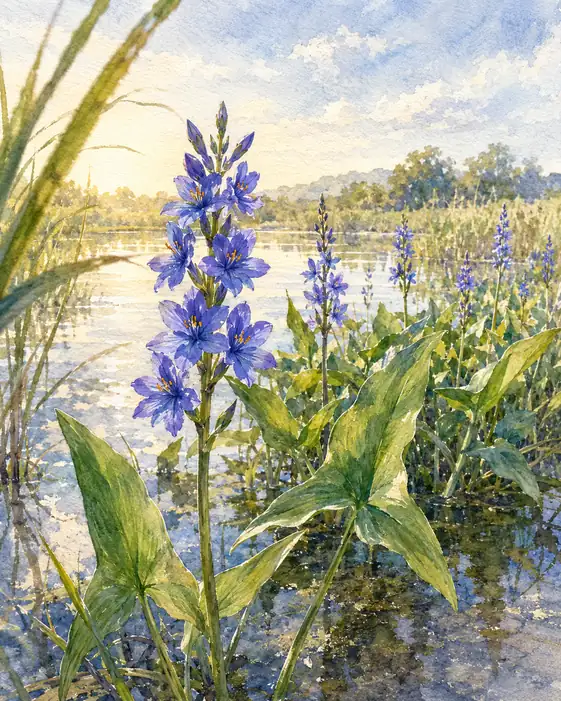 Morning Radiance on the Water Spire
Similar Artworks
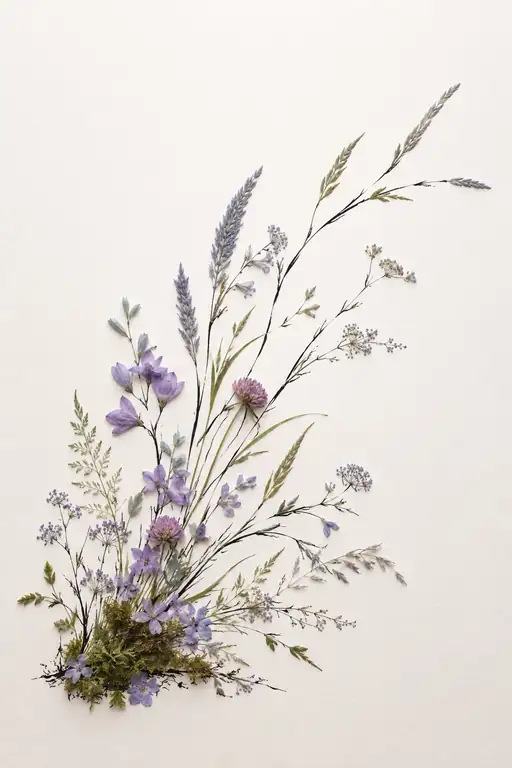 Meadow Winds in Lavender
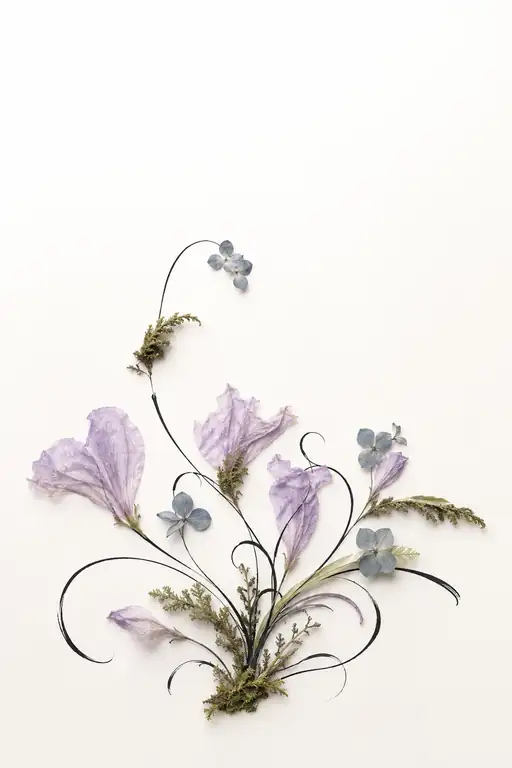 Violet Blossoms Swaying on Calligraphic Stems
 Grace in Solitary Bloom
 Bloom in Layered Rose
 Wild Yellow Blossoms Reaching for the Breeze
 Ascent of Ivory Petals Toward the Light
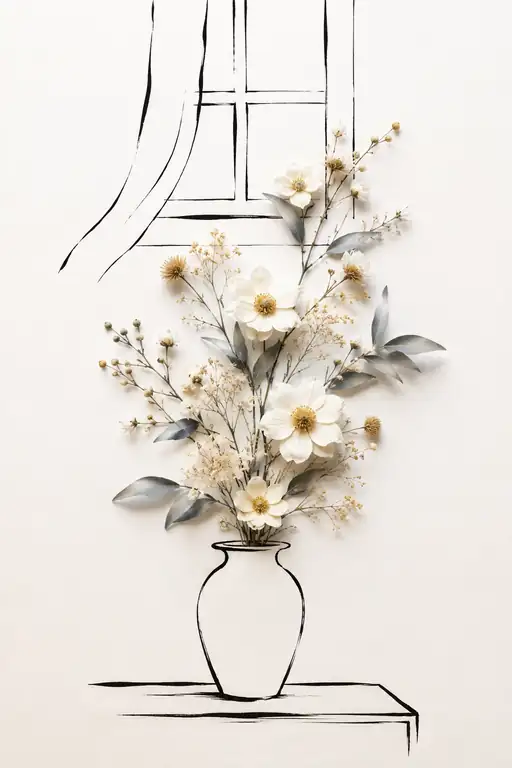 White Petals Whispering by the Curtain's Fold
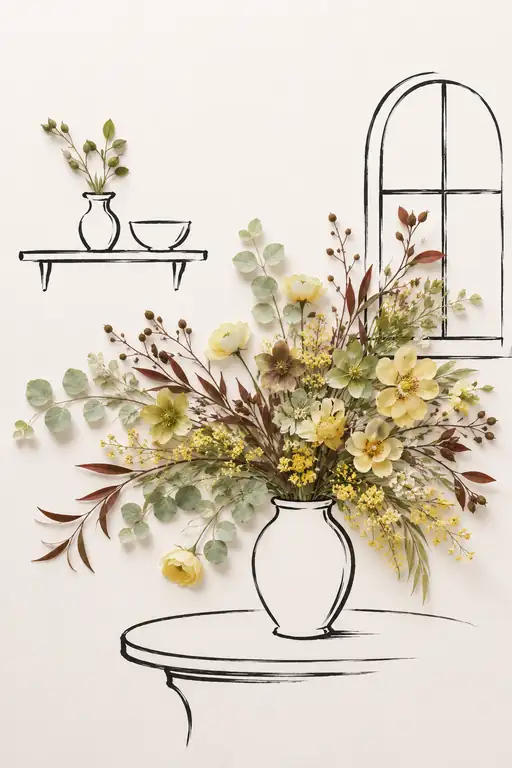 Autumn Flourish Beside the Arched Casement
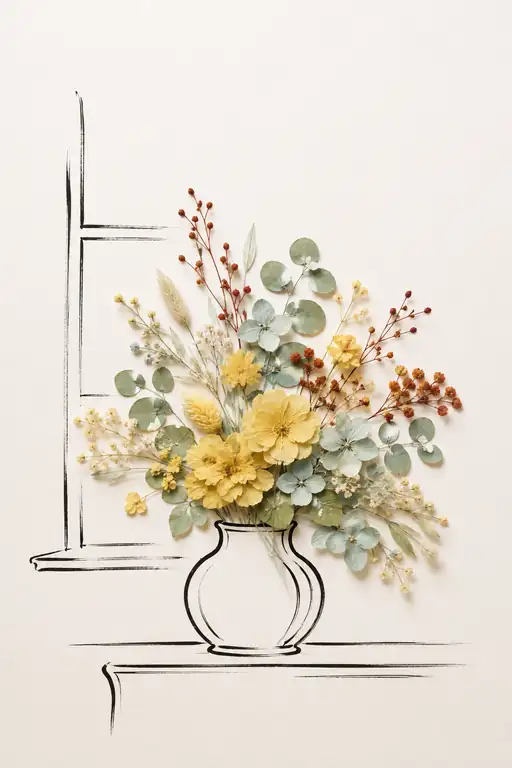 Sunlight Gathered in the Windowed Vase
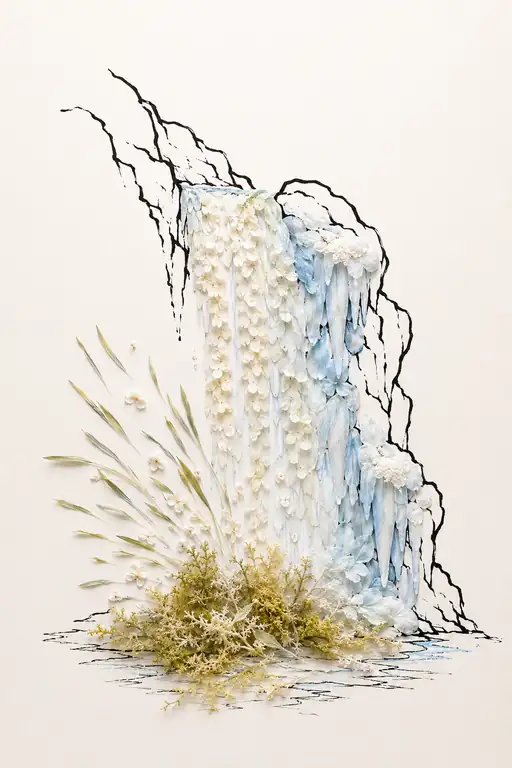 Petal Cascade on the Inky Crags