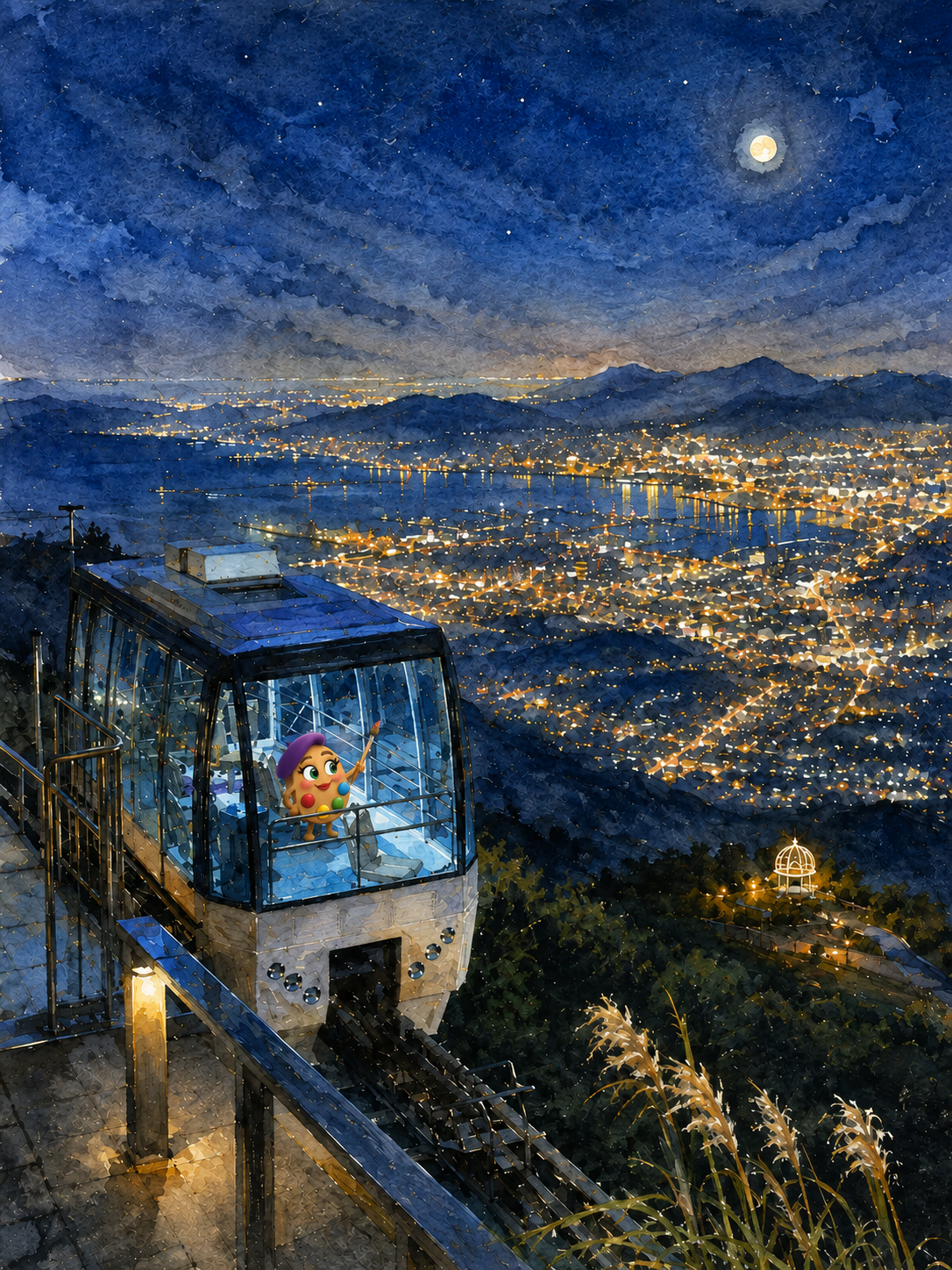
Pointing the Brush to the Starlit City
Critique
Introduction This landscape presents a funicular overlooking a radiant bay and city. Inside, a palette-shaped painter raises its brush toward the view. The gesture distinguishes the figure from machinery. Description The cabin sits at lower left on twin dark rails, with a platform lamp glowing beside it. The painter leans slightly and extends one arm upward, the brush pointing toward the city lights. Silver grasses occupy the lower right, and a small lit gazebo appears among trees above them. Roads, shoreline reflections, mountain ridges, stars, and a haloed moon fill the upper field. Analysis The uplifted brush repeats the diagonal ascent of rail and handrail, joining the character’s action to the composition’s movement. Cool blue panes enclose the warm ocher body and its red, yellow, green, and blue paint spots. Dense golden points spread across the middle distance, while dark vegetation creates a necessary pause below. Thick, tessellated marks unify the scene, and the sparse grasses provide a fine linear contrast to the cabin’s heavy geometry. Interpretation and Evaluation The gesture can be read as selection: the painter appears to identify the moonlit city as a subject before making a mark. This active pose makes artistic looking visible rather than merely implied. The composition effectively coordinates figure, track, and distant lights; its spatial description remains convincing across steep changes of scale. Color contrasts are lucid, and the fanciful character is integrated through repeated circles and highlights. The textured technique sustains both atmosphere and originality. Conclusion At first the city seems to be the sole spectacle, but the raised brush gradually turns the image into a scene of creative decision.
Same Subcategory
Similar Artworks
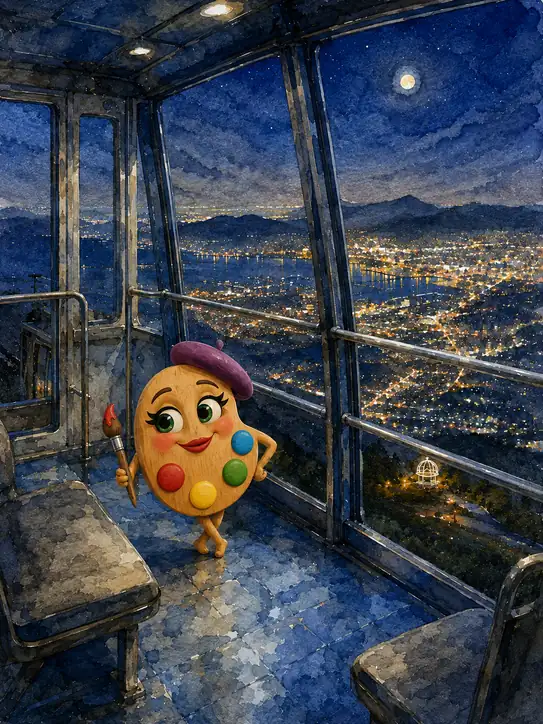 Little Painter Overlooking the City of Lights
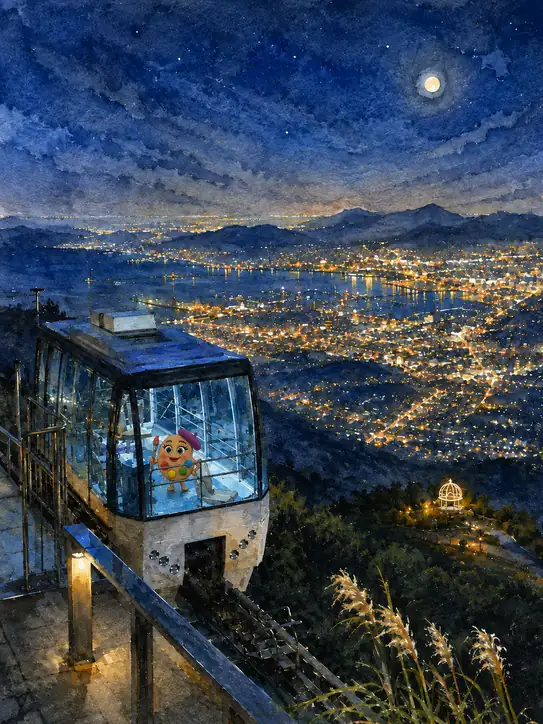 Quiet Gaze from the Midnight Tram
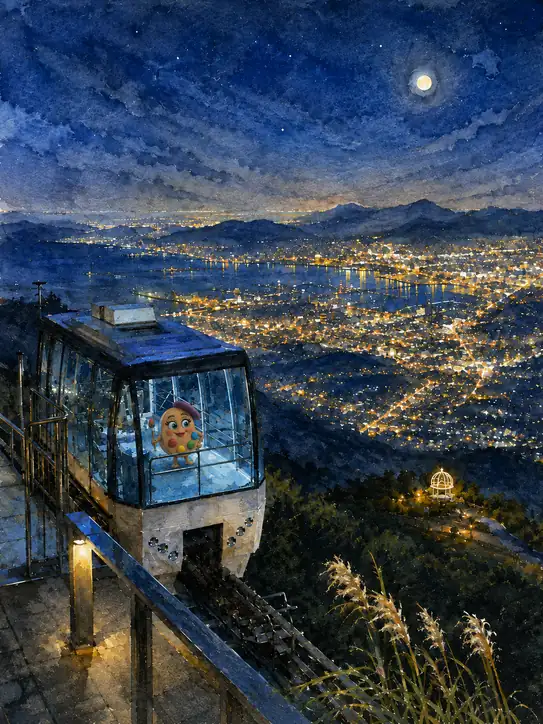 Descent Across the Sea of Golden Lights
 Where the Journey Breathes
 Perilous Balance on the Timber Frame
 As Night Deepens, Toward the Traces of Dreams, a Sea of Light
 Moonlit Descent and the Harbor Glow
 Moonlit Bay and the Shining Pavilion
 Trapped in the Cliff Crevice
 The Cradle of Shimmering Dreams