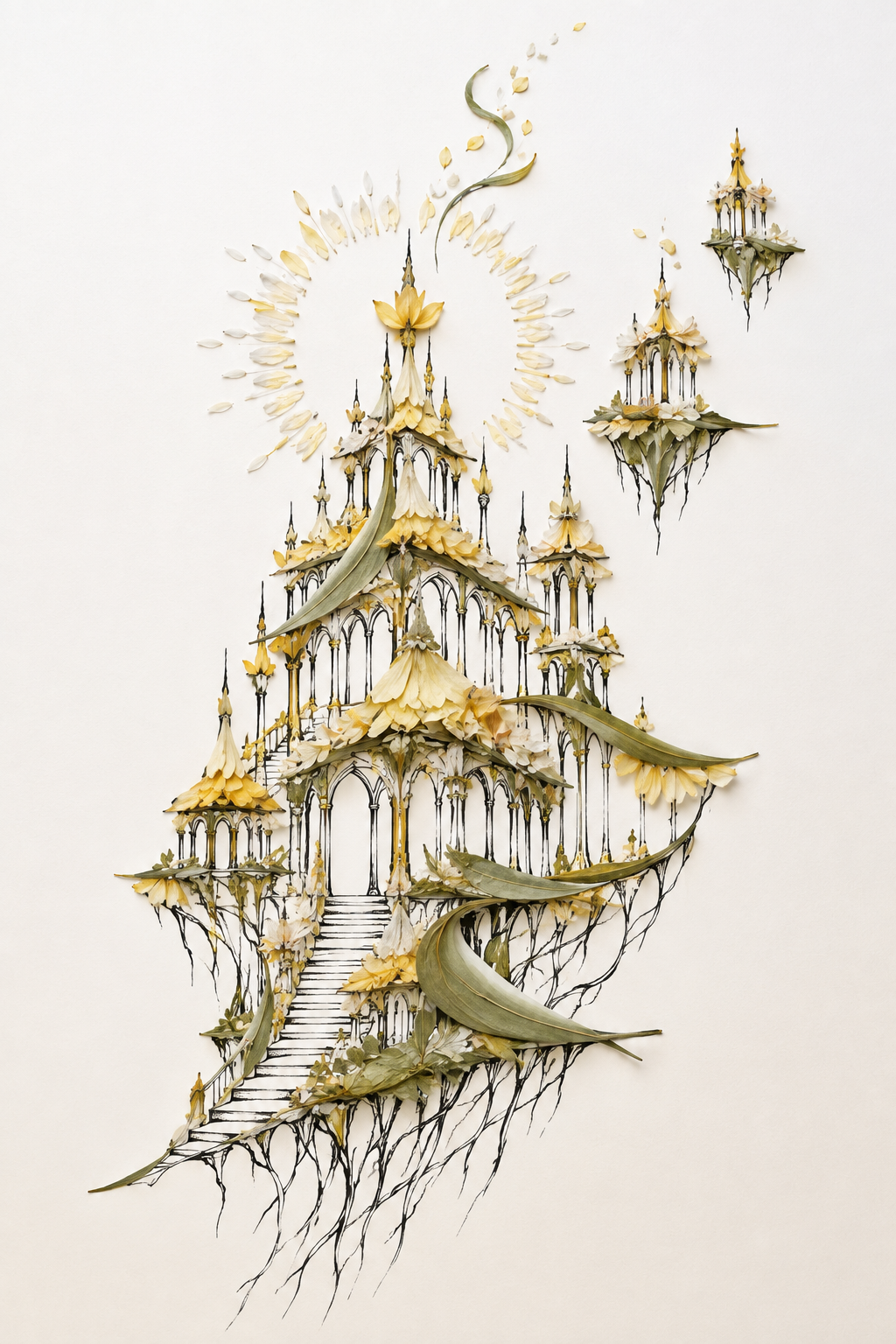
Floating Cathedral Reaching for the Golden Halo
Critique
Introduction This work imagines an elaborate floating sanctuary assembled from Gothic ink architecture, golden petals, and long olive leaves. Rising steeply through the center, the many-tiered structure is crowned by a radiant floral halo and accompanied by two smaller detached pavilions. Description A long stair climbs from the lower left into a large pointed portal. Around it, repeated arcades support clustered towers with narrow black spires and yellow petal roofs. Broad curved leaves become ramps, bridges, and sweeping eaves that cross the façade. Rootlike ink lines descend from the floating base. Above the highest central tower, cream and yellow petals form a broken circular radiance; a twisting green stem continues upward. Analysis The stair creates a strong diagonal entry, while the central spire establishes vertical ascent. Repeated pointed arches unify the dense structure, and changes in tower size distinguish foreground platforms from distant floating rooms. Olive leaves introduce broad curves against the thin linear framework. Yellow accents distribute light across many levels, but the halo reserves the brightest open space for the summit. Interpretation and Evaluation The sanctuary appears to grow rather than to have been built, suspended between root, flower, and architecture. Its open arches and incomplete edges make ascent feel spiritual without relying on enclosed mass. The complex composition remains legible through repetition, the gold-green palette is coherent, and the draftsmanship sustains remarkable delicacy. Transforming leaves into structural bridges gives the fantasy convincing internal logic. Conclusion At first the abundance of towers seems ornamental, but closer viewing reveals a carefully graduated path from the earthly stair to dispersed light. The work turns architectural hierarchy into an image of organic elevation and release.
Same Subcategory
Similar Artworks
 Winged Pavilion Floating in the Ether
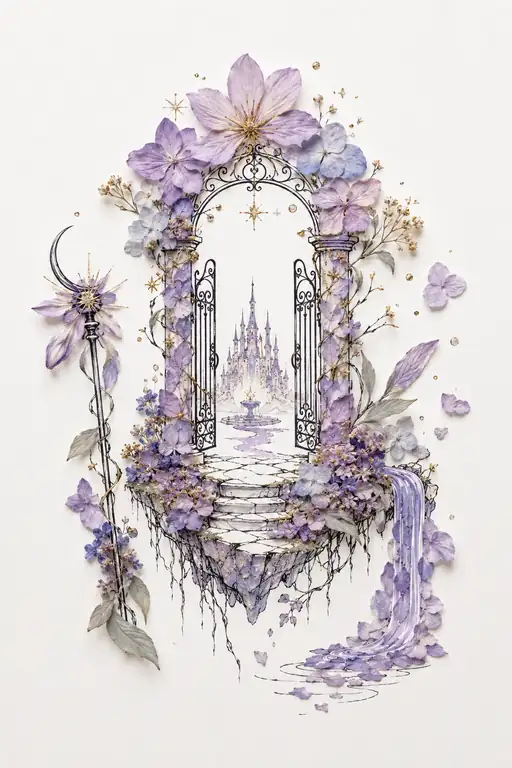 Floating Floral Portal to the Distant Castle
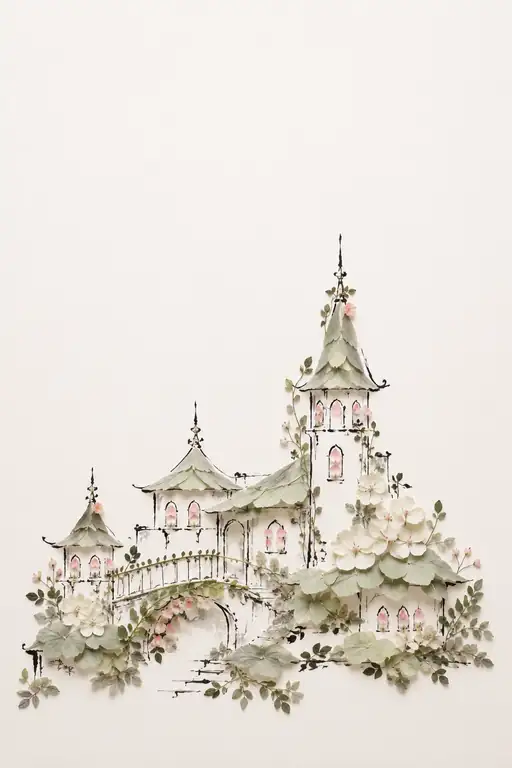 Sage Spire Castle and the Blossoming Bridge
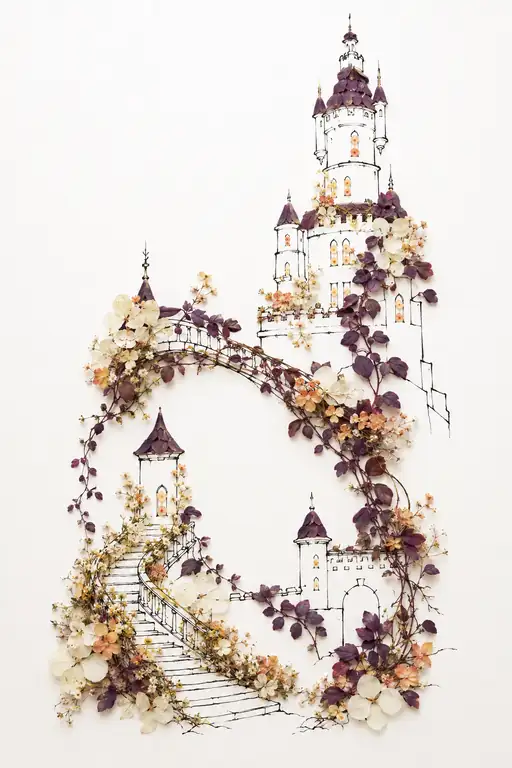 Fairytale Spire and the Arched Bridge
 Verdant Spire Castle and the Twig-Rail Bridge
 Fairytale Castle with Floral Conical Roofs
 Grand Palace Crowned with Floral Domes
 Voyage to the Spires in the Ether
 Path of Fairies to the Star Portal
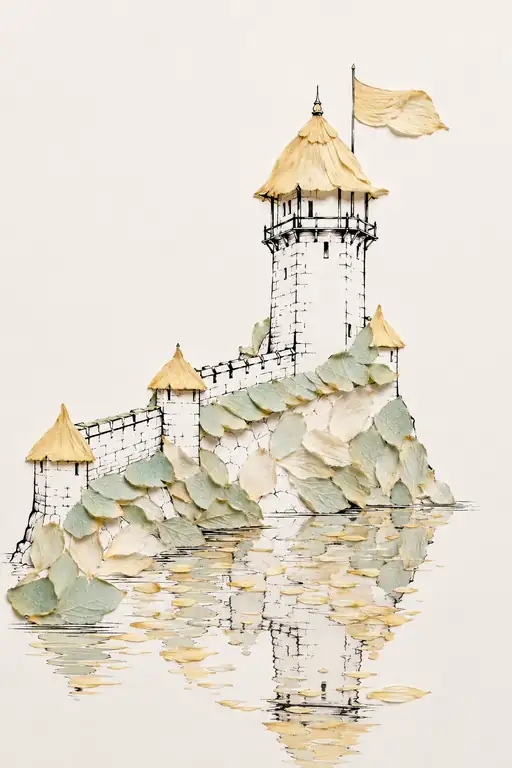 Fortress of Light Guarding the Shimmering Waters