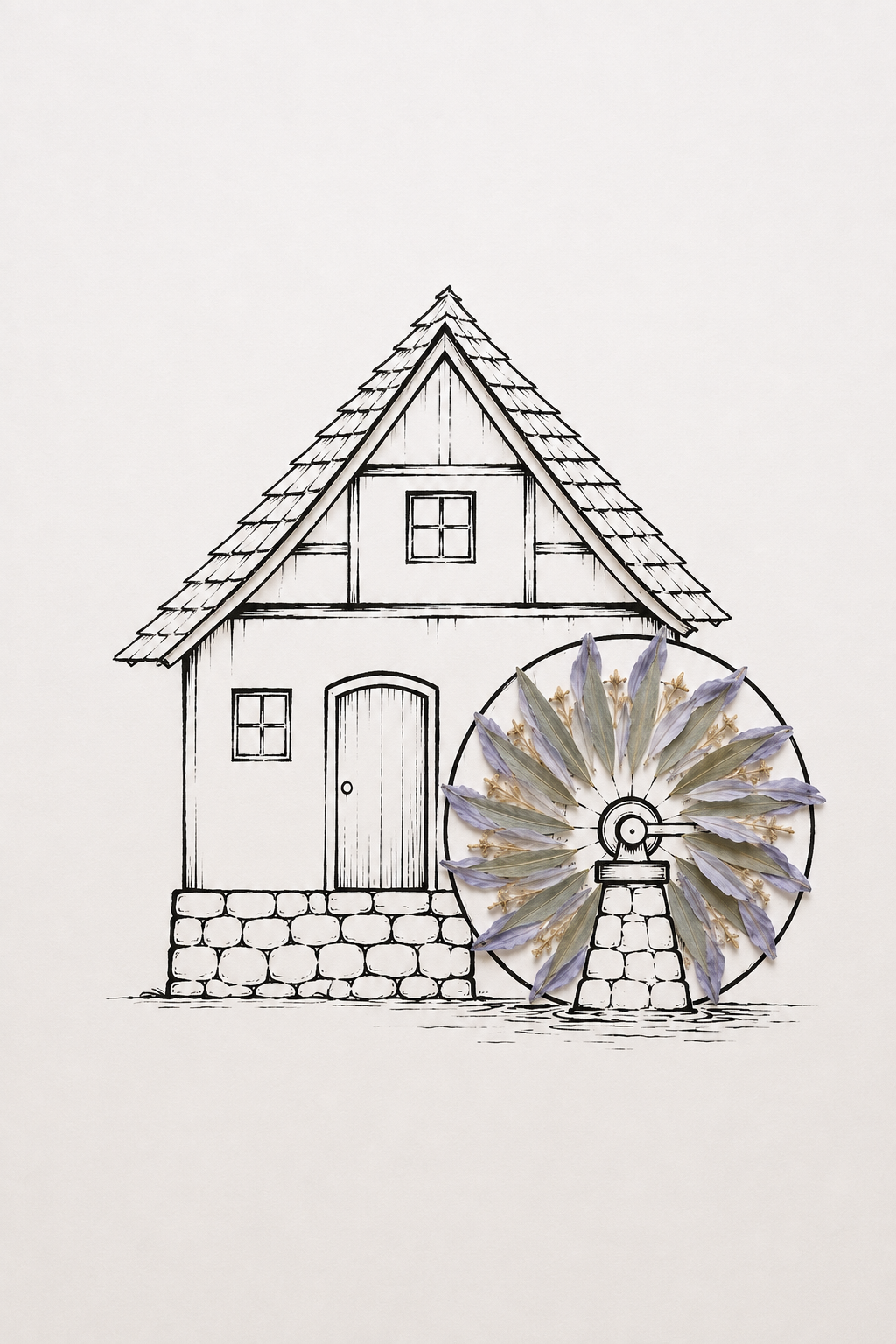
Quiet Turn of the Mill by the River
Critique
Introduction This work depicts a compact mill house and floral waterwheel through sharply controlled ink drawing and a small area of botanical collage. Unlike a heavily decorated variant, the bare tiled roof and unadorned walls give the wheel exceptional prominence. Description The house has a steep roof articulated by repeated rows of rectangular shingles and a triangular timbered gable. A square upper window, smaller lower window, and arched plank door punctuate the white façade above a blocky stone base. At right, gray-green leaves and narrow violet petals radiate inside a black circular rim. Fine ocher sprigs fill the gaps around the central hub, which stands on a stone support. Analysis The building's tall triangle and the wheel's circle create a clear two-part composition. Because the roof remains entirely linear, the tactile wheel becomes the sole area of color and relief. Alternating leaves establish a measured rotational rhythm, while the ocher stems soften gaps between blades. Repeated shingle lines echo the wheel's repetition but remain angular, distinguishing shelter from motion. Interpretation and Evaluation The restraint of the façade directs attention toward power generation as the building's defining activity. Organic blades make mechanical rotation seem dependent on growth, yet the firm rim and hub contain their irregular edges. The composition is unusually economical, the violet-gray harmony is controlled, and the architectural drawing is precise. Its originality lies in concentrating material transformation at one functional point. Conclusion At first the image appears austere beside the colorful wheel, but closer viewing reveals a deliberate exchange between linear stillness and radial movement. The limited collage makes every vein, petal, and interval structurally significant.
Same Subcategory
Similar Artworks
 Rustic Mill Whispering of Flow and Season
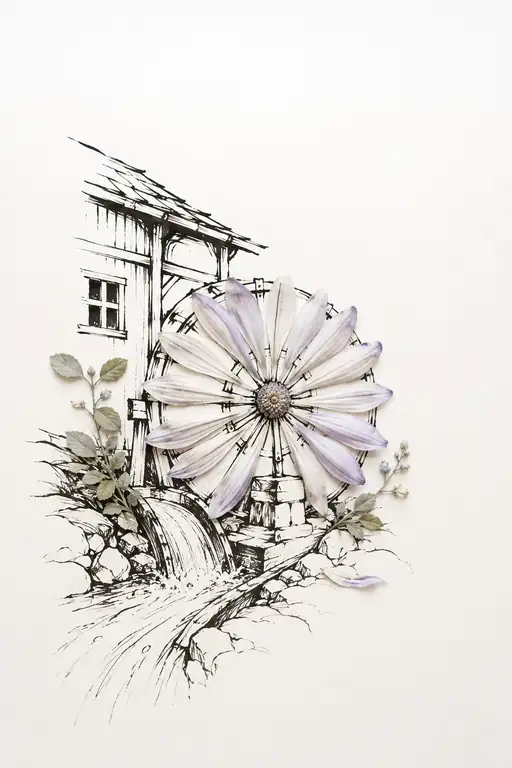 Wheel of Whispering Waters
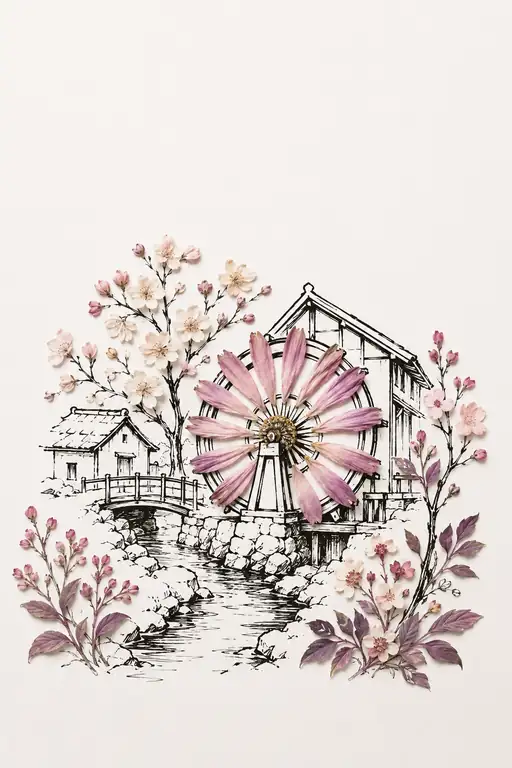 The Blossom Wheel of Time and Stream
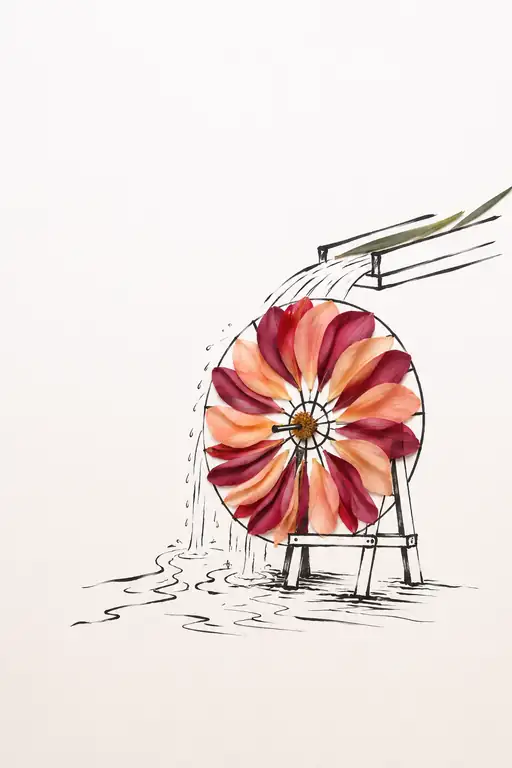 Crimson Flower Wheel Turning in the Stream
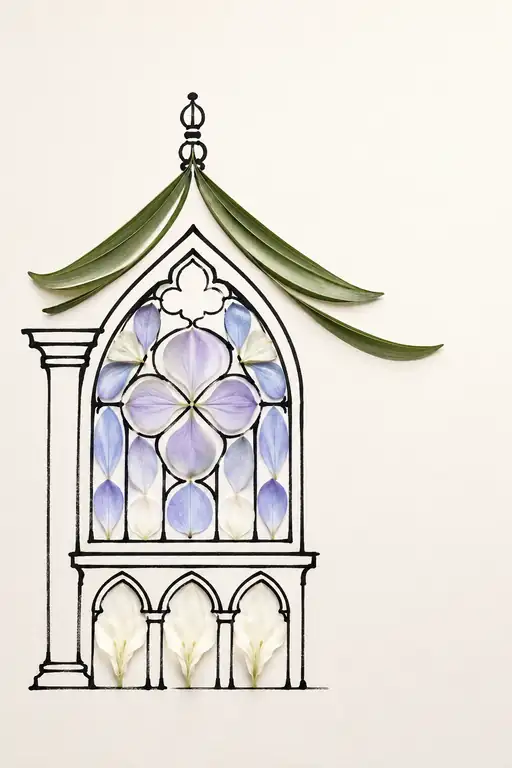 Gothic Rose Window of Translucent Petals
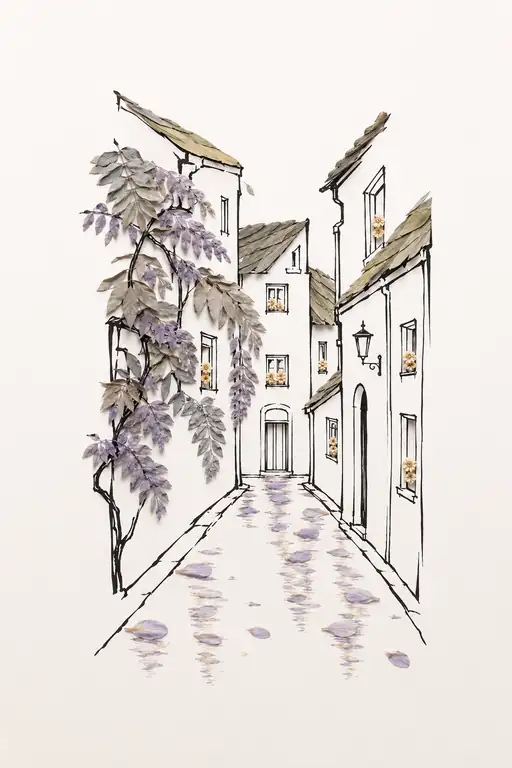 Wisteria Lane Overlooking Cobblestone
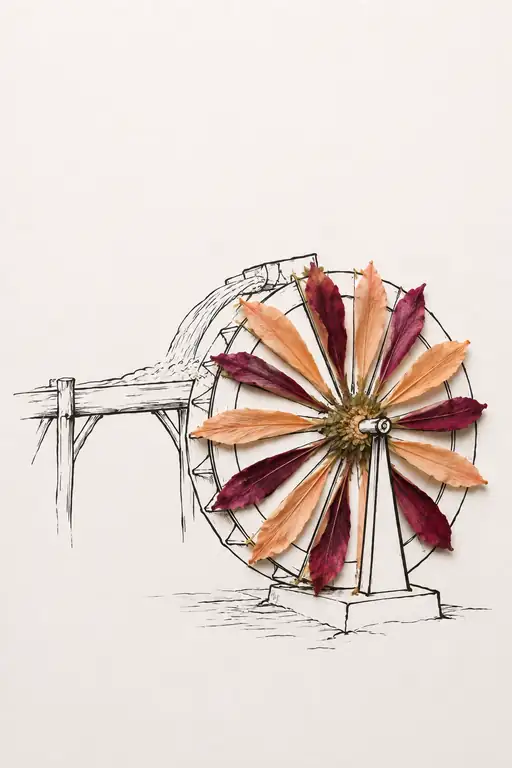 Flower Wheel Turning in Sunlit Waters
 Deep into the Wisteria Lane
 Leaf-Paved Arch Across the Serene Flow
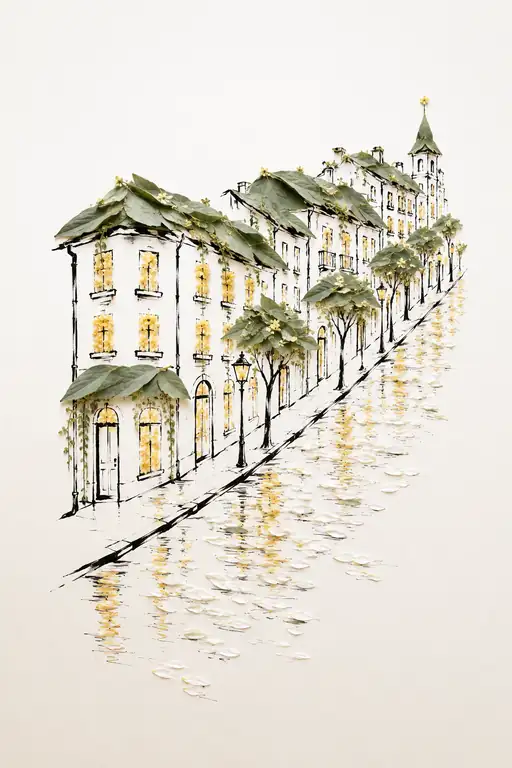 Golden Lights Ascending the Rain-Washed Hill