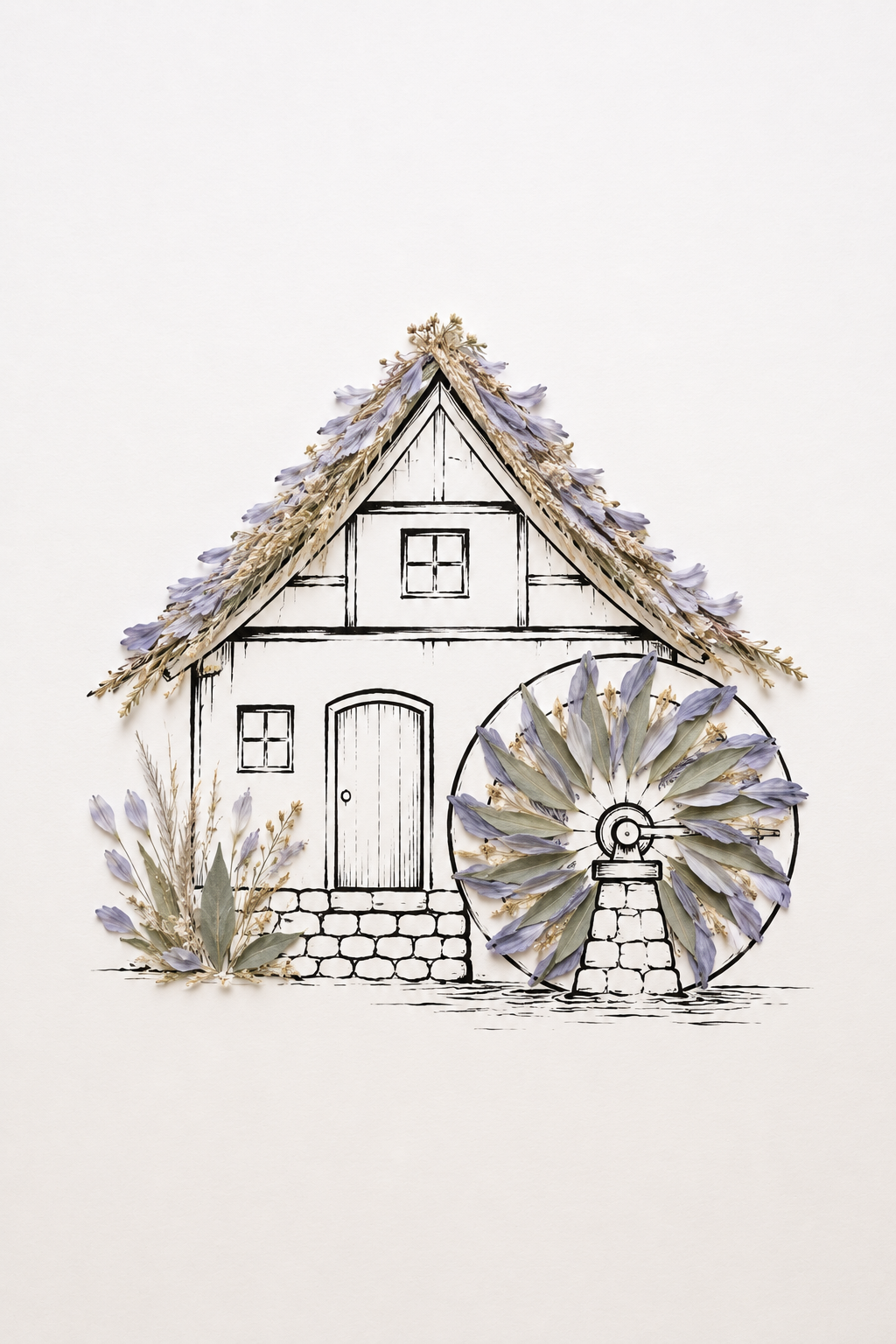
Rustic Mill Whispering of Flow and Season
Critique
Introduction This work portrays a gabled mill whose roof and waterwheel are enriched with flowers and leaves. Centered low on an open sheet, the building combines precise rural architecture with a restrained lavender-gray palette. Description The steep triangular roof is edged by layered beige stems and small violet florets that meet in a tuft at the ridge. Black timber lines divide the upper façade around a square window. Below are a smaller window, an arched plank door, and a stone foundation. At right, a large circular wheel contains alternating gray-green leaves and lavender petals radiating from a compact hub. A smaller plant cluster grows at left. Analysis The roof triangle and wheel circle form two strong geometric masses, balanced across the vertical door. Repeated radial leaves generate rotation, while the descending roof flora emphasizes shelter and gravity. Thick black outlines retain structural clarity against the soft, raised materials. Violet accents travel from the roof edge to the wheel and foreground plants, integrating elements that otherwise differ in scale and function. Interpretation and Evaluation The working mill is presented as a partnership between constructed order and seasonal matter. Botanical growth crowns the roof, gathers beside the wall, and becomes the wheel's mechanism, so nature occupies several practical roles. The composition is compact and legible, the cool palette is harmonious, and the timber and masonry are economically described. The petal-and-leaf wheel is especially effective as an image of cyclical motion. Conclusion At first the house seems simply decorated with flowers, but closer viewing shows that plant forms organize its roofline, ground, and source of power. The work's measured geometry turns fragile materials into a coherent account of dwelling and labor.
Same Subcategory
Similar Artworks
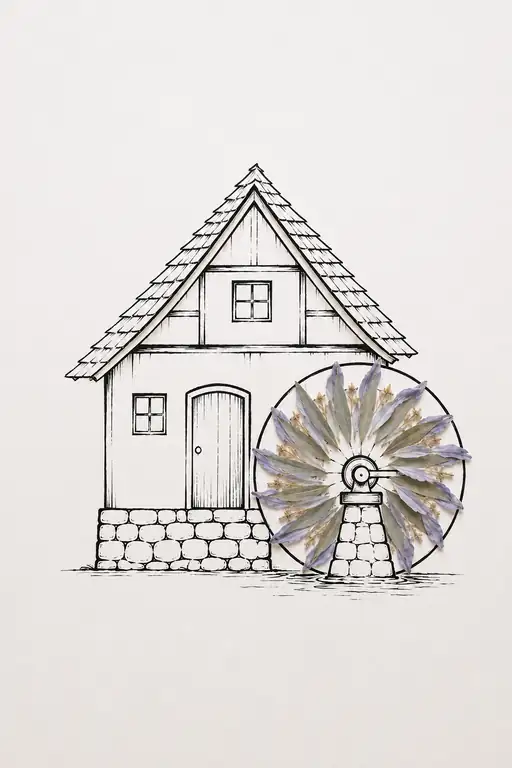 Quiet Turn of the Mill by the River
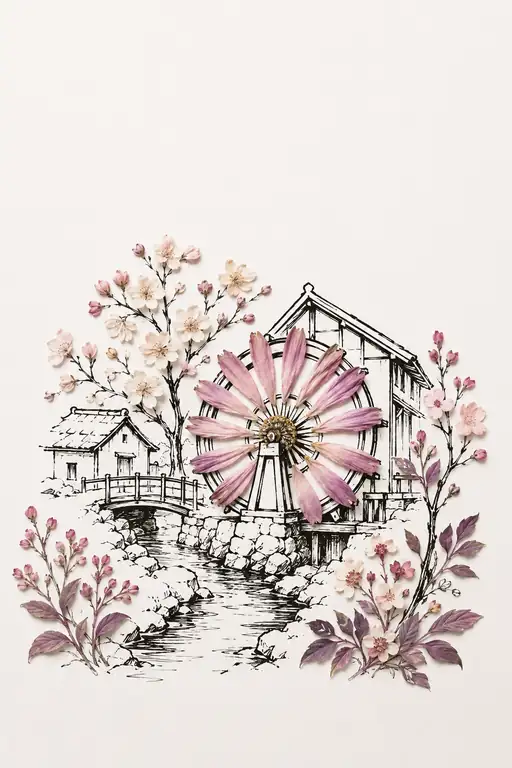 The Blossom Wheel of Time and Stream
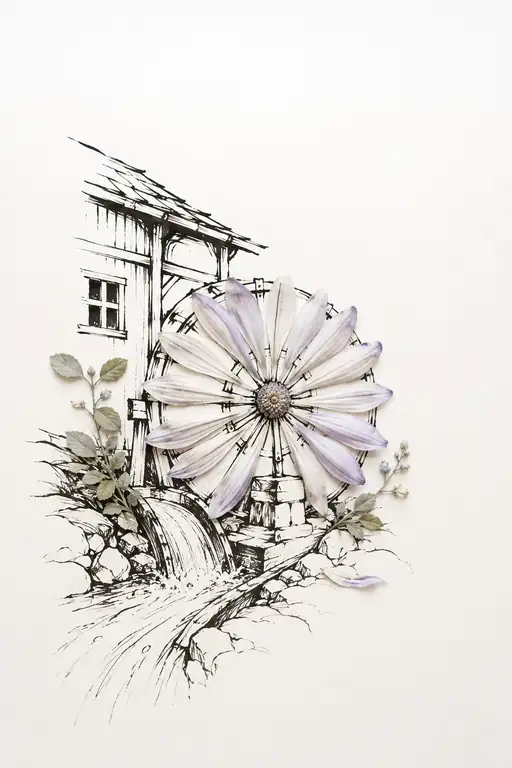 Wheel of Whispering Waters
 Flow of Blossoms by the Stone Bridge
 Passage Beneath the Arch
 Wisteria Lane Overlooking Cobblestone
 Riverside Gathering of Blossom and Lineage
 Evening Anchorage Under Leaf-Woven Sails
 Quiet Morning with the Broom
 Gothic Rose Window of Translucent Petals