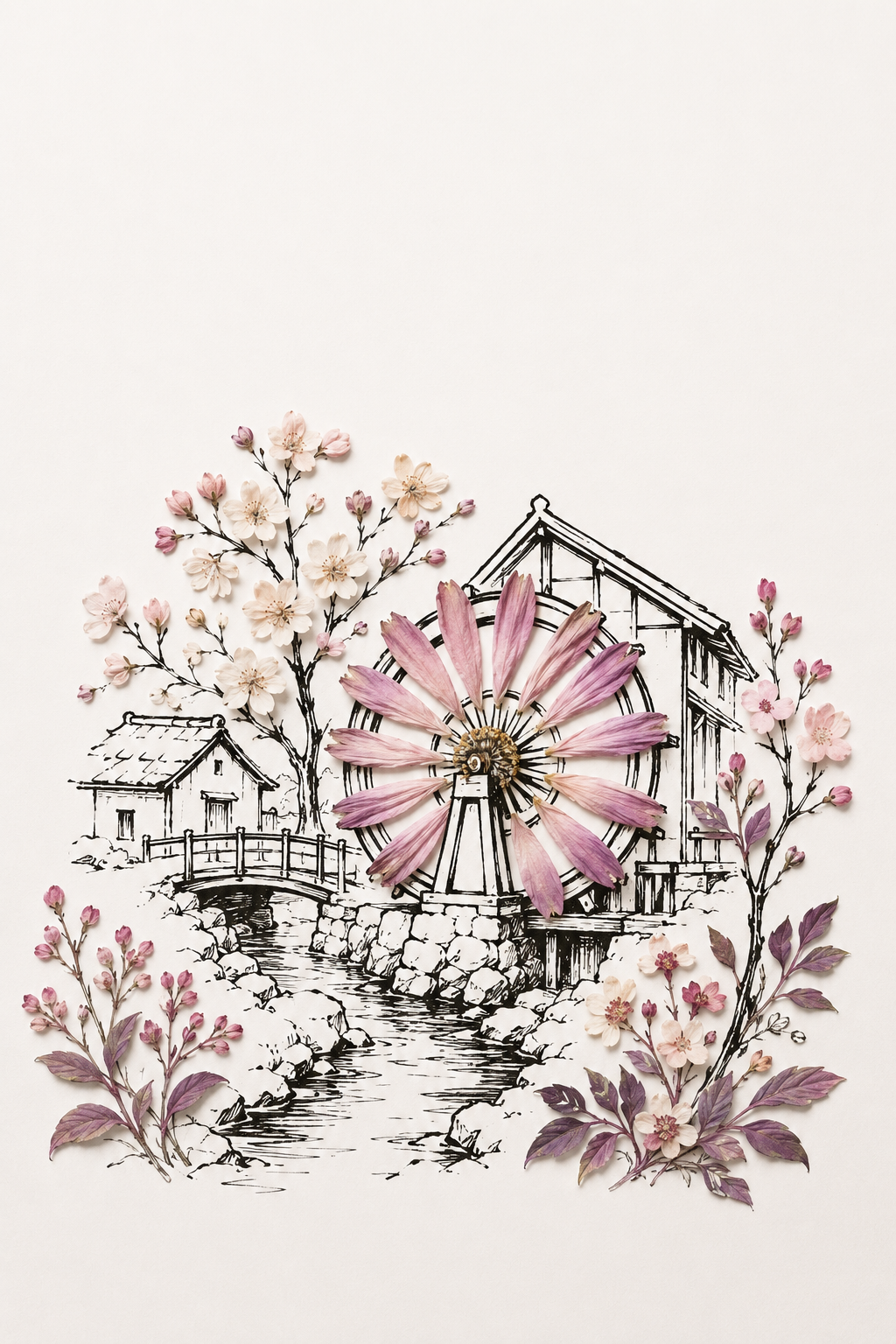
The Blossom Wheel of Time and Stream
Critique
Introduction This work depicts a riverside village dominated by a waterwheel whose paddles are made from pink petals. Blossoming branches surround ink-drawn houses, bridge, rocks, and stream, integrating a working structure with the seasonal growth around it. Description The large wheel stands right of center against a steep-roofed building. Long mauve and rose petals radiate from a textured brown hub, while black circles and spokes retain its mechanical outline. At left, a low bridge crosses the stream toward a small house. Pale blossoms rise behind it, and purple-leaved branches frame both lower corners and the right edge. Water lines lead forward between irregular stones. Analysis The wheel is the dominant circle within a composition built mostly from roof diagonals and vertical trunks. Its repeated petals create rotation, while the stream's narrowing channel carries that movement downward. Floral masses are carefully distributed around the central architecture, preventing the wheel from becoming isolated. Black ink gives spatial continuity; pink and violet accents connect foreground shrubs, orchard, and machine. Interpretation and Evaluation By constructing a mechanism from flower parts, the work links useful labor to natural cycles. The wheel appears capable of motion, yet its fragile paddles emphasize that renewal depends on temporary forms. The composition is dense but legible, the color scheme is unified, and the architectural drawing convincingly establishes place. Transforming petals into radial blades is a simple, effective, and memorable technical invention. Conclusion At first the flowering wheel seems primarily decorative, but closer viewing shows how its circular rhythm organizes buildings, water, and vegetation. The image balances craft and growth without allowing either to become merely background for the other.
Same Subcategory
 Purity Woven in Blue
Similar Artworks
 Rustic Mill Whispering of Flow and Season
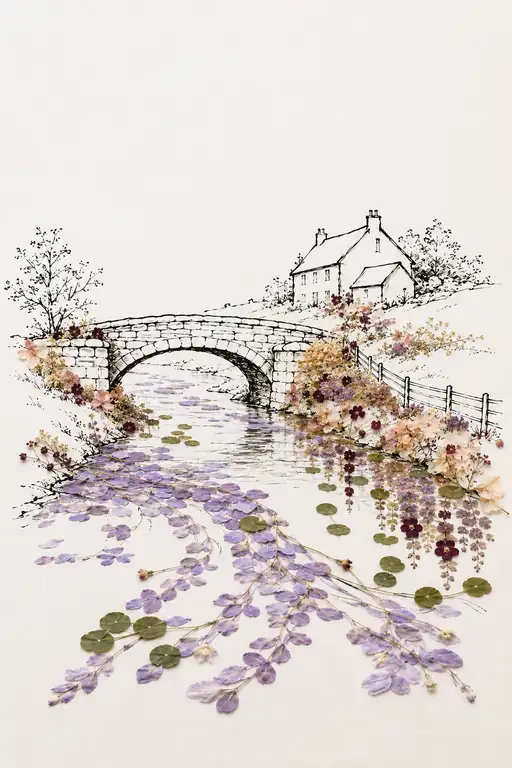 Flow of Blossoms by the Stone Bridge
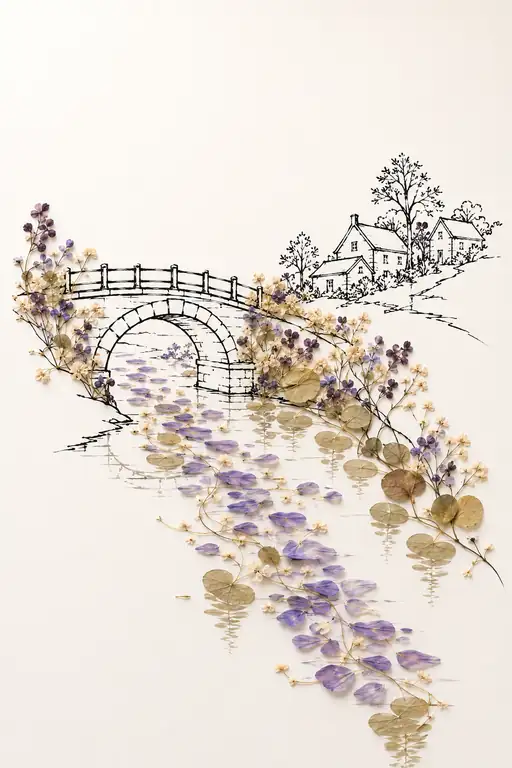 Passage Beneath the Arch
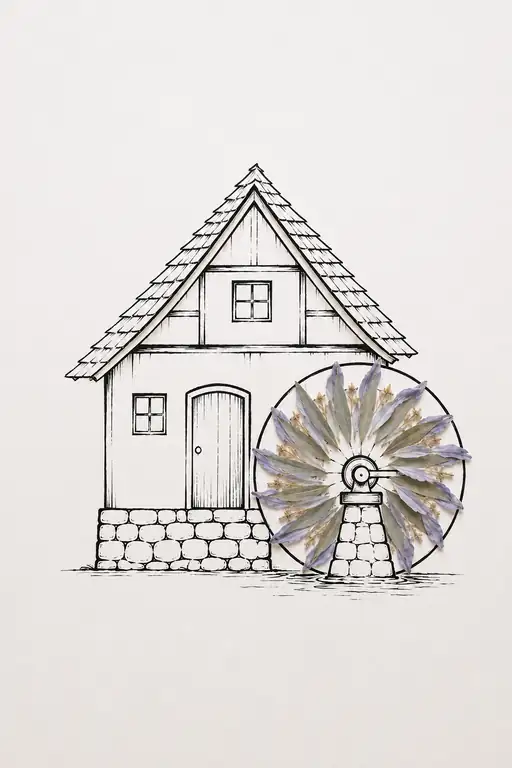 Quiet Turn of the Mill by the River
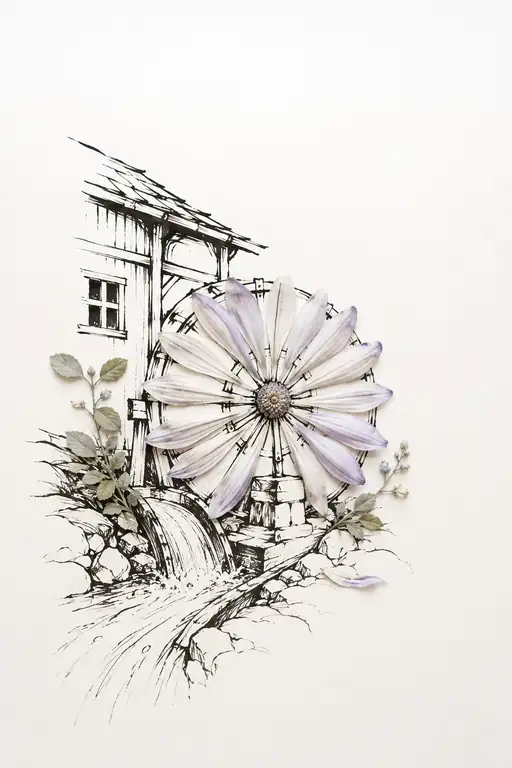 Wheel of Whispering Waters
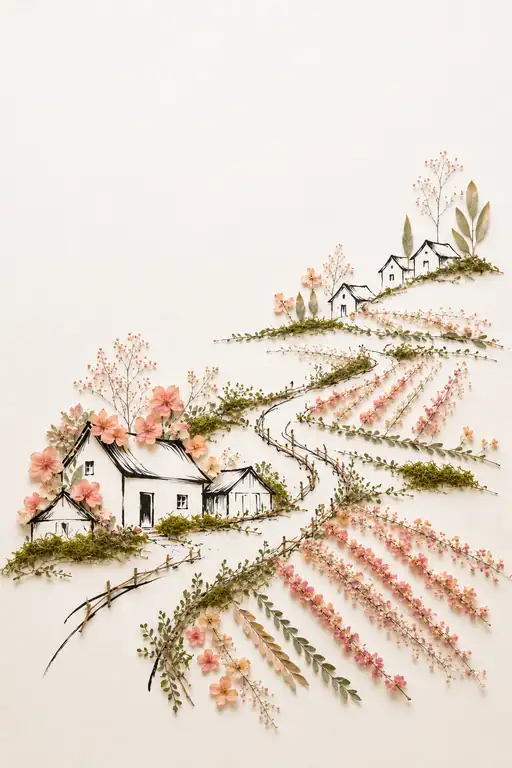 Spring Ascent to the Hilltop Cottages
 Meandering Stream in the Awakening Meadow
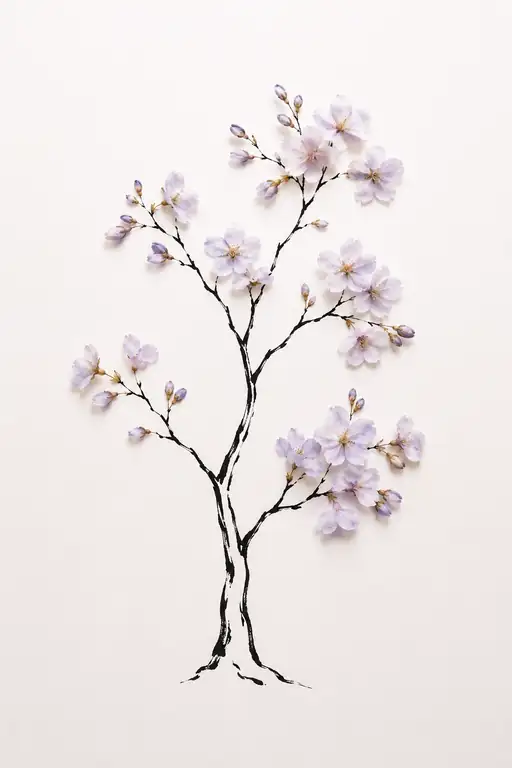 Slender Tree Blossoming with Lilac Dreams
 Waterfall of Lilac and Light
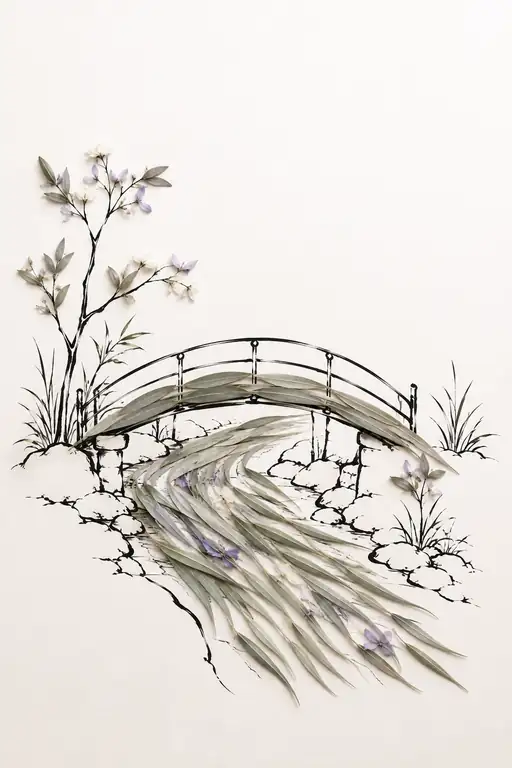 Stream Beneath the Arched Bridge