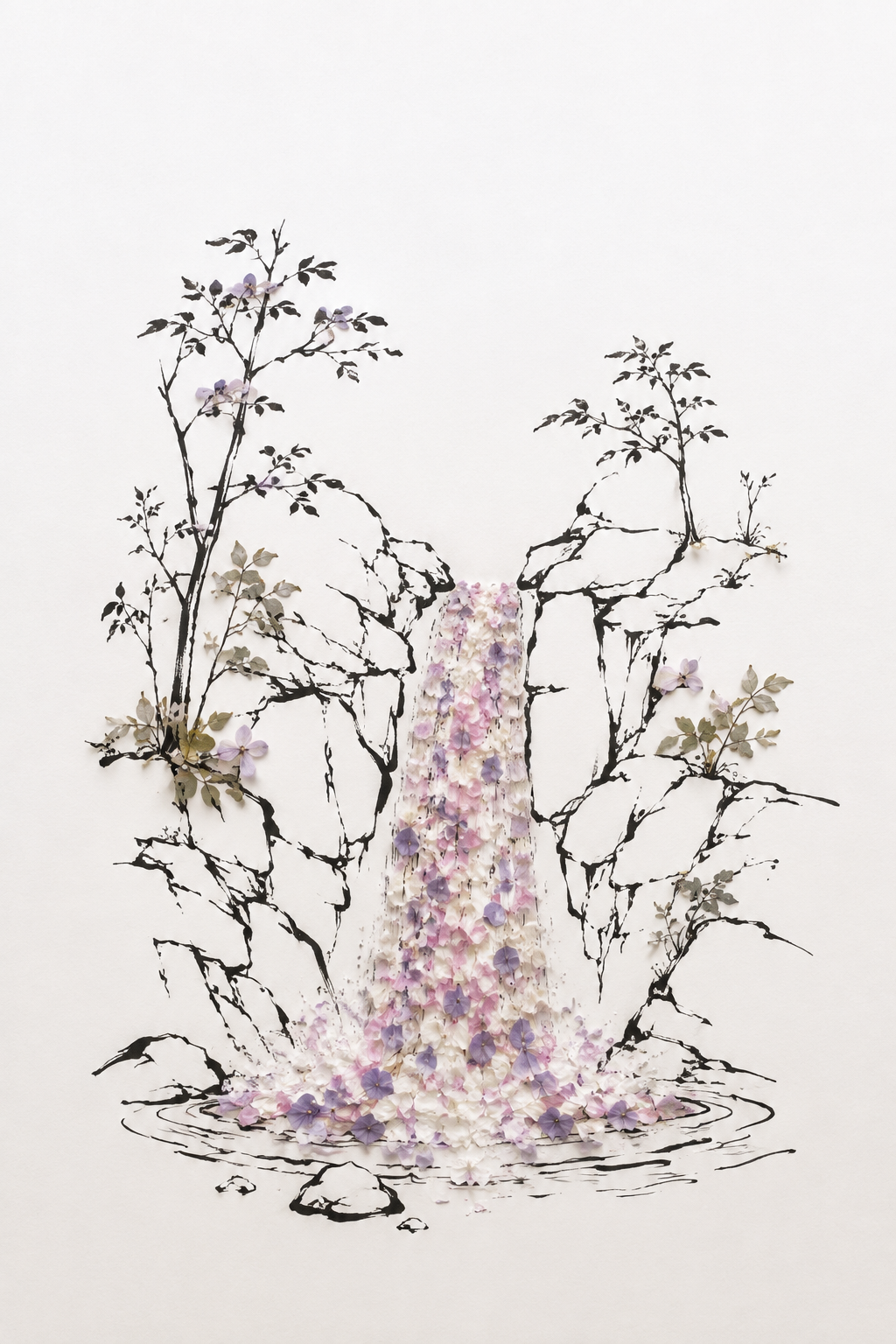
Waterfall of Lilac and Light
Critique
Introduction This work imagines a gorge waterfall, replacing water with pale petals. Ink cliffs and sparse trees surround the floral column, which falls from the middle distance into a broad pool near the lower edge. Description Two broken cliff walls open around a narrow white gap. Tall dark trees rise from the left rim, smaller trees stand on the right, and clusters of gray-green leaves and lavender blossoms occupy ledges. The fall itself begins as a tight vertical strip of white, pink, and violet petals, widens near the base, and scatters across concentric ink ripples. A few dark rocks interrupt the foreground water. Analysis The central vertical provides a calm axis against the cliffs' jagged diagonals. Petals become larger and more widely dispersed toward the pool, creating depth and suggesting impact without painted spray. Dark ink fissures frame the light cascade, while scattered botanical clusters balance the dense center without competing with it. Violet accents connect treetop flowers, falling petals, and the foreground basin in a continuous chromatic route. Interpretation and Evaluation Fragile blossoms convincingly assume the force of water because accumulation and repetition replace literal transparency. The fall appears both continuous and divisible, joining ideas of natural circulation with the brief life of flowers. The composition is strongly focused, the black-and-pastel palette is controlled, and the cliff drawing conveys scale with economical marks. The transformation of petals into water is imaginative and technically persuasive. Conclusion At first the work reads as a luminous waterfall scene, but close inspection changes fluid abundance into a descent of individual floral forms. Its clear hierarchy and measured dispersal make delicacy, rather than weight, the source of visual power.
Same Subcategory
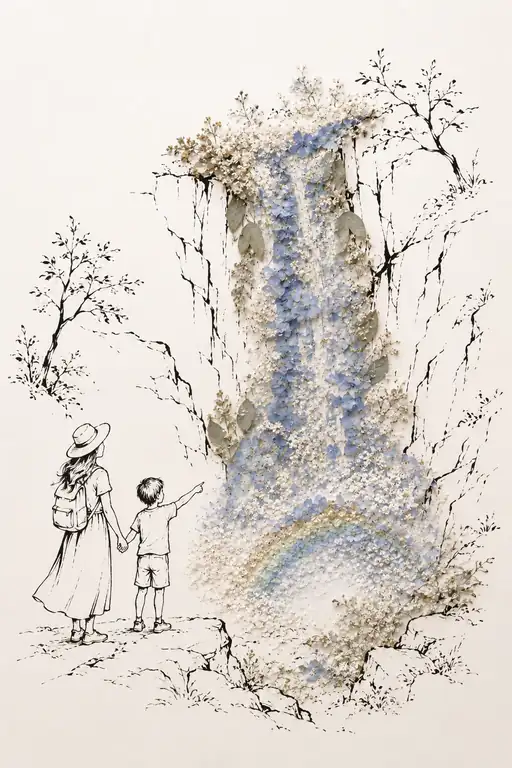 Rainbow at the Foot of the Blue Cascade
Similar Artworks
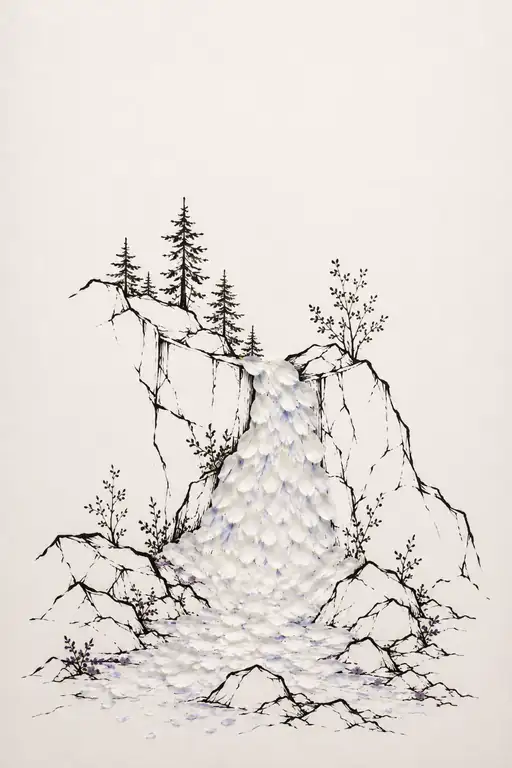 Cascade Down the Cliffside
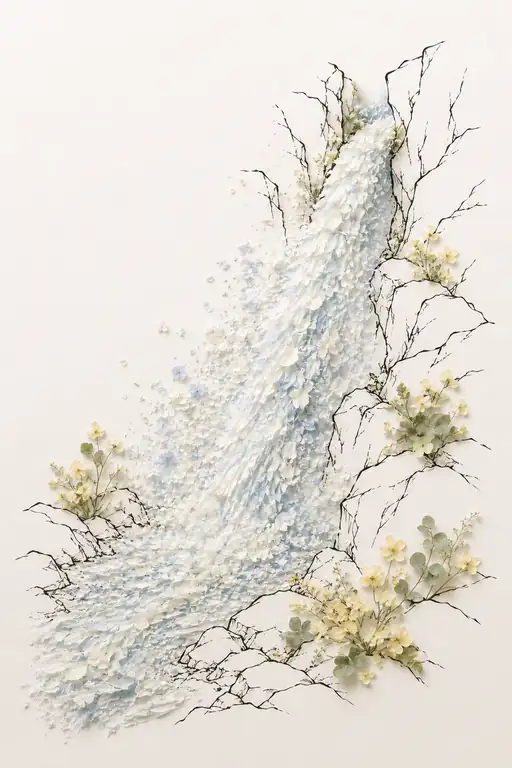 Cascade of White Blossoms in the Silent Gorge
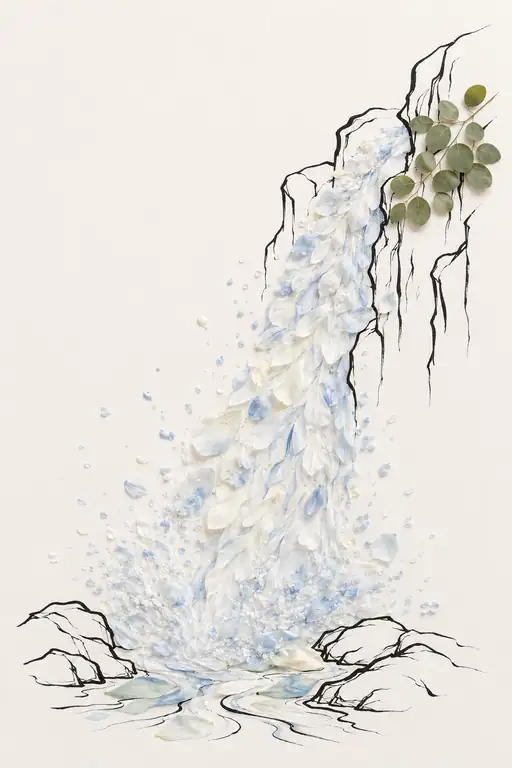 Crystal Torrent in the Silent Gorge
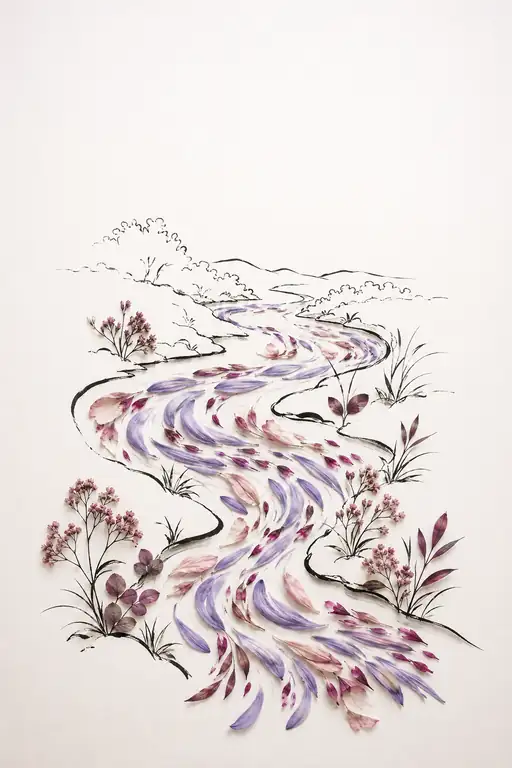 Meandering Stream in the Awakening Meadow
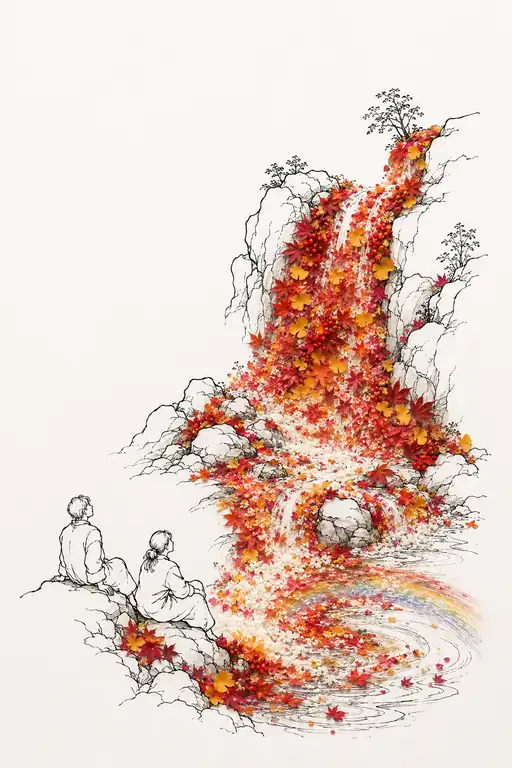 Contemplating the Fiery Cascade
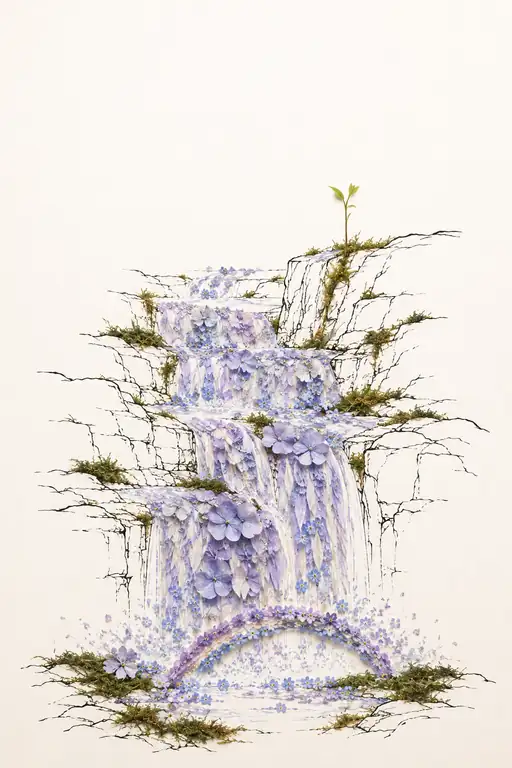 Tiered Cascade and the Violet Arch
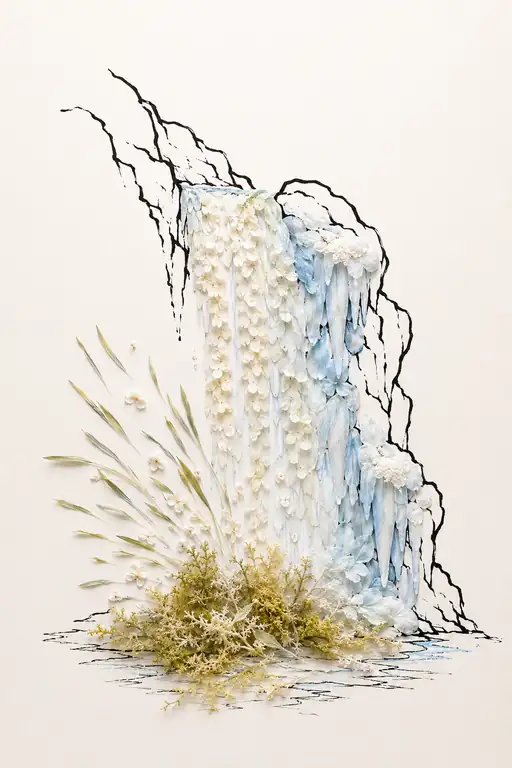 Petal Cascade on the Inky Crags
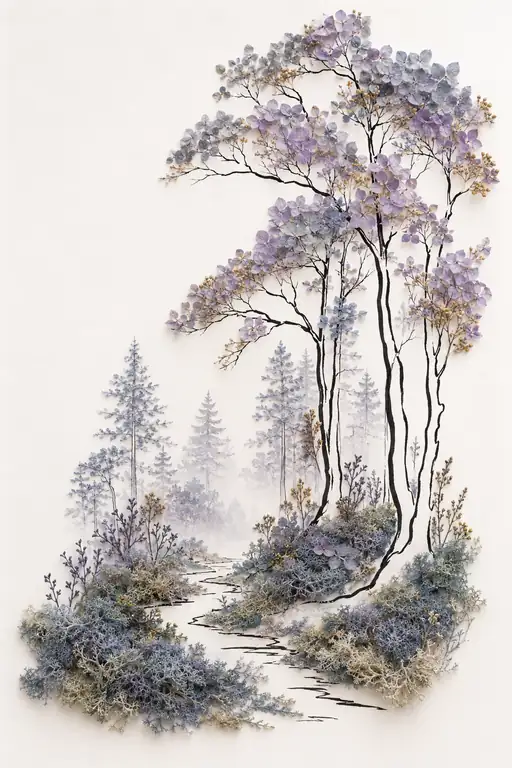 Mists in the Lavender Forest
 Purple Petals Drifting on Mirror Lake
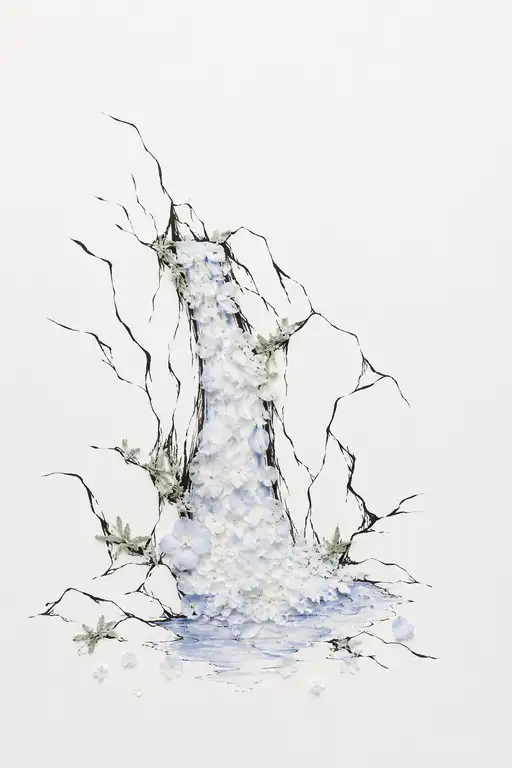 Silken Torrent of Pale Blue Petals