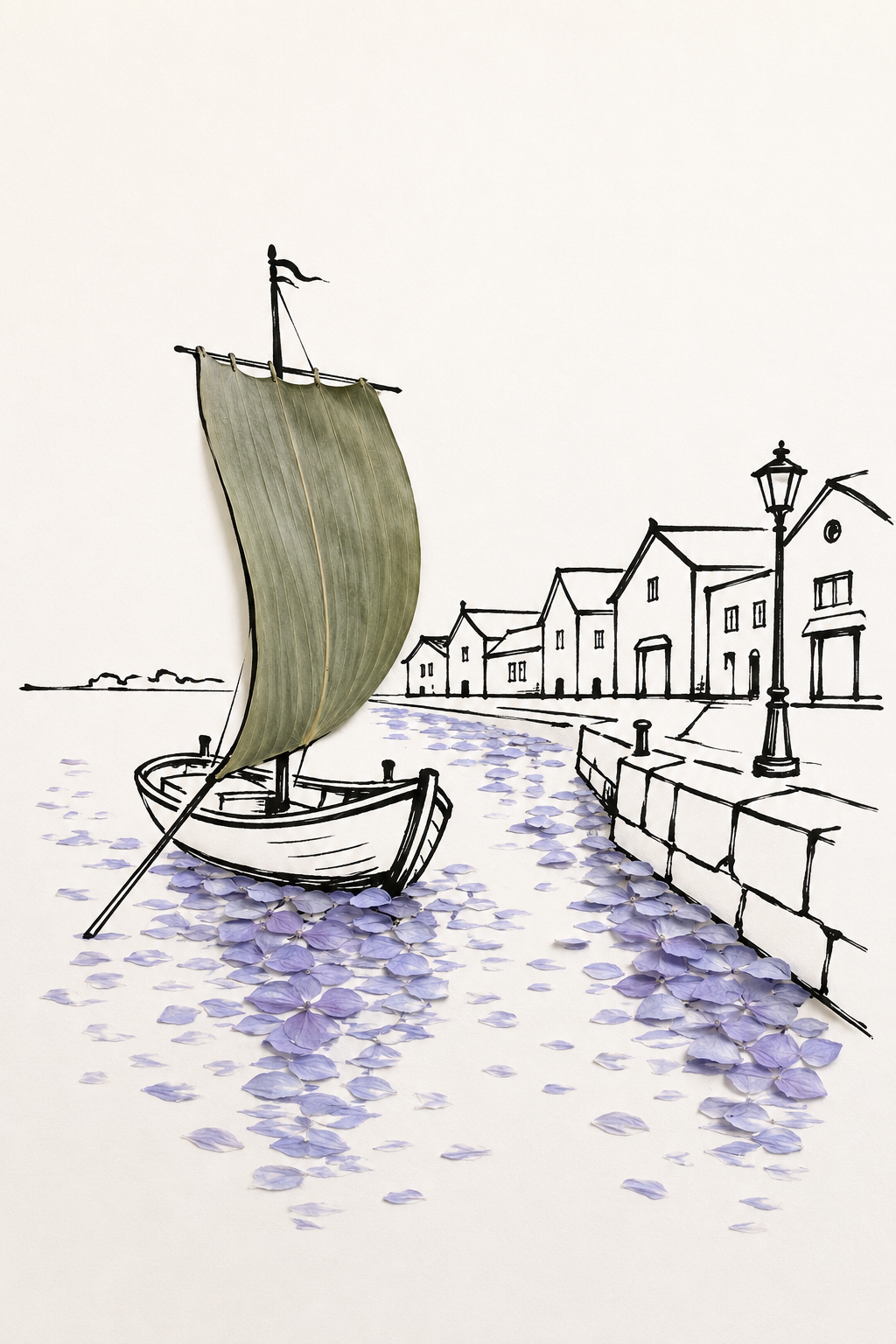
Canal Journey Under Pale Skies
Critique
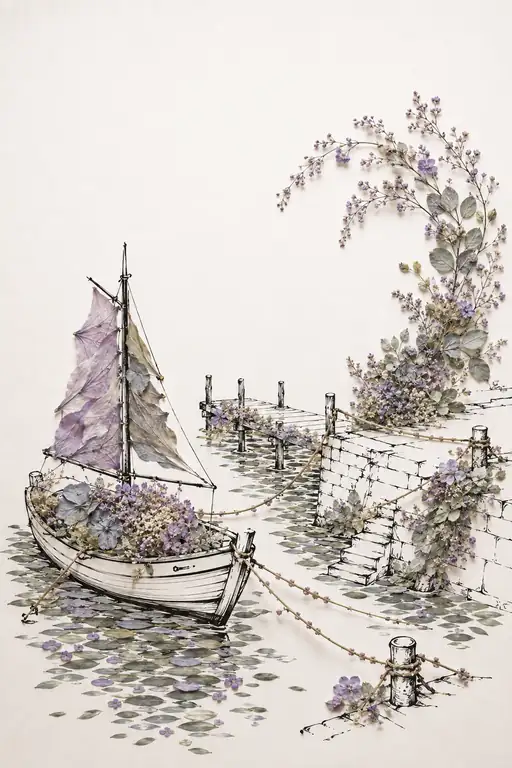
Introduction This waterfront image centers on a small sailing boat whose real leaf sail rises against an ink-drawn town. The restrained materials and broad white ground give the scene clarity, while lavender hydrangea petals convert the water into a tactile field. Description The boat sits left of center, angled gently toward the viewer. Its tall gray-green sail is a single veined leaf attached to drawn spars, and a long oar reaches diagonally to the lower left. On the right, a stone quay, lamp, and row of gabled houses recede into distance. Purple blossoms gather beneath the hull and along the quay, then disperse into smaller fragments. Analysis The sail forms the largest vertical mass and balances the architectural block on the right. Its curved edge and fine veins contrast with the rigid walls, rooflines, and heavy black contours. The oar, quay, and diminishing houses establish converging directions that deepen the otherwise pale space. Repeated lilac petals trace two channels around the boat, while their decreasing scale and softer density suggest recession. Interpretation and Evaluation By replacing canvas with a leaf and water with flowers, the work makes navigation depend upon fragile natural matter. The boat appears both serviceable and dreamlike, held between the town's stability and the drifting surface. The perspective is economical and readable, the gray-green and lavender palette is harmonious, and the inventive substitutions remain structurally purposeful rather than decorative. Conclusion The initial charm of the leaf sail gives way to a more considered dialogue between movement and anchorage. Strong directional composition, controlled color, and precise contrasts of texture turn a simple harbor motif into a coherent reflection on passage.
Same Subcategory
 The Ship Returns across a Mirror of Dawn
Similar Artworks
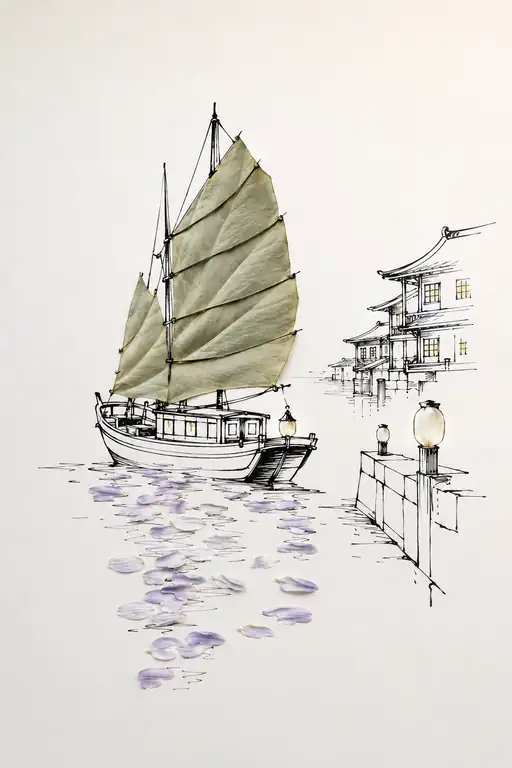 Evening Anchorage Under Leaf-Woven Sails
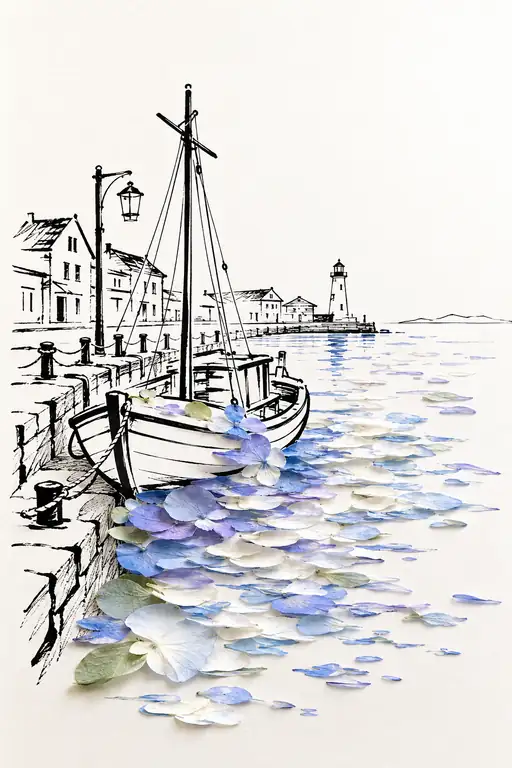 Harbor Rest on Shimmering Waters
 Moored Sailboat Resting on Gentle Ripples
 Waterway of Drifting Petals
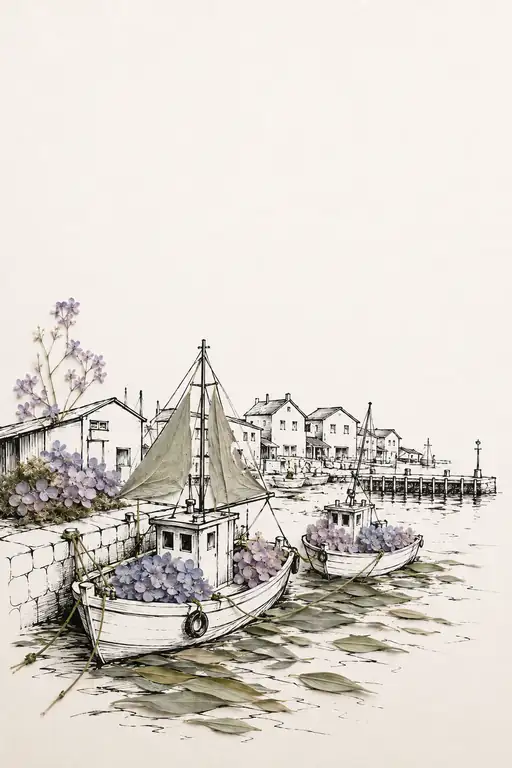 Harbor of Slumbering Tides
 Flower-Laden Sail at the Stone Wharf
 Wisteria Lane Overlooking Cobblestone
 Lone Scull and the Flowing Wake
 Stream Beneath the Arched Bridge
 Moored Sailboat with a Rose Leaf Sail