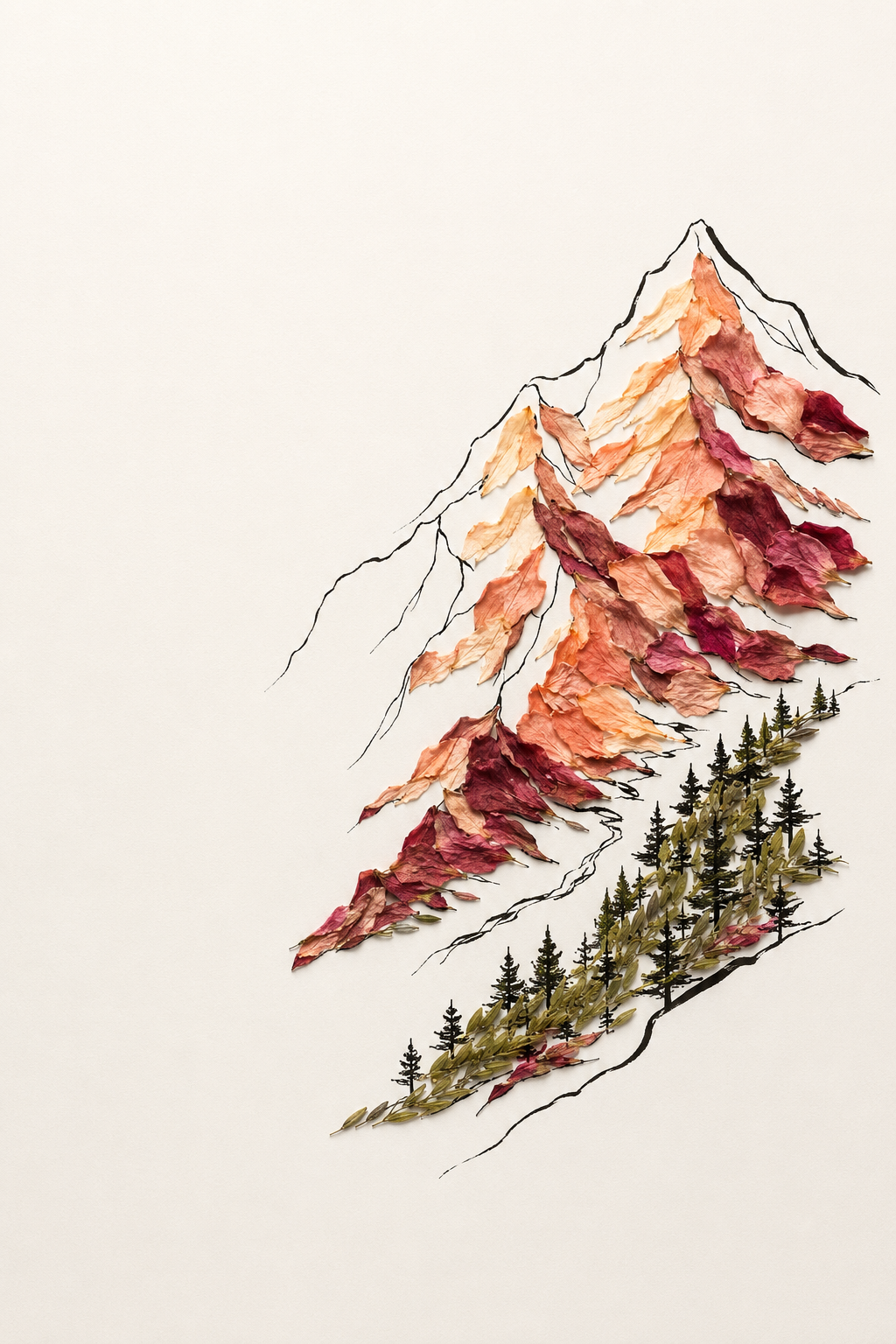
Alpenglow on the Jagged Peak
Critique
Introduction This mountain landscape uses black contour and autumnal petals to distinguish rock, snow, forest, and elevation. Peach, coral, and burgundy fragments cling to the upper slopes, while olive leaves and dark conifers occupy the lower ridge. Description Two adjoining peaks rise on the right, the taller summit sharply outlined near the upper edge. Wrinkled petals form angular bands across their faces, shifting from pale orange near high ridges to deep red below. Fine ink crevices remain visible between them. A diagonal foreground ridge supports small black firs interspersed with narrow green-brown leaves. Analysis The highest peak and forested ridge create two stacked triangles, joined by a strong descending diagonal. Petal edges naturally resemble fractured strata and snow cornices; cast shadows increase relief. Warm colors advance visually, while black line preserves the mountain’s skeletal geometry. The forest’s repeated verticals counter the slopes. Interpretation and Evaluation The mountain appears simultaneously geological and seasonal. Its supposedly permanent rock is clothed in materials that fade, suggesting that even monumental forms are perceived through changing light and foliage. Burgundy bands convey depth and danger, whereas peach crests seem briefly illuminated. The tiny conifers establish scale effectively. Some petal layers are dramatic, but exposed ink keeps the form from dissolving into pure decoration. Conclusion The work succeeds through a clear hierarchy of summit, slope, ridge, and forest. Botanical matter supplies color and physical relief; drawing gives continuity and distance. By leaving the surroundings almost blank, the artist turns the mountain into an isolated encounter rather than a scenic panorama. The result is austere yet radiant, balancing endurance with seasonal transformation.
Same Subcategory
Similar Artworks
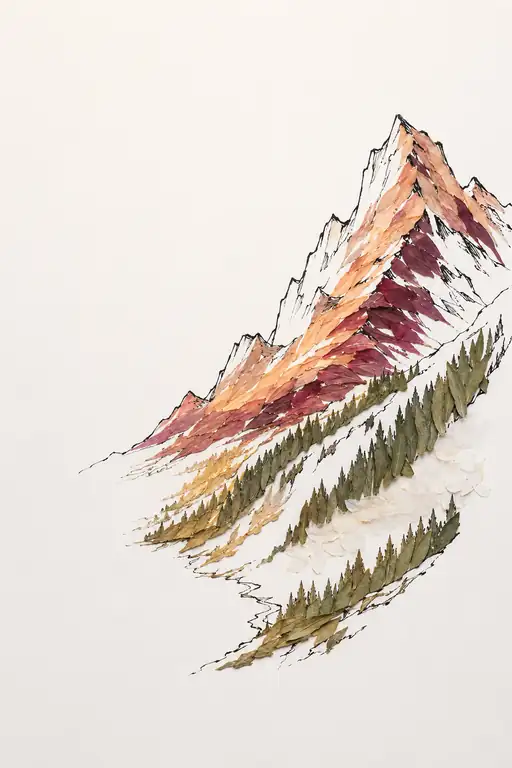 Ridge of Sunset and Evergreen Slopes
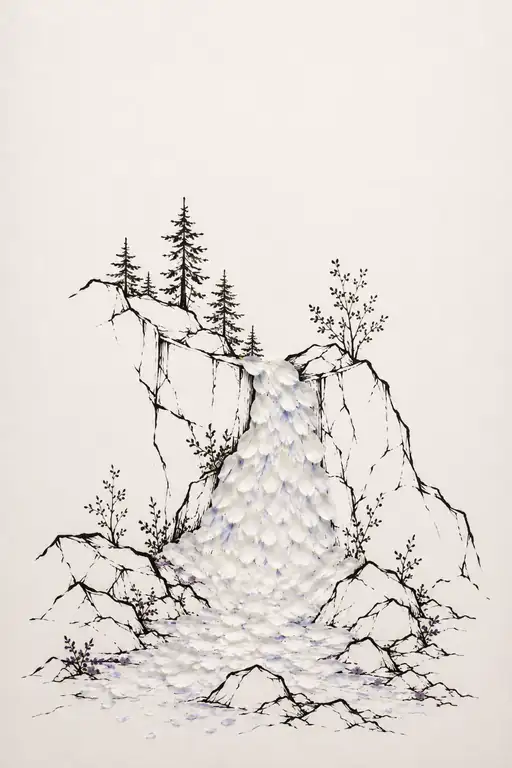 Cascade Down the Cliffside
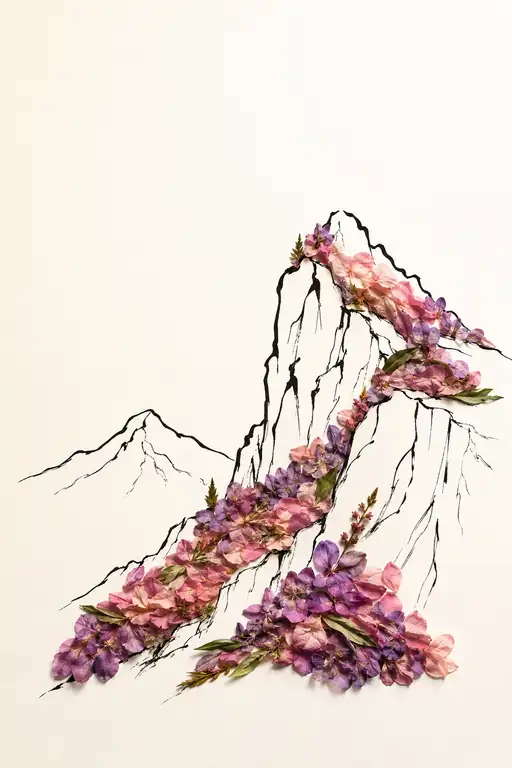 Whispering Ridge of the Solitary Peak
 Lavender Snowfields on the High Peaks
 Glacial Ridge in Silent Slumber
 Blossom Volcano in the Morning Sky
 Mists in the Lavender Forest
 Whitecaps of Petals on the Sunset Path
 Solitude on the Azure Ridge
 Twilight Shore Whispering to the Tide