
Ascending on Pale Wings
Critique
Introduction This ascending airliner is reimagined with broad botanical wings and a long flowering wake. Ink defines the fuselage, cockpit, tail, engines, and structural edges, while cream, yellow, and sage petals spread across the wings. Description The aircraft climbs steeply from lower left to upper right. Its white fuselage remains mostly empty except for a narrow line of cream petals along the center. Large wings extend laterally, covered in overlapping pale yellow petals and gray-green leaves. Twin engines and tail planes are drawn behind. Analysis The powerful diagonal establishes speed, while the nearly horizontal wings create a cross-axis and make the silhouette expansive. Layered petals behave like feathers or overlapping aerodynamic panels. Yellow warms the wing cores; sage leaves clarify outer edges. The wake shifts from dense forms near the engines to sparse fragments far behind, convincingly marking distance. Broad empty space ahead of the nose allows the ascent to continue imaginatively. Interpretation and Evaluation The aircraft appears to carry the logic of birds and plants within its technological body. Its wake resembles seeds, blossom, or memory scattered from departure, replacing pollution with a hopeful fiction of renewal. The largely blank fuselage keeps mechanical identity intact and prevents decorative overload. Wings are materially dense, but their tapered tips and repeated veins sustain lift rather than heaviness. Conclusion The work communicates ambition with clarity and grace. Ink provides precision and recognizability; plant matter supplies life, color, and metaphorical consequence. The flowering trail makes movement visible across time, linking origin to upward possibility. Familiar yet freshly transformed, the airplane becomes an emblem of travel propelled by fragile natural forms and leaving beauty in its passage.
Same Subcategory
 Wings Over the Mountain Lake
Similar Artworks
 Winged Airliner Soaring on Flowered Paths
 Cascade of Blossoms from the Slanted Pitcher
 Drifting Lights on the Pond
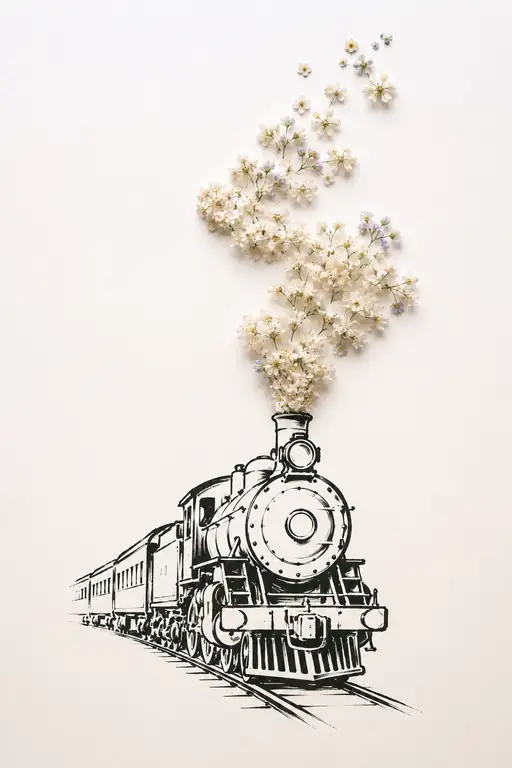 White Plume of the Dream Locomotive
 Spiral Ascendance of Form and Growth
 Voyage to the Spires in the Ether
 Flight from the Gilded Cage
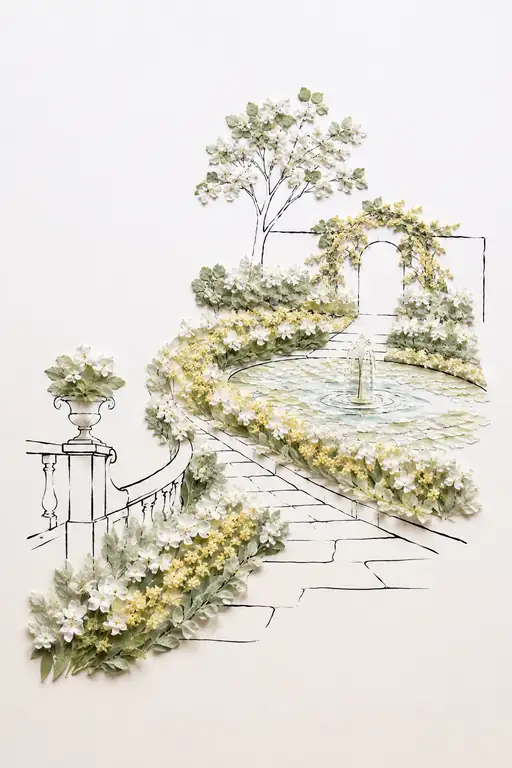 Blossom Terraces of the Sunlit Garden
 White Lamb Ascending the Grassy Hill
 Quiet Gaze by the Sunlit Window