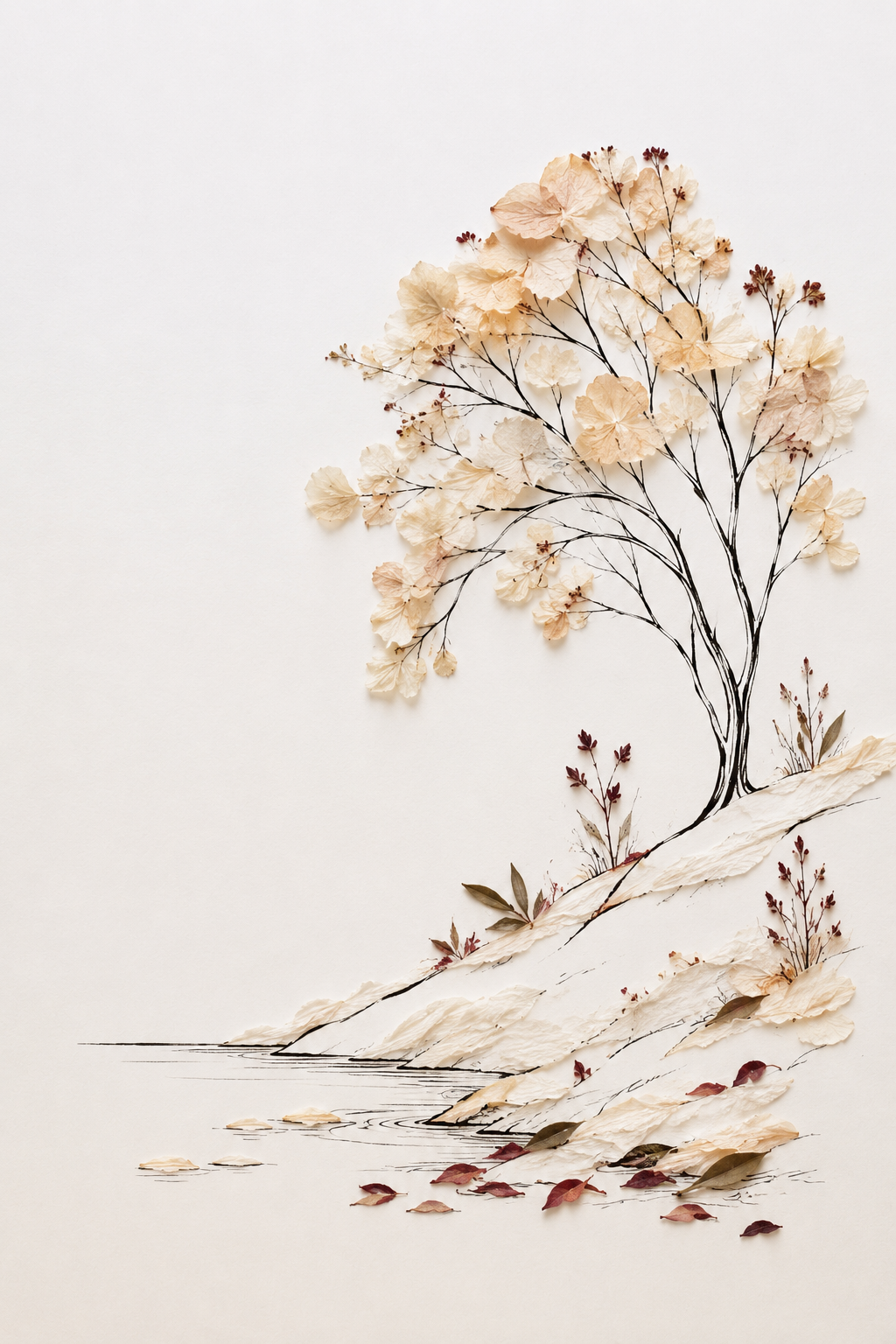
Autumn Whispers on the Sloping Hill
Critique
Introduction This restrained winter landscape depicts a pale flowering tree on a sloping bank above quiet water. Ink defines trunks, branches, shoreline, and ripples, while cream petals become both canopy and snow. Rust-colored buds and fallen leaves offer the few warm notes. Description Two slender trunks rise from the upper-right bank and divide into a broad crown of black branches. Large ivory blossoms cluster most densely at the top, interspersed with small dark-red seed heads. Layered white petals form snowbanks that descend diagonally toward the lower left. Sparse grasses and reddish buds punctuate the slopes. Analysis The bank’s descending diagonal counters the tree’s vertical lift and directs attention toward the water. Branches radiate through translucent flowers, preserving structural clarity within abundance. Cream-on-white differences depend on texture and cast shadow rather than strong color. Burgundy accents trace a loose path from crown to shoreline, joining upper growth with fallen remnants. Interpretation and Evaluation The pale canopy can be read as blossom, frost, or snow held in branches, making season intentionally uncertain. That ambiguity turns the landscape into a meditation on transition rather than a fixed month. Fallen red leaves suggest what has ended, while upright buds anticipate what may return. The botanical snow ridges are particularly effective because their wrinkled surfaces resemble wind-shaped crust without literal modeling. Conclusion The work achieves emotional breadth through a narrow palette and economical drawing. Its tree is neither fully dormant nor openly flourishing; it occupies a threshold. Textural whites reveal themselves slowly, rewarding close attention. Balanced between upward branching and downward shore, the landscape offers a quiet image of continuity in which loss, rest, and renewal remain visible together.
Same Subcategory
Similar Artworks
 Blooming Blossoms on the Thawing Shore
 Winter Shore Awakening with Budding Boughs
 Drifting Lights on the Pond
 Seasons Intertwined on a Single Bough
 Slender Tree Blossoming with Lilac Dreams
 The Celestial Carp Clad in a Dream of Dawn
 Willow Shadows and Floating Petals
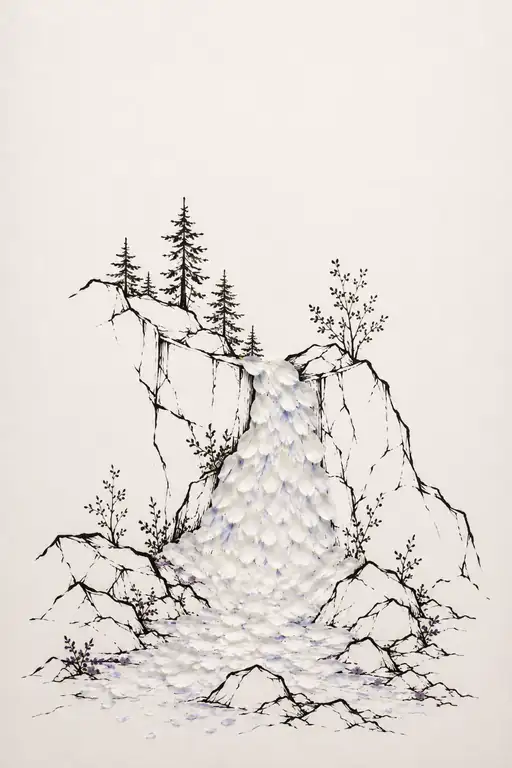 Cascade Down the Cliffside
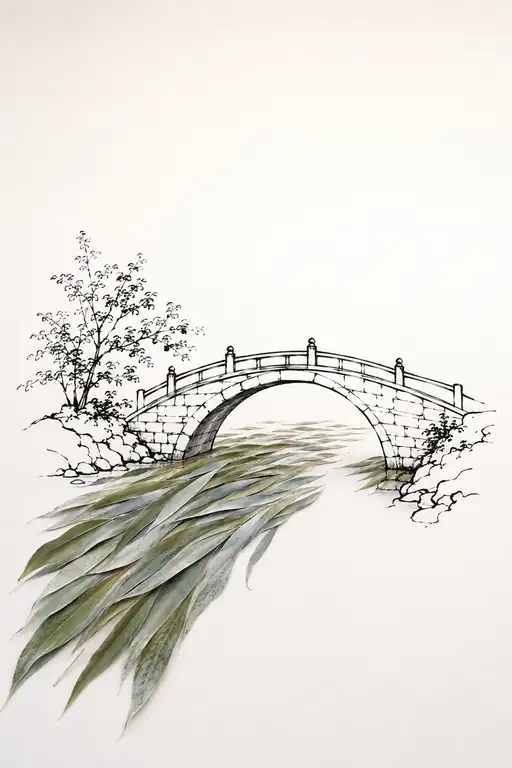 Gentle Currents Beneath the Stone Bridge
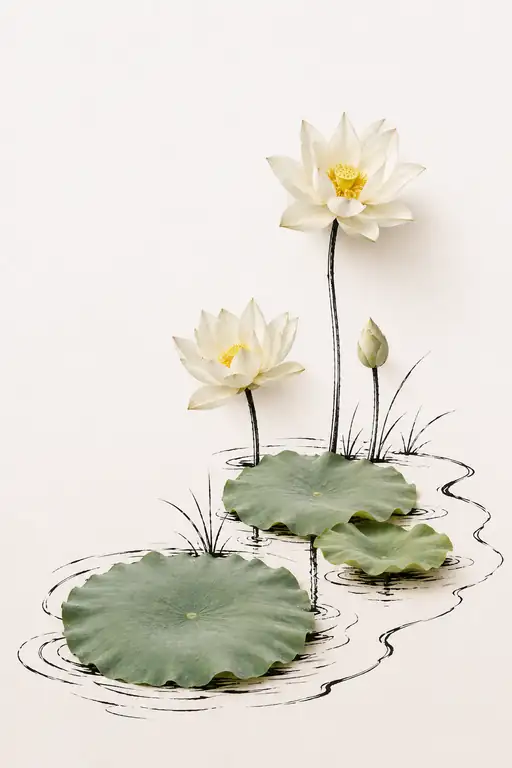 Purity of the White Lotus