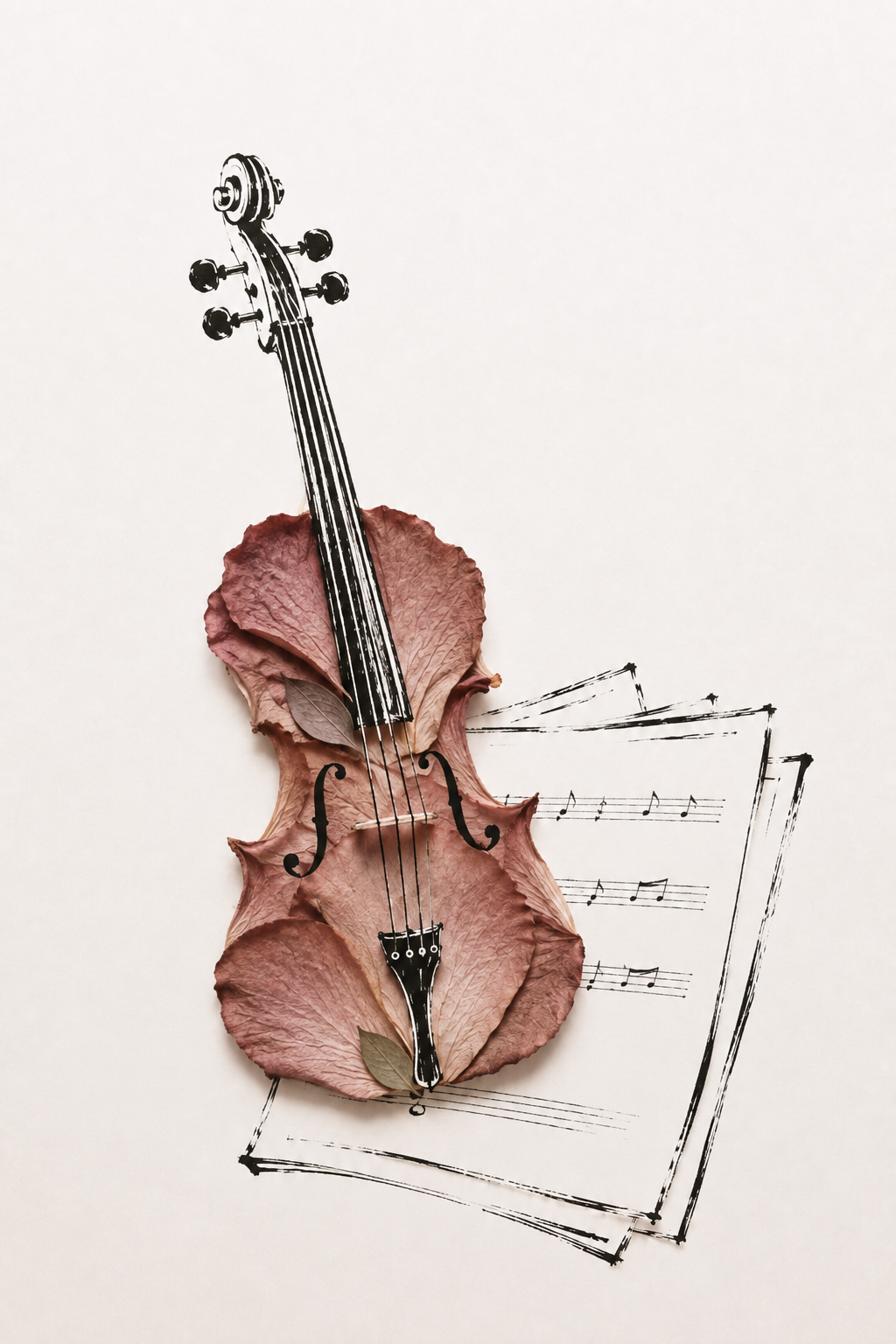
Verse of the Antique Cello on Sheet Music
Critique
Introduction This mixed-media composition depicts a cello laid diagonally over a loosely drawn musical score. The instrument is constructed from black ink and broad dusty-rose petals, but unlike a more floral variant, decoration is reduced to two muted leaves, emphasizing the cello's body and structural lines. Description The scroll, four pegs, long fingerboard, strings, bridge, sound holes, and tailpiece are rendered in bold black marks. Large wrinkled petals overlap to form upper and lower bouts, with curled brown edges extending beyond the contour. One gray leaf lies beneath the fingerboard and another beside the tailpiece. Sparse notes appear on stacked pages behind. Analysis The dark neck establishes a steep upward diagonal, opposed by the score's slant toward the lower right. Nearly monochrome rose petals make the body a single substantial mass, so the thin parallel strings read with unusual clarity. Wrinkles follow several curved bouts and reinforce volume. Minimal green accents interrupt the warm field without fragmenting it. Interpretation and Evaluation The restrained ornament directs attention from decorative association toward resonance, tension, and construction. Petals replace wood yet retain dryness, folds, and vulnerability, suggesting sound as something produced by a delicate surface under pressure. Accurate instrumental details ground the metaphor. The reduced palette and uncluttered score give this transformation formal strength. Conclusion At first the petal body attracts attention through scale, but closer viewing shifts toward the taut black strings crossing it. Material fragility and structural discipline become mutually dependent, making music visible as controlled vibration.
Same Subcategory
Similar Artworks
 Silent Melody of the Rose Cello
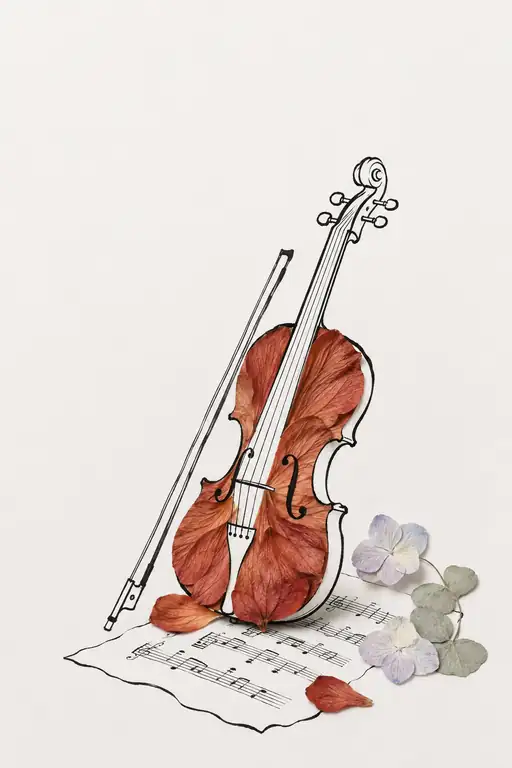 Violin of Resonant Memories
 Violin of Petals and the Metronome of Beats
 Nocturne in Blossom and Strings
 Cadence of Breath and Strings in Bloom
 Gentle Foliage in Rose and Violet
 Fairytale Castle with Floral Conical Roofs
 Moored Sailboat with a Rose Leaf Sail
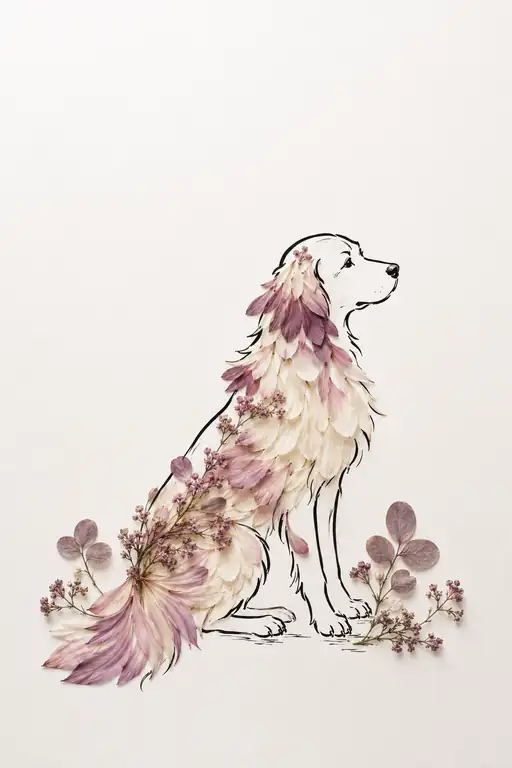 Faithful Dog Seated in Blossom Fur
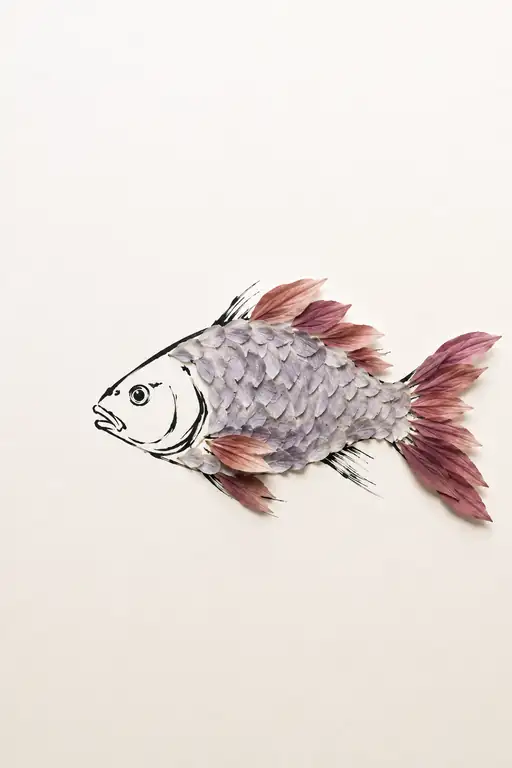 Fish Gliding with Lavender Scales