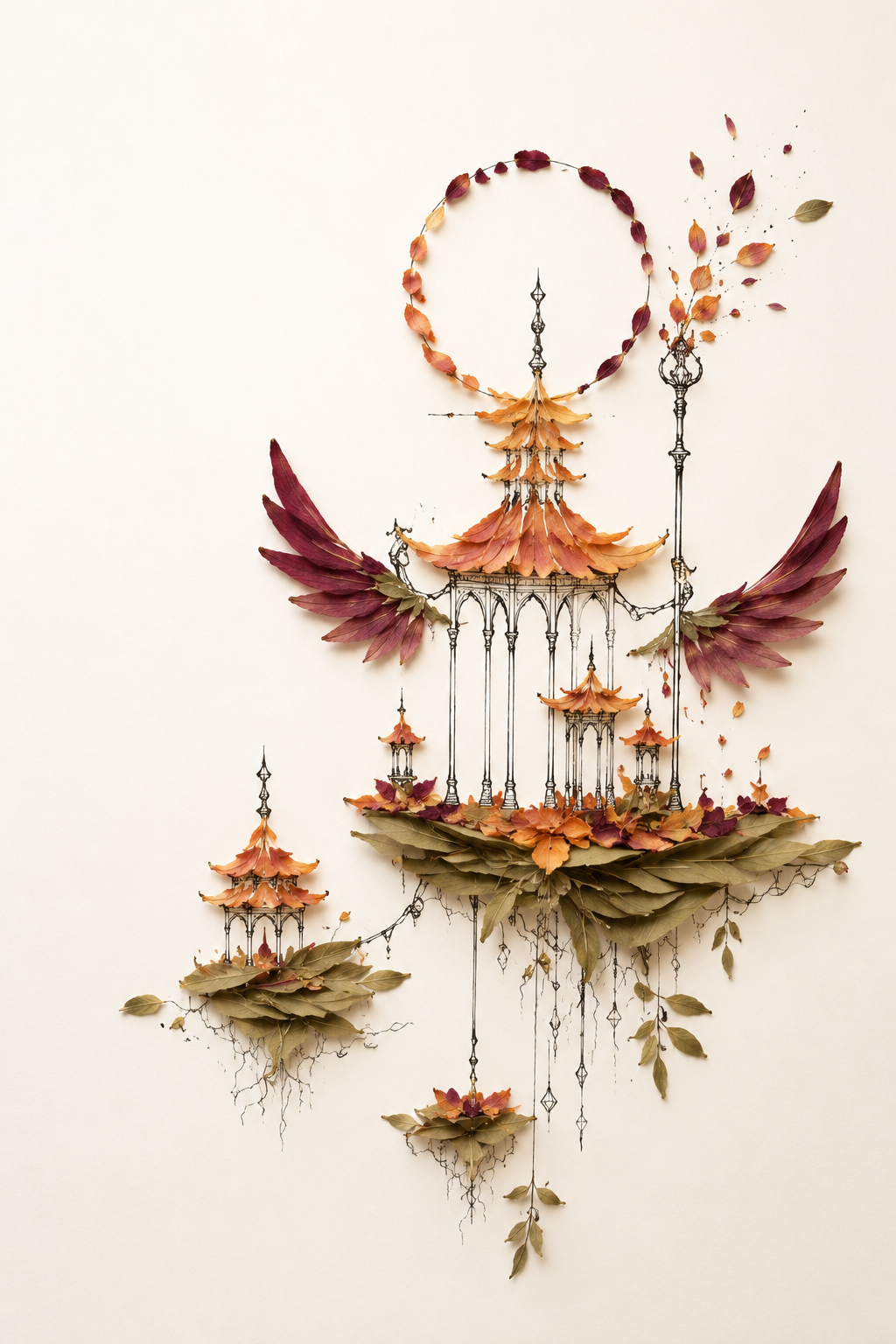
Winged Pavilion Floating in the Ether
Critique
Introduction This imaginative mixed-media composition assembles an airborne pavilion from fine architectural drawing and autumn leaves. The principal structure occupies the upper center, flanked by broad burgundy leaf-wings, while three smaller floating platforms descend unevenly through the lower half. Description Orange leaves form tiered, upturned roofs above slender black columns and pointed arches. A circular vine of red and amber leaves rises behind the highest spire like a halo. To the right, a tall ornamental staff releases scattered leaves upward, while layered olive foliage builds the islands and wiry roots, chains, and pendants hang beneath them. Analysis The large central island supplies stability, yet its dangling lines and dispersed leaves keep the composition buoyant. Bilateral elements—the wings, roof tiers, and colonnade—are disturbed by the staff and windblown fragments on the right. Warm orange and wine-red accents stand clearly against the cream ground, while fine black linework provides structural precision against the irregular edges of dried plant material. Interpretation and Evaluation The pavilion merges cultivated architecture with seasonal matter, suggesting an imagined civilization held aloft by fragile natural remnants. Its drawing is exact enough to make delicate towers plausible, but the leaves retain wrinkles, veins, and uneven contours. Strong hierarchy, controlled asymmetry, and inventive material transformation give the fantasy coherence rather than mere ornament. Conclusion What first appears as a whimsical autumn castle gradually reveals a careful negotiation between permanence and dispersal. The refined composition, economical palette, and tactile contrast between rigid line and brittle leaf make fragility the source of the structure's expressive strength.
Same Subcategory
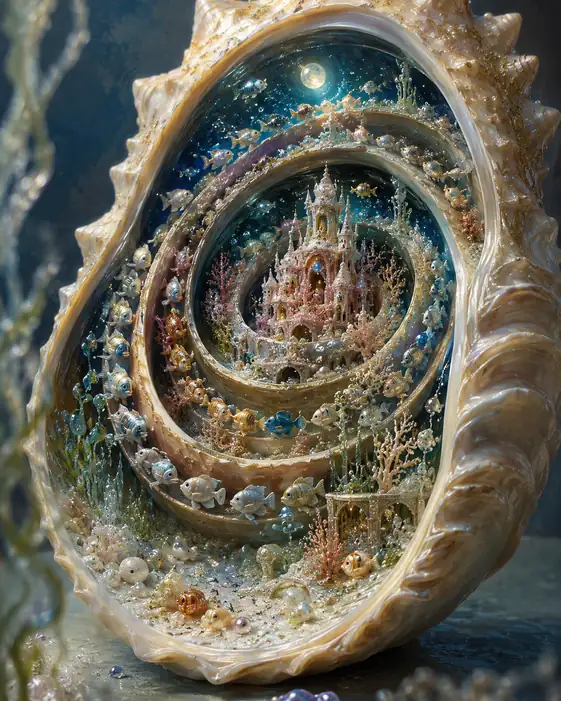 Where Every Tide Returns Home
Similar Artworks
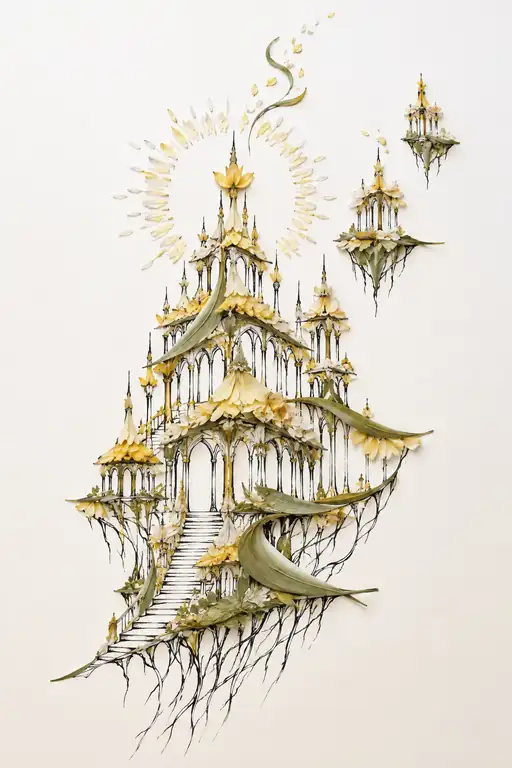 Floating Cathedral Reaching for the Golden Halo
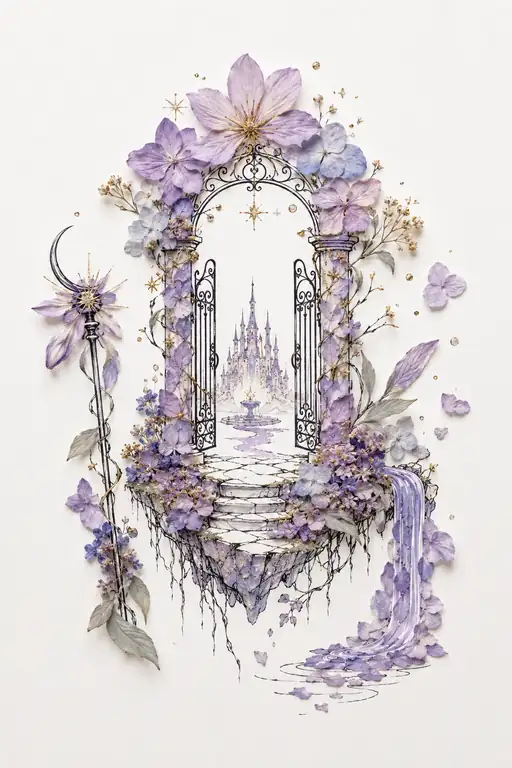 Floating Floral Portal to the Distant Castle
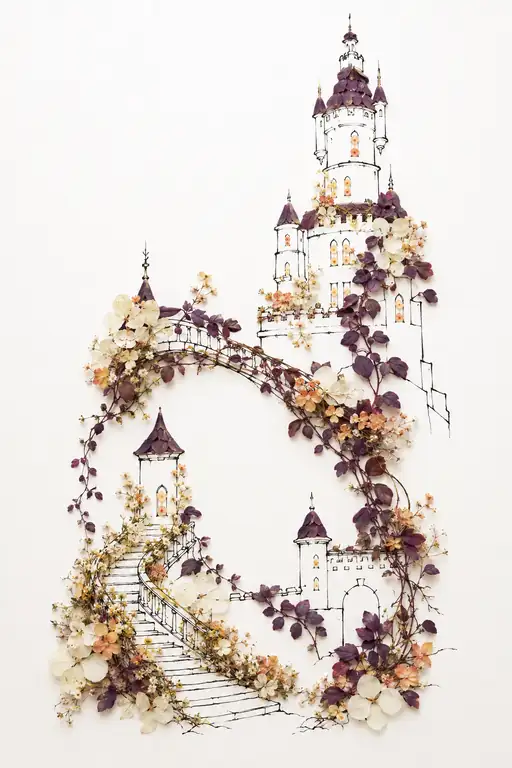 Fairytale Spire and the Arched Bridge
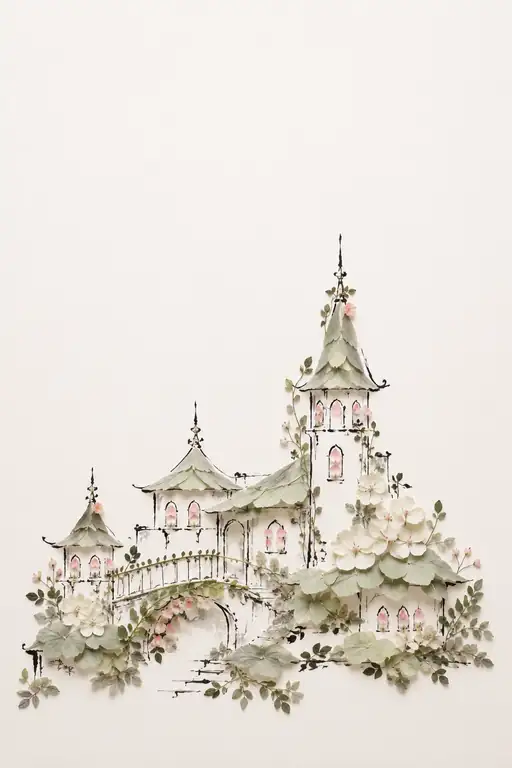 Sage Spire Castle and the Blossoming Bridge
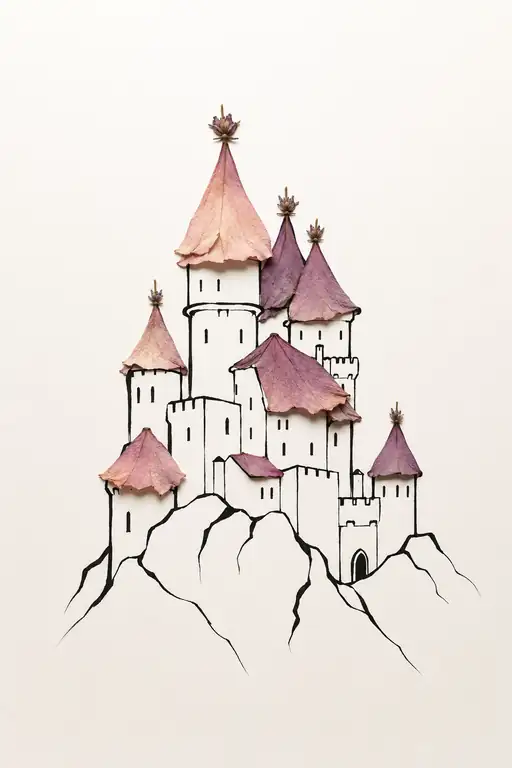 Fairytale Castle with Floral Conical Roofs
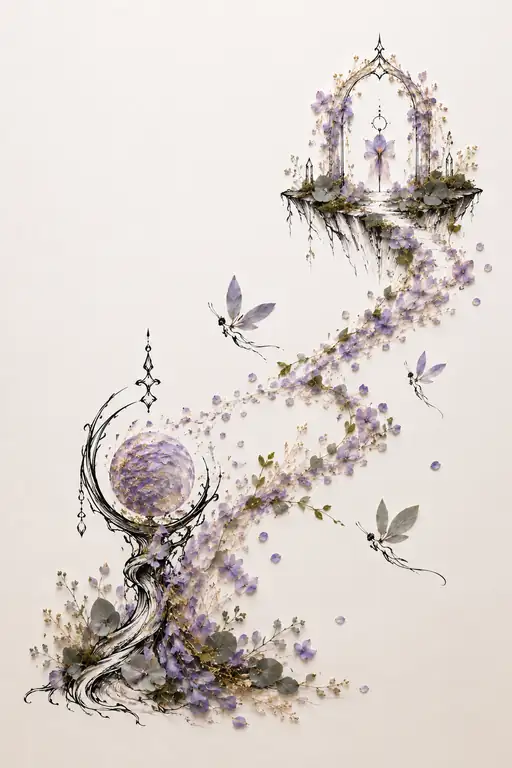 Path of Fairies to the Star Portal
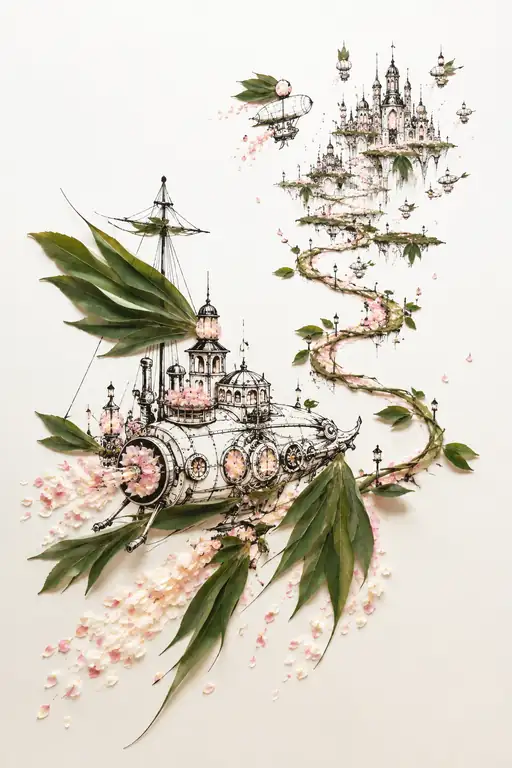 Voyage to the Spires in the Ether
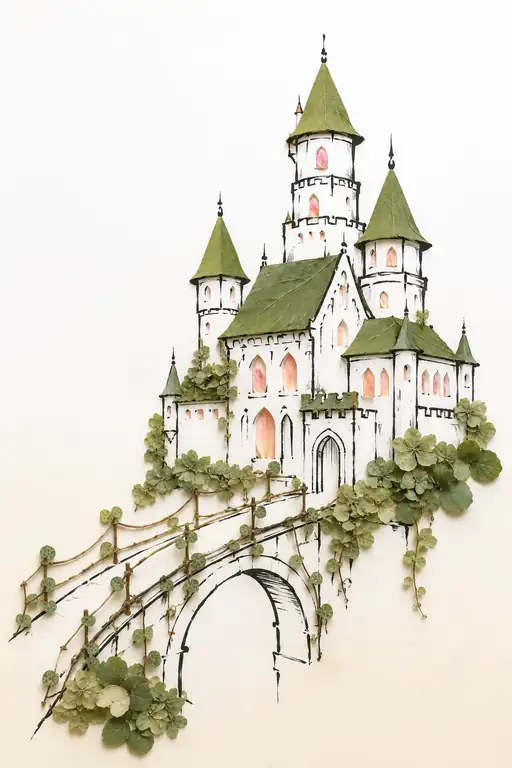 Verdant Spire Castle and the Twig-Rail Bridge
 Ascending Guardian of the Blooming Crags
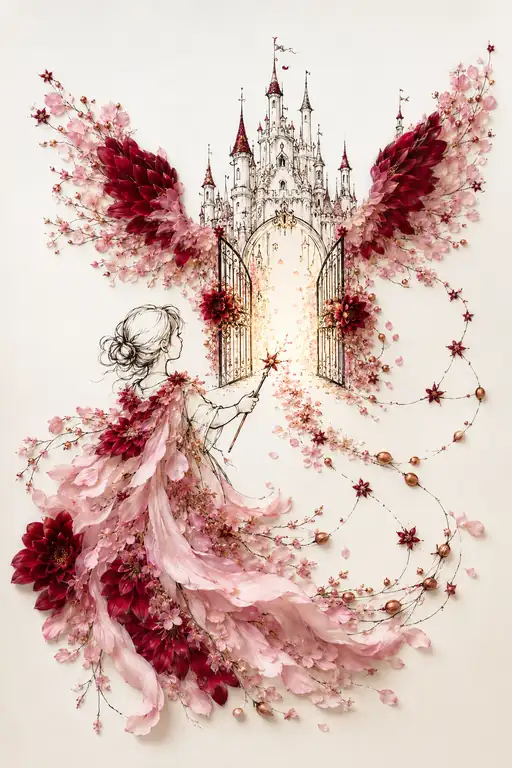 Awakening of the Crimson Castle